Showing posts with label grief. Show all posts

Friday, June 20, 2014

The Fourth of July - Commemorations of Freedom, Life, Death...


It is a year already since my Mom died on the Fourth of July, 2013. I was riding in the Village Poets Car in the Fourth of July Parade in Sunland.  Her manifold illnesses have finally caught up with her.


The Color Guard

Above the hills' crooked spine, clouds dissolve
into the azure. A red rose lazily unfolds.

It blossoms by the birch tree, petals
glowing with the innocence of lost summers.

White bark hides among green leaves,
pale oleander spills over the picket fence,

shines against the deepest blue of the iris.
Its yellow heart matches the sun's golden glow

bouncing off the brilliant sphere of stamens
wrapped in the bridal silk of matilla poppies.

My garden presents the colors at noon
dressed in the red, white and blue of the flag.

At night, the fireworks tear the indigo fabric
into light ribbons and multicolored sparks.

The visual cacophony echoes the loudness
of sound explosions imagined by the genius

life insurance salesman, Charles Ives.
The orderly march of brass anthems

scatters into the joyous chaos of laughter -
a child's delight - the Fourth of July.

 (c) 2010 by Maja Trochimczyk


The fireworks of the Fourth have ended. My Mom is gone, buried with my father in Warsaw's Orthodox Cemetery, among beautiful ferns, tall chesnut, maple and linden trees, their canopies filled with birdsong. It is a luxurious, peaceful place; both elegant and melancholy. You think of death there with gratitude for the full, rich lives well lived. I visited it again this week, upon arriving in my home town for the Fifth World Congress of Polish Studies held at my alma mater, the University of Warsaw.


I still have two phone messages from her, recorded in early June, a month before her death. When the recorded voice tells me they are old, I save them again. She called me to wish me a Happy Children's Day (June 1). Her voice was feeble, coarse. She sounded frail. She did not have much energy left. I have walked this earth for more than half a century and I was still just a child to her, a lovely, beloved child. A spoiled brat who wasted many gifts. A grateful daughter.


I celebrated the memories of my parents in a strange way soon after that: by writing down their most painful war memories of deprivation, hunger and a multitude of horrors. I made them into a book of poetry, "Slicing the Bread" - with a subtitle "Children's Survival Manual in 24 Poems."  It is a tough, rough book, without my usual sentimentality, sensuousness, and warmth, without the delicate spiritual inspirations that have been a hallmark of my poetic style.

This book of 25 poems, had already found a publisher, but I'm wondering what to do about its cover.  Should it be a medal on the bread?  It is about hunger and slicing, saving bread, after all. Should it be my mom's engagement ring on a slice of bread?


The publishers also asked for pictures of me. Should I have a new portrait made in Warsaw, with my beloved city in the background - a slice of an Old Town, or a wall still covered with bullet holes, perhaps? Or the greening of the linden trees? Filled with honey bees? They buzzed, alive with the promise of sweetness, all summer long in the village of my grandparents.


I have not written any "regular" mother-daughter poems; I could not write yet about her death and suffering, not about hospitals, not about the bullet that pierced her lung, an inch away from her heart, not about the blood pooling on the cement floor of the basement after she was shot and slipped in and out of coma. I should write about her sailing adventures, her travels around the world, her delicious cakes and gourmet stews, and wild parties, dancing all night, making that unique New Year's Eve's dress right up to eight o'clock, in time for the party... She loved picking mushrooms - a harvest of "prawdziwek" in a oak and birch forest...


Hmm, mushroom picking, I picked up that passion from her. She also spent her free time taking thousands of photographs, developing them in the darkness of the bathroom with a checkered blanket covering the window, a purple light bulb casting an eerie light on our faces, images slowly emerging on the paper soaking in chemical baths...Now, I'm a photographer, with a digital camera and colorful online albums.

No, I am not ready for a true memorial poem yet. Here's one poem about a gift from her, then, a tribute of sorts to her personal taste and flamboyant style...

My Scarf  (An Assigned Object)

Wine-red and grey, embroidered, sparkly –
I’m safe embraced by its warm hug –
I'm elegant adorned with its rich patterns –
I'm dressed in a new persona.

My scarf came from a high-fashion world
Of folksy make-believe
That trickled down to discount stores
–  Made in India –

It brought back my Grandma’s shadow
With her wool chustka of a Polish peasant,
It came out of my Mama’s suitcase
Gifts of handmade comfort
And exotic splendor

It carried a distant reflection
Of a silk white shawl
That covered my shoulders with light
At the end of my baptism

It was a foreboding of the shroud
That will wrap me to burn when I die.

© 2007 by Maja Trochimczyk

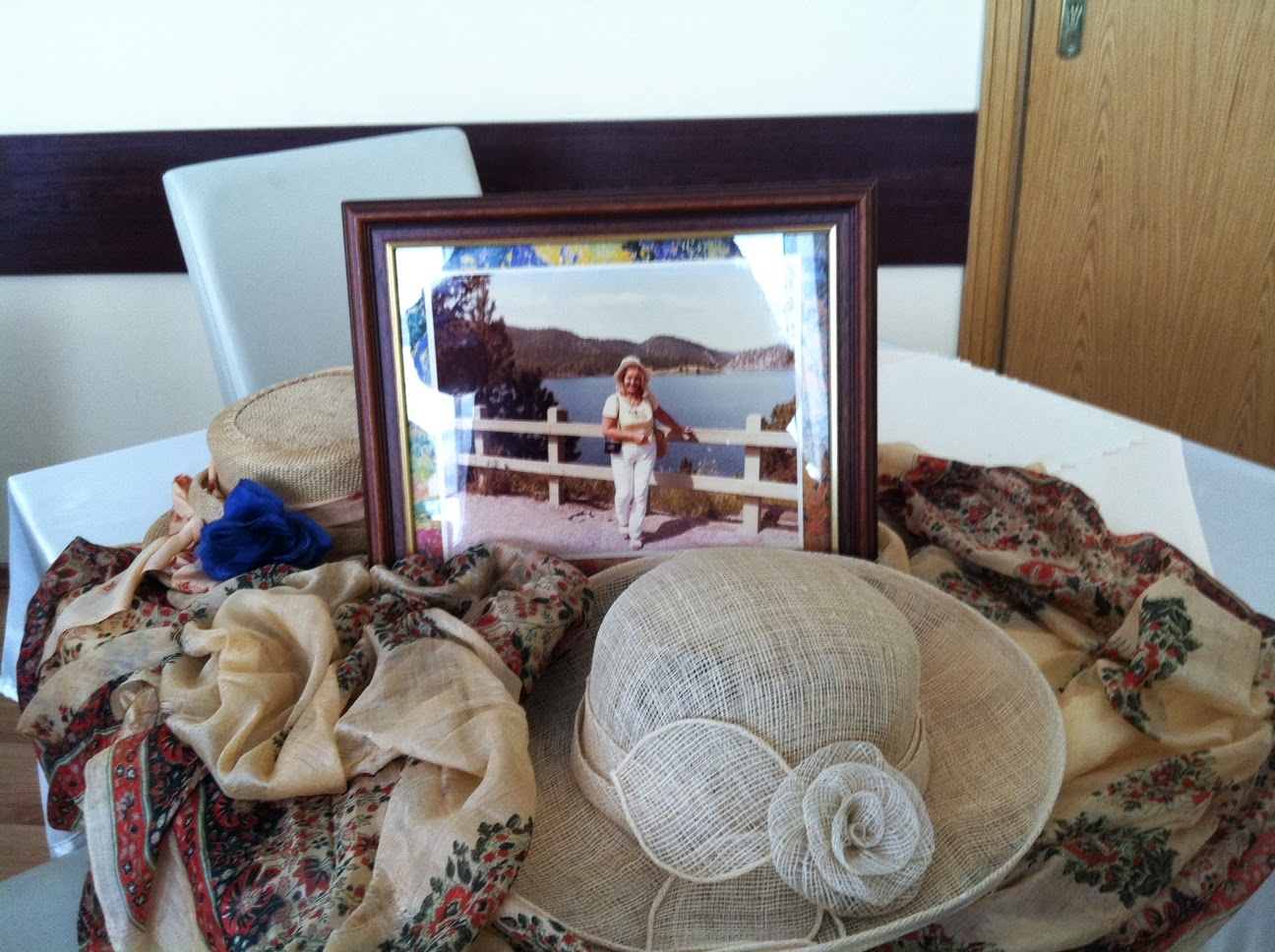
After the funeral, I brought her favorite off-yellow patterned silk scarf with me to L.A., I wore it with a black dress, wrapped myself in the scent of her perfume. In vain. There were deep gaps in the scarf already, shredding in the corners, torn. It was beyond hope last year. Now, the fading silk is just a limp reminder of a former subtle, supple beauty, slowly disintegrating in my closet. I cannot throw it out. No. Not yet.


Monday, April 14, 2014

The Polish Easter of Sorrow and Joy - In Memoriam

A Blossom of Peace (Rose) by Maja Trochimczyk

It is quite surprising, if you arrive from Poland, to see the American Easter, with its Easter Bunny that lays chocolate eggs (this idea is somewhat disgusting, if you think what round objects of chocolatey hue come out of the Bunny's other end). Another surprise is the obligatory pastel coloring of the entire set of decorations - baby rabbits, baby chicken, baby ducks, puppies, kittens, and all sorts of baby everything, including pastel colored eggs and egg-wreaths that replace Christmas wreath. And, of course, chocolate. Tons of chocolate. It is astounding to see so many major holidays transformed into excuses for buying chocolate: St. Valentine's Day, Easter, Halloween, Christmas... Then there are the pastel dresses and hats of children running around pastel yards with pastel baskets looking for pastel plastic eggs filled with chocolate in pastel wrappers... Actually, I've grown quite fond of this tradition and continue hiding my three dozens of eggs in my front yard for the neighborhood kids for Easter Sunday... We have a street celebration. It is fun to see the kids grow, have their own kids, year after year running to find the precious "golden eggs" with money inside. 

Sunbloom Rose by Maja Trochimczyk, 2014


For a Christian from Europe, however, the colors of Easter are different, starker. It is the hue of green palm leafs of the Palm Sunday, the stone bareness and austerity of Good Friday, the vermilion red of liturgical vestments on this day of cosmic suffering, the shadowy darkness and brilliant new flames of Easter Vigil, and the purity of white and gold of the Easter morning Resurrection Procession. I experienced these colors of truly religious Easter at the convent of Fransciscan Sisters, Servants of the Cross, in Warsaw, where I was baptized as an adult during the Easter Vigil on March 30, 1987.  There was not a pastel Easter bunny in sight. 

Listen: "O, Holy Cross" - A Choral song for Good Friday (14th C. Poland)

Listen: Easter Vigil's "Exultet" - with music and text (Gregorian Chant, tutorial)

Listen: "Chris is Resurrected" - A choral song for Easter Vigil (Polish children's chorus)

Listen: "A Joyous Day" - A Choral Song for Easter (Polish children's chorus)

Listen: "Wipe your Tears" - A Choral Song for Easter (Polish children's chorus)

Yes, there are less austere decorations in Polish homes for Easter - eggs colored in onion peel (dark reddish brown), with scratched out patterns; handmade "palms" with colorful dried flowers - a folk-art specialty, the first branches of willows with their soft yellow furry flowers ("bazie"), and the sugar lamb, the symbol of the Divine Lamb, decorating the table and waiting to be eaten, licked into nonexistence, limb by limb.... 


Easter table in Warsaw, 1981, with Marcin Depinski.

Of course, there is food: the meats, the breads, eggs and salt, blessed in Easter baskets. On our table first and foremost was the mazurka, the main Polish cake for Easter. There are many kinds of mazurkas, many flavors (you see three different ones on the picture above). I favored the Royal Mazurka, which, to Americans, resembles a very light and delicate fruit cake (baked without butter or any fat, but with tons of ground nuts, chopped figs, dates, prunes, and raisins).  I immortalized it in my poem dedicated to Chopin and my grandparents.

How to Make a Mazurka

            After Mazurka in A Minor, Op. 17, No. 4,
                        for my Grandparents, StanisÅ‚aw and Maria Wajszczuk,
                        who could play and bake their mazurkas like no one else.


            Take one cup of longing
for the distant home that never was,
one cup of happiness that danced
with your shadows on the walls

of Grandpa’s house, while he played
a rainbow of folk tunes
on his fiddle, still adorned
with last wedding’s ribbons

            mix it – round and round to dizziness

stir in some golden buzz of the bees
in old linden tree, add the ascent
of skylark above spring rye fields,
singing praises to the vastness of blue

            mix it – round and round to dizziness

add chopped walnuts, figs, dates
and raisins, pour in some juice
from bittersweet grapefruit
freshly picked in your garden

            mix it – round and round to dizziness

add dark grey of rain clouds in Paris
that took Chopin back to the glimmer
of candles in an old cemetery
on the evening of All Souls’ Day

            mix it – round and round to dizziness

bake it in the cloudless heat
of your exile, do not forget to sprinkle
with a dollop of sparkling crystals,
first winter’s snowflakes at midnight 

(c) 2010, published in Chopin with Cherries

If you would like to know what kind of music is mixed like this, "round and round to dizziness" listen to the Prusinowski Trio. Event the dance of the shadows is just right in this visual interpretation of my childhood memory:

https://www.youtube.com/watch?v=bfcsTxTKqH0

Easter Table by Maja Trochimczyk, 2013


My kids prefer chocolate mazurka on the layer of shortbread, "kruche ciasto"- with a thick layer of soft dark chocolate, decorated with walnuts and almonds. One year, in California, we put fresh strawberries on the chocolate-almond mazurka - the best ever!  Traditions change, the colored eggs are made of wood and put out year after year...


Strawberry Almond Chocolate Mazurka by Maja Trochimczyk

The Easter brunch comes, or should, after 40 days of fasting, giving up a favorite food, sweets, or deserts, or anything at all that we like too much.  Then, in a village tradition of "przednowek" - the time before the first harvest, the time of hunger -  the starved celebrants gorge themselves on cuts of cured meats, horseradish, eggs, egg salads, rye bread, and a variety of mazurka desserts. 

My Grandma and Mom also made Easter yeast-cake, "babka wielkanocna" - but those concoctions are too hard to do, in my busy lifestyle. They have to cool off on towels in a closed, warm room. In Grandma's house kids were banned from the house, lest they slam the door and the cake collapses on itself, resulting in the barely edible, ugly and squishy "zakalec."  One year, an attempt at a "babka" ended up with a zakalec that was not only completely flat and rubbery, but also burned. It was so bad that even a hungry dog did not want to touch it...


Family holidays with Marcin Depinski, Ania Harley, Aleksy and 
Henryka Trochimczyk, Maja Trochimczyk and Ian Harley, 1999.


It is fun to remember the holidays, the amusing mishaps, the laughter around the table. But all good things come to an end. For me Easter is and always will be also the time of remembrance, a sorrowful time changed forever by a family tragedy.

On the 4th of July 2013 as I was riding in the Poets' Convertible in the Sunland-Tujunga Parade, my Mom Henryka Trochimczyk, nee Wajszczuk, died in Warsaw, after an emergency surgery. Born on December 16, 1929 in Baranowicze, then Poland, now Belarus, she survived an escape from the Soviet occupation, spent WWII as a refugee with 20 people in a two-bedroom house, met my Dad while removing bricks from Warsaw's ruined streets afterwards, became a chemical engineer, worked for Foton (a photochemical company), took and developed lots of wonderful pictures, traveled, sailed, danced, loved people, loved her children and grandchildren, loved cooking and having parties, and loved life...

Shot in her home by robbers on April 3, 2000 (the bullet went straight through her lung, three centimeters away from the heart), widowed in 2001, she never fully recovered, but in poor health soldiered on. My dad, Aleksy Trochimczyk (born on September 25, 1927 in Bielewicze), fared much worse. The killer bullet went diagonally through his stomach, intestines, spleen, liver... After being tied up and left to die on the floor of the house,  he somehow freed himself, dragged his wounded body to neighbors' houses, but in vain... Nobody opened the door, nobody answered. 

Only the next day, fifteen hours after the attack, he managed to get help for himself and my mom, saving her life. His strength astounded the doctors who could not believe that for over a year, until May 11, 2001, his body simply refused to die, against all dire prognosis, against lost hope.  He recovered from sepsis, multiple dialyses, multiple surgeries, blood transfusions.  In the meantime, he managed to tell me some secrets during my repeated visits to the hospital in Poland.  The poem below was written on the way back from the first, shocking trip.


The Polish Easter

Chance. A whim of fate.
A wheel of Fortune
falling off its path.

The bullet pierces the lung,
blood spills in darkness:
shortness of breath,
mouth tied with tape,
agony in the basement
on the cold cement floor.
How does one live after that?

Does one live?
After a midnight stroll
on all fours, searching for help
screaming, unheard?

How does one live 
without the stomach,
kidneys, intestines and spleen?
Plastic pipes carry out
all kinds of liquid.
Seven drains and two IVs
for blood and feeding liquid.

The Polish Easter
is a celebration of
overeating. Food is life.

Would dad ever eat again?
Would mom ever breathe 
without gasping?

Honor your mother and father.
I do.


They did not.

(c) 2000 by Maja Trochimczyk


Written on a plane from Warsaw to Los Angeles, after the attack of April 3, 2000.

That's what Easter means to me: a baptism and two funerals...The end and the beginning.  My father just retired, it was  his first full year in Poland after decades of working abroad. My parents just came back from visiting me in California. They were here for three months - Thanksgiving, Christmas, New Year... They went around, to San Francisco, the Grand Canyon, San Diego. They had energy. They had fun. After coming back home, they were getting ready for me to visit in the summer with children. They were planting roses, cleaning up - that's why they went to the summer house so early, when the area was still empty. My mom wanted to have a head start on spring cleaning, planting.  In the evening on that fateful Monday, the robbers cut the wire to the phone, broke in, shot them, tied them, left them to die. Took their wedding rings and the milk money from the purse. There were looking for gold. What gold? In a summer house? There was nothing else to take. The robbers were never found. Four months later, another elderly couple was found in their summer home, shot, tied, and dead. The murderers were never found then, either. 

My father, a half-orphan from a small village of Bielewicze (b. 1927, his birth certificate burned with the Eastern Orthodox church he was baptized in) lost his father when he was 12 and the war was just starting. The teen was resilient, he was hardworking and took care of his mom and brother. Only after the war ended he went on to finish the gymnasium, high school and college. He got a M.Sc. in electrical engineering from the Polytechnical University of Warsaw and worked in the high-energy area of power-plants. He started his doctorate, taught for a while, but then family duty called and he had to earn more money. 

He designed power plants and electrical installations and started travelling to building sites in the Middle East where Poland was constructing these power plants, water desalination plants, sugar refineries, and other infrastructure. He worked in Iraq, he worked in the Emirates. He was very good at what he did. He could not stand nonsense and found an engineering solution to every problem. People loved him, though he preferred books to company. Thus, he made his way through life; took care of two children; traveled to see the world: Italy, Greece, Turkey, Lebanon, Spain. The funeral of Princess Diane in London. Trips to Paris. 

My parents had a rich, busy life and were looking forward to having even more time for having a rich, busy life,  in retirement. Then,  the two bullets ended their dreams. 

Henryka and Aleksy Trochimczyk, Abu Dhabi, UAE, 1980s.


When I posted the portraits of my parents on FB, 14 years after that fateful attack I was surprised by the outpouring of kindness from my friends. I thank them all for sharing their wisdom, advice and compassion with me. It is good to know we are not alone, after all...

 When my parents were shot in a home invasion robbery in Poland at 9 pm on April 4, 2000, I was in my office at USC at noon, just after my morning class. I sat down to answer emails and suddenly I could not move, this incredible peace washed over me, "nothing matters... everything is fine...it is all over... my life is over....it is good"  I was in that state for about 20 minutes, and the next morning got a call from Poland, that my parents were shot and found, alive,15 hours after the shooting. When I arrived in the hospital in Warsaw, my mom told me her experience in detail, that incredible otherworldly peace after life is over that I shared with her on the other side of the globe. That serenity stayed with me for a long time, not long enough..... Fear of death is useless and so is "stay safe" admonition, life is inherently dangerous, we do best when we laugh and love instead of being terrified.


Friday, March 28, 2014

Heartbreaks and Betrayals with Tanka and Madame Butterfly

Here she is, Madame Butterfly, so in love with Mr. Pinkerton, who left her with a baby, and returned with his American wife to claim his son and leave his crying mistress all alone. Susan Dobay's digital integration artwork is inspiring and touching.  Let's see...

Madame Butterfly - by Susan Dobay, 2013

sometimes it comes back
his memory, her softness
their reckless flight
his baby, their child, his firstborn
half-orphan outside

You will be able to see some of this beautiful art at Susan Dobay's next exhibition, "Regeneration" that will be held at the Shumei Hall Gallery in Pasadena and will open on Sunday, April 6, 2014 at 1 to 5 p.m. There will be a concert, too, though not of "Madame Butterfly".... 


Rock Cherries - by Maja Trochimczyk, 2014 

I wrote three tankas for a presentation of Susan Dobay's artwork inspired by Madame Butterfly, Puccini's immortal opera. The presentation, with the accompanying chapbook was one of the string of events associated with the California visit of an extraordinary Japanese poet, Mariko Kitakubo - held at the Altadena Library, and including Mariko's poetry, a segment on Madame Butterfly and Dobay's art, and a Japanese tea ceremony. Since two were included in that performance, I presented the third one here. 


Broken Heart by Maja Trochimczyk, 2014 
Why do we still care about Madame Butterfly? What's most attractive and bewildering in that opera is the perennial conflict of cultures, and betrayal.  The jilted lover commits suicide, like so many others, who could not imagine life alone.  Heartbreak can kill, literally. 

The topic of heartbreak has recently attracted the attention of a young poet, Karineh Mahdessian, who solicited contributions for and published an anthology by women, called "Heartbreak" and featuring "ache" on the cover. There are 80 poems in the book, written by  a diverse group of poets, ranging in age from high school graduates to grandmothers. Some poems are the very first publication of their authors, others are penned by experienced poets and writers with extensive teaching and publication careers.

Karineh's own heartbreaking story inspired her to find compassion and comfort in the words of her spiritual sisters. Her method of compiling the anthology was unusual: she asked poets to send her three poems so she could chose what she liked.  Her choice was only revealed in the final publication. At the reading on March 16, 2014, in La Puente, poets got their copies of the anthology, in burning orange and yellow.

Heartbreak Anthology by Karineh Mahdessian

When leafing through this volume,  bursting with stories of grief and loss about children, mothers, fathers, as well as all sorts of romantic heartbreaks, I realized that my own poem - indeed all poems I sent - were not really heart-breaky at all. It is hard for me to write about things I do not feel and I understood the assignment" to relate strictly to romantic heart-break, as in : </3, or the complaint of a jilted lover. My response to emotional distress of this kind is, by now, of someone who's been there done that, and knows the arts of coping, grounding and self-soothing (or pretends to know).  The point of losing a loved one, or a love interest, is to learn to say, with Hiob, "God has given, God has taken, praise be to God." 

Easier said than done, of course. But ultimately, serenity and contentment are our goals, reached typically in old age. I remember that British study of happiness that discovered that people are the happiest in their seventies, when the ranging storms of passions have passed, the life's work is done, and they spend hours of contentment in their gardens.

New Spring - by Maja Trochimczyk, 2014 


Gardens - the ancient Garden of Eden - the small patio gardens and large botanical gardens - are the true medicine for heartbreaks. Walking, photographing flowers, listening to birdsong, people-watching - all this medicine is contained right there, in the gardens. Those who know how to heal have spent hours digging into the rich dark soil, pulling the weeds out, planting a new flower, a tomato, or a fig tree... Then, they watch the plants grow, and finally enjoy the fruit of their labor - a blossom, a fruit... Perfect! A heartbreak? What was that, again?

Ice Cream Street


Days come and go,
the earth keeps turning.
You left. I am still.

You drive down my street,
come back for another look.
What do you want to see?

Love is not an easy thing
to manufacture.
I make it in large dollops,
served like ice cream
in cups of kindness.

I package it in dulcet tones
of good memories.
It is expensive,
also quite refined.

It is perfect that way.
The world is, too.

Oceans breathe.
Stars do not ask questions.
Night trees sleep
with birds in their branches.

The mountains
 grow more distant,
settling into calm.

(c) 2008, reprinted in Heartbreak from Rose Always (rev. 2011)

Desert Blossoms - by Maja Trochimczyk, 2011

Now, that serenity was not an instant discovery, but a result of years of hard labor. I had to write volumes of distress out of my system first.  Some of this confessional "poetry" is not really of any interest to anyone, except another woman with a broken heart. Somehow, in hindsight, getting these long strings of complaints together seems really selfish. When crying, we do not see the world, for all the tears needlessly spilled.  But at a moment, when the heart is broken, it really seems broken. The world comes to an end. 

As Karineh and her colleagues so eloquently wrote, a heartbreak leaves one feeling literally "broken-apart" - torn and destroyed.  

i entered broken world
i broken entered world
i entered world broken

~  from Karineh Mahdessian's "breaking" in Heartbreak

the words now hardened and metallic in my mouth,
I feel our shared language disintegrating in my hands
dust between the pages...

~ from Alexandra Hohmann's "English Major Breakup" in Heartbreak

the agony of drought
the swagger of flash flood
day after day, no grass

~ from Ruth Nolan's "When Rain Can Kill," in Heartbreak


Fence Geography - by Maja Trochimczyk, 2014
Sometimes, there's a good reason to cry: the mother, child, or husband dies. It does not seem fair. Grief-stricken parent, daughter, lover screams in anguish, gets in a fit of rage, simmers with anger, falls into despair. It is easy to accuse God of being evil at this stage of dealing with a heartbreak. God's indifference... does not God see what's going on? Why is my beloved taken? 

I wrote some of those types of poems after the death of my father who was shot by robbers in his summer home and never recovered, finally succumbing to a long, wound-caused illness.  A bullet tore through his abdomen, spleen, liver, intestines. A miracle he lived through the sepsis. Another miracle: he lived through the multiple surgeries. Seven drains, living on IV food for four months. And then, still alive, a year after that. Through that time, after being released from the hospital, following a six month stay, half of that time in an ICU, he could only eat unsalted mashed potatoes and chicken broth... My mom, who lost one third of her lung to a bullet, cooked and cared for him. His last call: "Majusiu, you would not believe what happened. I changed into a vampire. I live on other people's blood." It turned out his own spine marrow stopped producing red blood cells and he had to have a transfusion every two weeks, and a dialysis, the kidneys were not working either... 

His body fell apart, and our lives fell apart with him. For a long time before that I felt as if I was all splintered inside into a thousand little pieces, pierced by a bullet. On my desk, I even had a hologram of glass breaking apart, forever held together, forever breaking in that image... Then, the bullet, the breaking became a reality.  When I went to an art exhibit at REDCAT once, I saw a mirror mosaic "Resist Resisting God" that did the same to me...

Mirrored by "Resist Resisting God" - by Maja Trochimczyk, 2012

Eloe 6

grief is a thief
and a stupid one at that

he stole your life
when God was not looking

(too busy –
concocting colors
to paint the canyons, stars,
dabbling in sunsets)


(c) 2008, reprinted from Miriam's Iris (2008)


Sunset by Maja Trochimczyk, 2012

There are many kinds of grief and loss, many reasons for heartbreak.  Those caused by others we have no control over: evil neighbors, evil "tribes" - wars, hatred, discrimination, a bullet piercing the skin... Those caused by others we belong with in our immediate communities and families - family disputes, divorces, deaths after a long illness, fading away with cancer...  Those caused by the two persons intimately involved - one person leaves, the other one stays, brokenhearted...

All victims of senseless crime know the first type of heartbreak. The criminal does not know them, yet they suffer, their loved ones die... Here's a different example of the first type of heartbreak, from a post by Carla Tomczykowska, about the family of her husband,a child of a mixed marriage, refugees from Europe: "Polish AND German were his first languages although he was born here. His father, a Polish survivor of Auschwitz, after the war met a German woman and they got married!!!! When they finally settled in the Polish community in Baltimore, she was reviled for her nationality, and as a young boy, my husband suffered from that hatred at the hands of Polish relatives, neighbors and even the nuns at school. This affected him so much, for he loved his sainted mother dearly, that he totally blocked out the Polish language and refused to speak it anymore.... My husband's dilemma as a post-war child was a two-edged sword - he suffered from both being a child of a survivor of a concentration camp (this is a recognized syndrome) and also the stigma (within the Polish community) of being the child of a German woman, being called a 'Nazi.' It has taken him all these years to recognize and deal with these traumatic emotions formed in his childhood."

This is a peculiar, I'd say "linguistic" variant of the loss suffered by refugees and displaced persons around the world. They were not welcome where they went after their homes were destroyed and their lives broken. Not this kind of loss... 

The Heartbreak anthology does not go into these sorts of heartbreaks - consequences of war, famine, crime, natural disasters, floods and fires. Instead, the stories in Heartbreak are about human grief over human loss of just one person, a loved one: a daughter, son, mother, father. The loss of a love. A lover who left, a husband who was not faithful, a child who will not send a mother's day card. 

Mother's day
an empty mailbox

~ haiku by Jan Benson, from Heartbreak


What do they know?
Do they know your smile, your laugh?

~ from Tairy Barrie's "One Tear" in Heartbreak


While reading about so many passionate, depressed, enraged, and disappointed women, I thought I should at least try and write a truly angry "heartbreak" poem, if only to feel young. But I could not quite feel very serious about it, so it came out as a comedy of errors. Enjoy!


The End


I imagined you dead
and me, your widow
dancing in black veils
purple lipstick, amethyst
nail polish.

But you lived.
You came back to stab me,
pour salt water 
on my wounds.

Enough. Dosyc. Basta.

I can't stand seeing you
laughing at my weakness.

Unexplained.
Unforgiven.

I hang my bra 
on my bathroom door.
I pull a blanket 
over my head.
Listen to a chorus of frogs
pairing in the wet darkness
of spring chaparral

Enough. Dosyc. Basta.

It will dry out. 
There will be fire.
It will turn into charcoal,
flames dancing 
with the shadows
on the rim of the valley - 
dying, gasping
with the last breath
of my love.

(c) 2014 by Maja Trochimczyk


Imprisoned Heart - by Maja Trochimczyk


... like a long trail 
that they leave on
me ripping 
open my 
wounds once
again

~ from Toti O'Brien, "Queen of Hearts" from Heartbreak


Monday, October 21, 2013

On Halloween, All Souls, and All Saints...


Halloween with a Smile, (c) 2013 by Maja Trochimczyk

Did you decorate your house for Halloween yet? I took out my laughing bats, magic hats, and pumpkins. Yet another year of trying to tame the monster, make the grime and horror go away. I wish to replace the vulgar tastelessness of eyeball soups and skeletons on the lawn with some carnival-style whimsy... I'll be disappointed again, surrounded by plastic atrocities emerging from the closet yet again, as we circle on this merry-go-round of time that accelerates every year. When I started my "Chopin with Cherries" blog in 2010, I wrote about the composer's death, cemeteries and Halloween... Let me start this rant against Halloween, then, with a self-quotation:

  "October in America is filled with the excitement of Halloween. Now, that’s a strange celebration! People dress up as zombies. They scatter eyeballs, skeletons, and torn, bloody limbs around their houses. They convert their gardens into makeshift graveyards… All to scare death away. The spiritual roots of Halloween are in Druidic rituals of the Winter Solstice, a holiday of darkness, marking the shortest day and longest night of the year. What if the night won and the sun never came back? Monsters, ghouls, and horrible, terrifying, dangerous creatures of the dark are supposed to be roaming the world that night, saying “trick or treat” – “bribe me, or I’ll kill you.” 

In a highly commercialized current version of this celebration, a wild party-season culminating on October 31, we conquer our fear of death by dressing up like the dead and dressing our children like cute little ghouls and monsters, to cheat and trick death, pretending we are already dead. There is more to it, of course, beyond the candy giveaway and all-night, carnival parties. To me, this is a day dedicated to fear and rejection of death. We want to live forever. We mock and deny the power of death, by ridiculing it in the most atrocious way possible. People love Halloween. I’m deeply conflicted about it. As a mother, though, I made my share of costumes… 


Traces into Earth - Photo (c) 2013 by Maja Trochimczyk

I remember going to a cemetery on October 31, during my first year in Canada, two months after coming from Poland. It was a culture shock. There was nobody there, the place was abandoned. In the city, stores and yards were full of make-believe tomb-stones, with sculls scattered around and zombies’ hands sticking out of the ground, but nobody went to bring candles and flowers to real graves. In Poland, at this time of the year, we used to visit the grave-sites of our grandparents, great grandparents, or soldiers, or victims of the war. We used to bring candles to these grave-sites and monuments. In the rain, in quickly falling darkness of a late autumn evening, cemeteries and war memorial sites were shrouded by the warm glow of thousands of candles. People wanted to remember their dead, their fore-bearers. They wanted to reflect on the past, think about their own mortality. The All Souls’ Day, October 31, is a melancholy, yet comforting remembrance of our ancestors and a time for reflection on our own place in the dance of generations.


 In Warsaw, where we had no family graves to visit, we went to the monuments of the fallen: the Unknown Soldier, the heroes of the Warsaw Uprising of 1944. (A handful of underground Home Army soldiers held out for 63 days before being defeated by the Germans, while the Allies waited for the city to bleed to death). We walked through the alleys of Powazki, the oldest cemetery in town, visited the graves of famous Poles. We brought lots of candles; children ran around and made sure all the candles were burning. They had fun: played with fire, skipped over puddles, collected dry, colorful leaves. Adults walked with their umbrellas, and said “shh, shhh… be quiet, this is a cemetery, a place of peace and eternal rest.” 


But it is not the disgusting artificial severed limbs, eyeless sockets of plastic skulls that may truly terrify you. The scary stuff happens behind closed doors, in homes that look so idyllic from afar, with their bright porch light and tidy gardens:


The Hour of Darkness

"Get out of my house!!!"
said the man.
"Look at the knife
in my hand!"
the boy answered.
The woman cried


with her heart split open.
The little girl whispered:
"I wish I were a fairy
and could make myself deaf
to not hear you..."

And it was night. 

__________________

Note: The last line is quoted from The Bible, NIV, the Gospel According to St. John: John 13:30.

(c) 1997 by Maja Trochimczyk 


Darkness comes, last sunlight  - Photo (c) 2013 by Maja Trochimczyk


Sometimes the pain that outlasts all others is internal, invisible, untouched: 

Love Horror

I saw you at the opera:
So royal in your splendidness,
you dispensed favors
left and right,
bestowing graces.

What did you see
in me, a Shulamite
dancing darkly
among throngs
of chaste-less virgins?

Love is a horror of distance -
silent scream
for one kind hour 

(c) 2000 by Maja Trochimczyk

And then, of course, out of a broken heart, a broken present, and no future:

Last Wish

Kiss me with the kiss of death
so my lips stop breathing
kiss me with the kiss of Lete
so its waters wash away
my memory
kiss me, please,
so I could go in peace
to the empty fields of Elysium
for a well deserved stroll in the park
of the late graceful

(c) 2003 by Maja Trochimczyk


The Waters of Lethe - Photo (c) 2013 by Maja Trochimczyk

Sometimes, things happen that you do not want to remember, do not want to forget. April 4, 2000. The day my parents were shot. May 12, 2001, the day my Father died, after a year in and out of the hospital. His last words to me? About a week before his death: "Majusiu, your Dad has become a vampire! I live off other people's blood." And we laughed at this joke about a very serious matter. His spine cells, exhausted by months of malnutrition, stopped producing red blood cells. He lived because he had a blood transfusion every two weeks. Indeed, a vampire.

Then: July 4, 2013, the day my Mother died. I would not believe it was serious, that trip to the hospital (again!), in an ambulance (again!). I had time to get used to to these phone calls from Poland, month after month, year after year, ambulance, hospital, home, convalescence... I have not written any poems in Poland, any about Her death. I'm still in denial. But I wrote this, when they were shot, on the plane back to L.A., returning after 10 days sitting in the hospital, by their bedside in Warsaw:


The Polish Easter

The bullet pierces the lung,
blood spills in darkness:
shortness of breath,
mouth tied with tape
agony in the basement
cold cement floor

How does one live after that?

Does one live?
Without the stomach,
kidneys, intestines and spleen?
Plastic pipes carry out
all kinds of liquid.

The Polish Easter
is a celebration of
overeating. Food is life.

Would Dad ever eat again?
Would Mom ever breathe without gasping?

Honor your mother and father.

I do.


They did not.


(c) 2000 by Maja Trochimczyk


Waiting for You, in Silence  - Photo (c) 2013 by Maja Trochimczyk
Add caption
Now, both of my parents are gone to the All Souls world.  Where is it? I do not know. What is it? I cannot imagine. It exists, I'm quite certain, as I often feel their presence with me. They both look over my shoulder as I write this, making sure I'm being a good girl. How? Certainly not like that overzealous Guardian Angel in a short story by Slawomir Mrozek; so eager to take care of his charge, a very active boy, he kept hitting and slapping and punishing the youngster for his every move. Unwittingly, the angel caused an adverse reaction. The boy, unable to run out and play with kids without being slapped by his Angel, instead got a chemistry kit, made a bomb, blew up his house, and ran away, followed by the Guardian Angel, limping...
Funeral Portraits in Wilanow Museum, Photo by Maja Trochimczyk
Funeral portraits (taken from coffins), 17th century Polish nobles and noblewomen.
Wilanow Art Gallery, Poland.

All Saints, then. Saints in Heaven. The realm of pure, white satin robes, gold halos, harps hanging on willow branches. Endless boredom. According to Mark Twain, at least. I have not been there yet, only peeked inside a couple of times. Looked and forgot what I saw.  We are not saints. Not yet.


Green shone the wings
of the dove - the Psalm says
with erudite certainty
that I don’t share
touched - as I am -
by an angel
of forgetfulness
and inattention.


Green shone the wings - Photo (c) 2012 by Maja Trochimczyk


______________________________________

Photos (C) 2011-2013 by Maja Trochimczyk
Poetry (c) 1997-2013 by Maja Trochimczyk