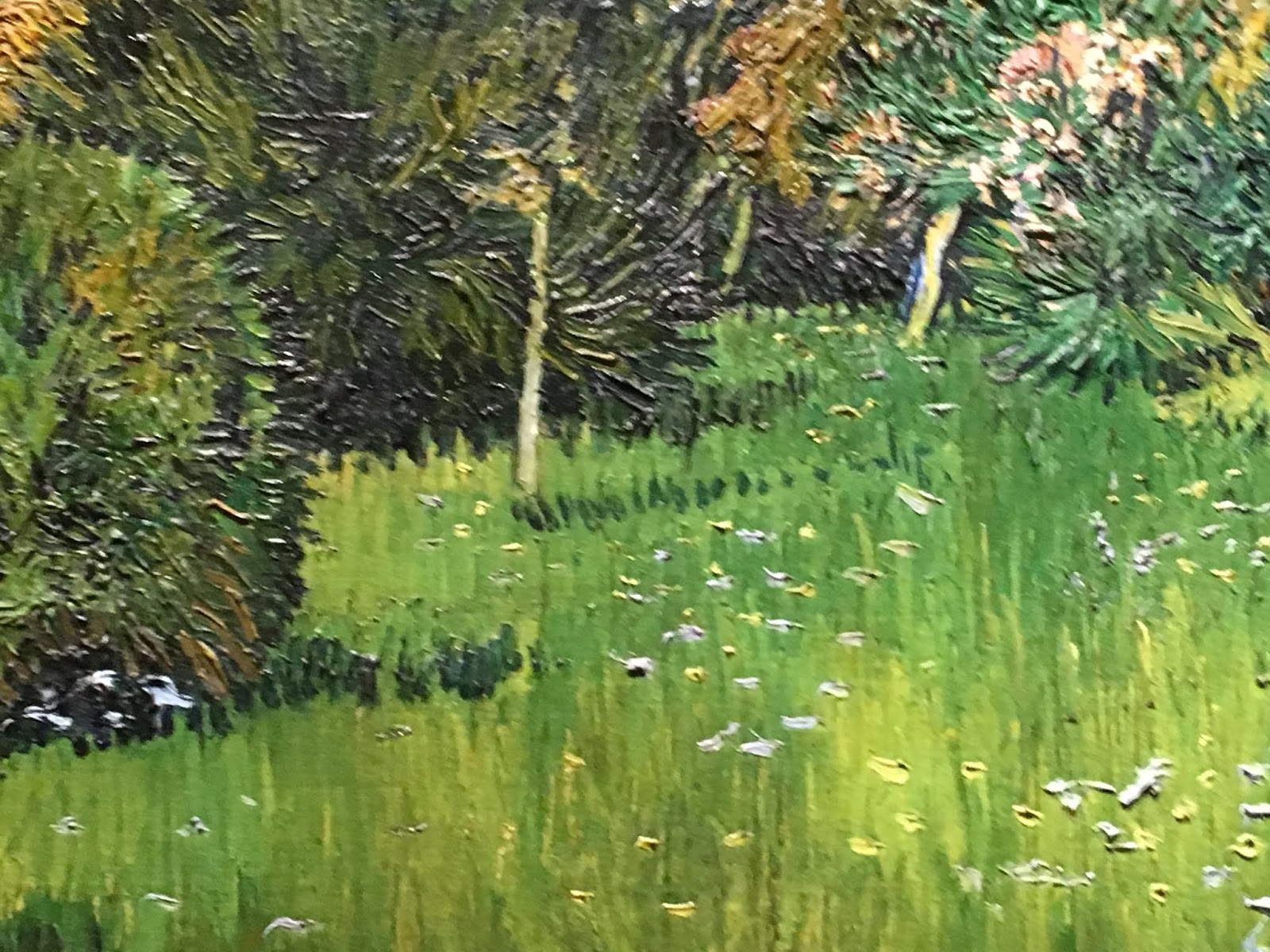
Rafik Anadol's Living Paintings are extraordinary, especially the evolving landscapes where mountains rise and fall, oceans advance and withdraws, star constellations build glaciers that melt into lakes. I was completely transfixed by their beauty, accidentally discovered during a visit to a Monday Evening Concert of Process Music... Then I came back for some more. This was a three-month show at an art gallery in Los Angeles, but I somehow missed it. Too many art exhibits I saw were basically the same, boring, broken bits and pieces, the detritus of sick imagination. Nothing to it.
But the three "California Landscapes" slow moving digital art based on landscape photographs were astounding! The explanatory notes talked about Artificial Intelligence being involved in the creation of these fantastic pieces; but I disagree. The computer could select individual trajectories of thousands of spheres floating around on the screens, but definitely did not come up with the whole idea. So the credit goes to the artist, in my mind. The California landscapes transforming into each other were my favorites. First, during my initial visit to the gallery, I admired the most the monumental waves of magma modelled from movement of air currents - a wall of images and colors, huge and amazing! Then, I noticed the smaller, slower-evolving "living paintings" in the second room of the gallery.
I think I was hypnotized by the evolution of the Earth I saw... I was joined on the bench in front of these three pieces by many others, resting their eyes on the beauty of artistically-transformed and ever evolving landscapes. Such delight!
Some of the misty mountain landscapes, with peaks rising and falling in shifting light of the seasons, spring, summer, fall, winter, day and night, rain and sunshine - reminded me of the most famous Romantic painting of solitude in the mountains by Caspar David Friedrich, "Wanderer above the Sea of Fog" (1818).

A sole man above a fog-covered valley, alone on a mountain peak, became the key symbol of romantic solitude and reflection, the key to the sublime. Mr. Amadol found a different version or many different versions of the sublime in shifting, clashing, transforming patterns of movement and color.
After a Visit to an Art Gallery
In a hall of Rafik Anadol's living paintings
the Universe breathes and moves,
mountain ranges rise and fall,
oceans clash and dance.
If I could live a million or a billion years
that's how I'd see the Earth - rising and falling -
a sea morphs into a lake shrouded in mists,
becomes the bottom of a mountain valley,
a melting glacier among snow-covered peaks,
under a cluster of alien stars.
Living, breathing matter folds itself into itself
pulled by invisible strings of constellations.
Patterns twist and evolve in waves
upon waves of transient beauty.
So that's what it was, that's what it is.
Nothing's fixed. There is no ground under our feet.
Everything's fluid. Only the endless motion.

The image above with multiple lines pulling itself into new shapes is a fragment of a larger, vertical "living painting" made from photographs of California landscapes, mountains, hills, lakes and oceans that slowly shift from one into another. The impression of watching California in geological time of whole eras is indelible. The fascination endless. No wonder so many young people were sitting in front of these evolving images for so long, transfixed by the evolution of the planet.
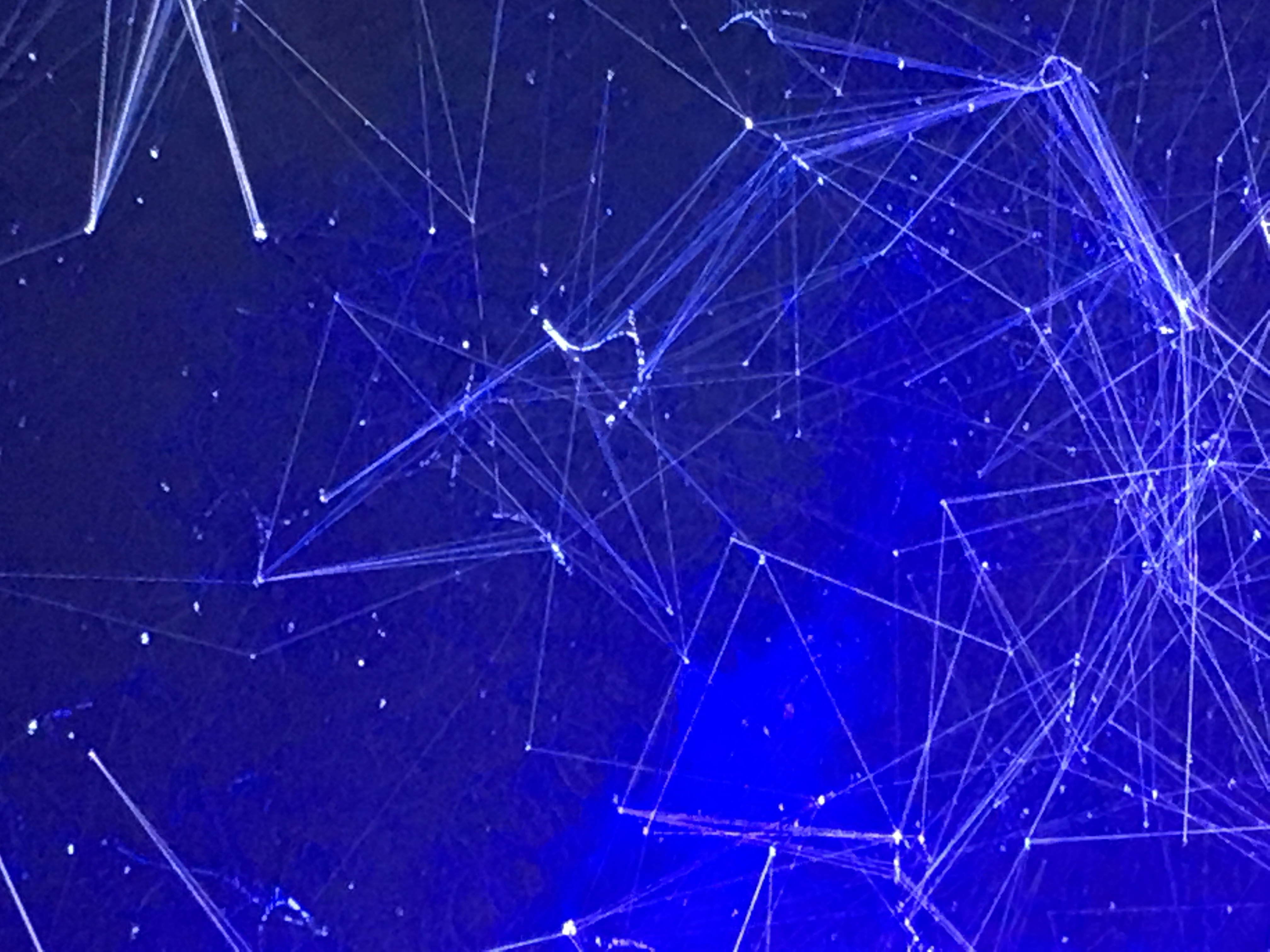
The images were made from thousands of data points fed into a computer and then calculated by the machine. Rafik Amadol, a Turkish artist, calls this machine creation and AI art, but I think it is Mr. Amadol's art -after all he programmed the machine, selected the images and made Art to Imitate Nature in the grandest and most ancient tradition of mimesis. In ancient aesthetic theories, "mimesis" or "imitation" of nature by art was its highest value.
This aesthetic hierarchy, placing first Art Imitating Nature, then all other art, has persisted in Western culture for thousands of years, from ancient Greece to the early modern period. Only in the late 19th century the artists' imagination became of more value than their ability to see and portray what they see. The breach with "Art Imitating Nature" took place. Mimesis became the domain of "kitsch." The results, though at first laudable, as in impressionism, were ultimately disastrous. From the jokes of surrealists, through the distortions of cubists, we reached the weirdness of conceptualism. After WWII we ended up with tons of garbage parading as art and pretending to have intrinsic value.
I somehow fail to notice value in such grand-standing experiments; except in cases of painters inspired by geometry, color, or the art of seeing itself, like Mondrian, Klee, Dali, and Julian Stanczak. So, when visiting galleries and museums I tend to gravitate to galleries where Madonnas and saints may be found with their golden haloes and intricately detailed gowns.

The crowds at Amadol's exhibit show that "Art Imitating Nature" is alive and well - and using huge banks of data of movement of Pacific Ocean, for instance, or shifting wind pressure, temperature and humidity around Los Angeles may result in the creation of unforgettable, vivid, hypnotically beautiful moving works of art. Hats off to the artist - for harnessing the machine to rediscover the ancient tradition of Mimesis and for restoring the principle of "artisanship" to art. Old masters spent a long time perfecting their paintings, portraits and landscapes. They did not just pour paint from backets or threw eggs on the wall. They actually worked on design, details of composition, details of textures, surfaces and expression to achieve the desired effect. Mr. Amadol harnessed the power of computing machines and software to achieve his goal of creating large-scale mobile artworks. So beautiful!

Sitting on a bench and watching the landscapes shift in front of me, made me think of the inevitable change, the patterns in my life, and the need to accept these transformation in magnanimity and peace.
The Breath of Life
The Earth breathes.
Mountains rise and fall.
Oceans spread out and withdraw.
Seasons change. Plants grow from seed
into flower into fruit into seed.
Why do you expect to never change?
Why do you spend thousands to torture yourself
with plastic surgery to remain slim and youthful?
Why not accept the flow of time and grow old with grace?
I was a girl, a woman, a wife, a mother.
Time to become a crone - time to withdraw
into a shell of wrinkles, collect the wisdom
from all I've seen and done.
The body changes, yet I AM the same.
I only know more, love more, laugh more.
The scales fall off my eyes, I see the infinite
in a grain of sand, a leaf, a stirring of breeze
in the tree branches, the swaying of golden grass
beneath live oaks. Cloaked in transient matter
I AM infinite like a perfect pebble, a perfect song
of the matter delighting in existence.
The Earth breathes. Let me breathe with her.
The mountains rise and fall. The Earth lives on.
Time is a turbulent river. I'm a rock carried
by its waves, polished into perfection
that I AM.

The imaginary landscapes erupt in a conflagration, or dissolve into different shapes, colors, hues...

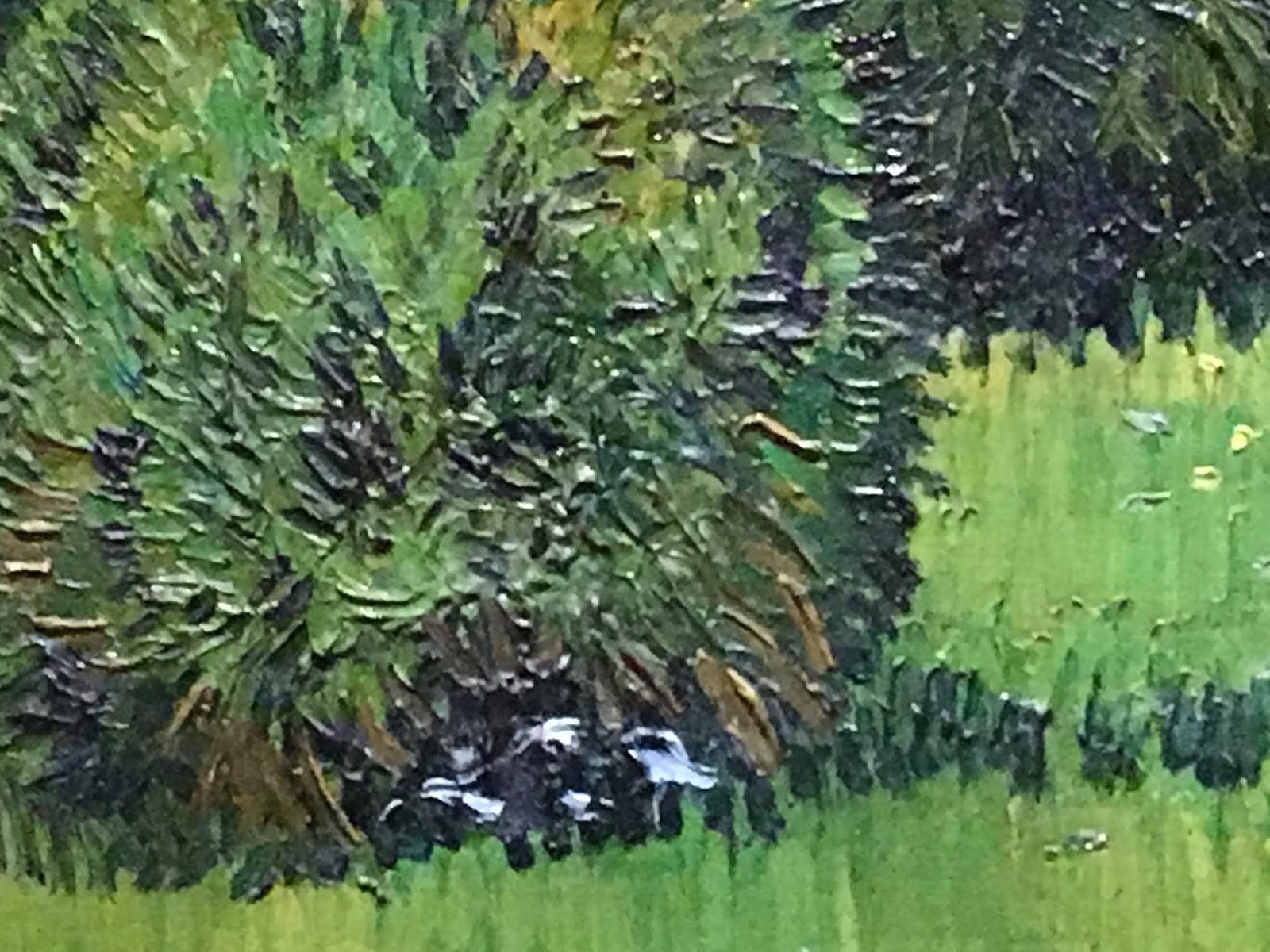
The "living painting" below is a fragment of a wall-size installation, here caught in a fragment resembling a classic landscape with green forest, a red-yellow hill turning colors in the fall, and turbulent sky. The magma above erupted from a two-tone semi-landscape "living paintings" with green-brown shapes at the bottom and various hues of blue and white on the top. It shifted into an ocean first, then exploded, in slow motion...
A fragment of the flowing magma motion of colors and shapes: https://youtu.be/bcVp-wxd59U
On the Art of Buying Art
There's no room for Amadol's Living Paintings
in my old house, with shelves full of teacups,
angels, and crystal balls. Gold-framed photographs
of kids and roses would not fit in with the insanity
of imaginary landscapes, bursting into flames,
wild magma flows, crashing and erupting,
storms of blue, azure, and sapphire rectangles
falling in an avalanche like snow.
I'd like to win a lottery and buy a mansion
in Malibu, overlooking the ocean, with huge windows,
chrome and glass, ultra-modern chairs and tables,
sparse furnishing among pristine white walls,
waiting for the burst of color from Amadol's lava flows,
bursting in vivid hues - straight from the souks of Istanbul
full of intoxicating magic of silk scarves and jewels
set in sparking gold admired, while steaming honey-hued tea
flows through the air in an acrobatic display,
not burning the hand holding a tiny cup,
painted with phantasm flowers.
I'd live where I am so happy, in my garden of birdsong
orange blossoms and roses, but I'd visit the mansion to admire
the other nature, filtered through the artist's imagination
with assistance of the machine. Not AI, not intelligent,
the soul-less machine was an efficient tool in the hands
of its owner, a magnificent, imaginative creator,
evoking the genesis of planets, the evolution
of electromagnetic cosmos on the broad expanse
of his electronic canvas.

Fragment of Julius Eastman's Buddha at the gallery: https://youtu.be/5FbeK60L56A
Some of Reich's pieces were fantastic, others unbearable (who can stand the shrieking noise of several glockenspiel played in their highest register, quite loudly?). For that part of the concert I escaped to the second room, to watch the evolving masses of color magma created by Amadol with the tool of a machine from patterns of humidity, temperature and wind speed in California. Fascinating.