Showing posts with label sunland. Show all posts

Wednesday, December 1, 2021

On Autumn Delights - California in November


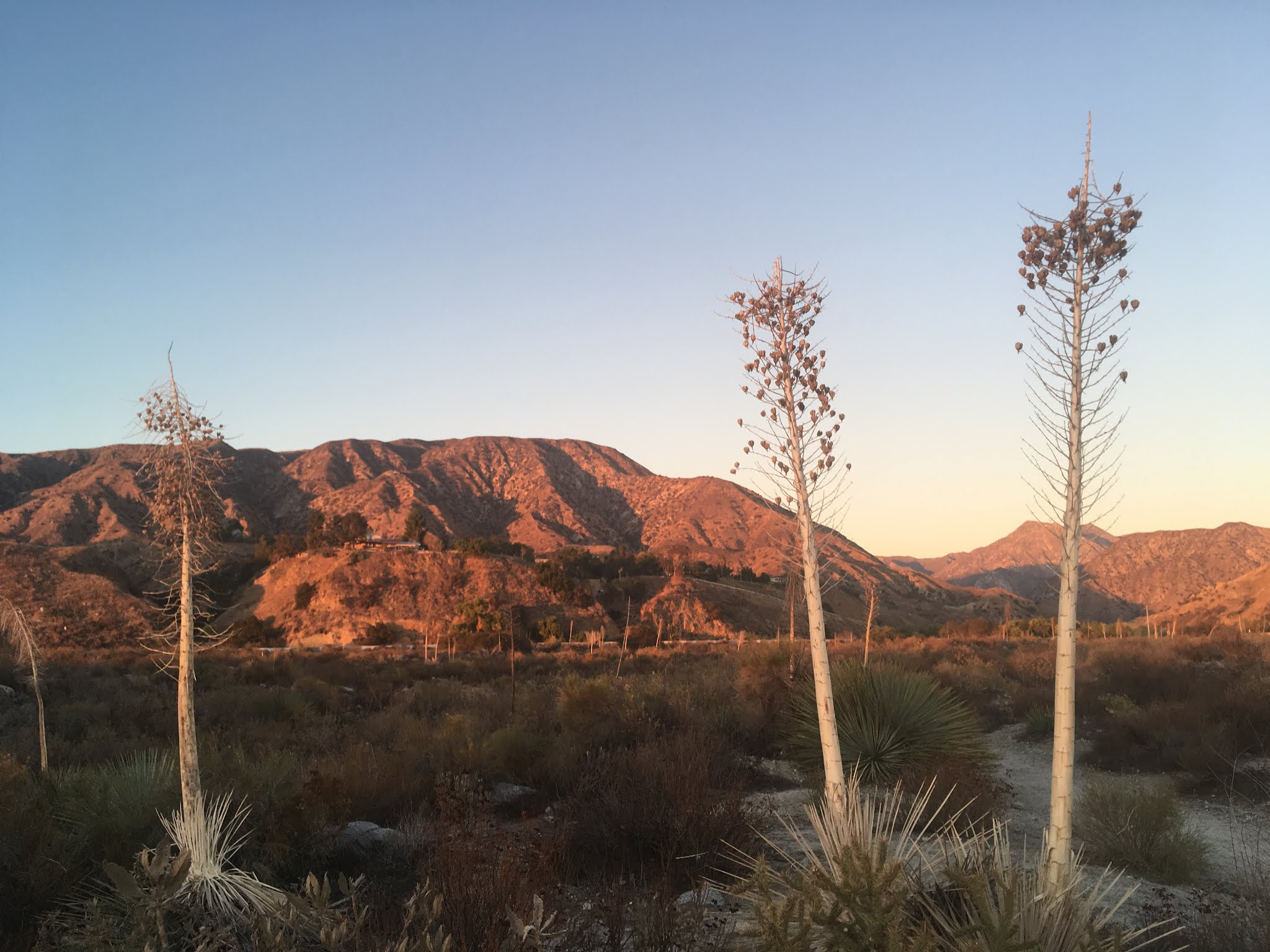
Since the stream dried out, yucca is no longer blooming, and I cannot wade in ankle-deep water, I stopped going for walks in the Wash. How many times can you walk down the same path and not get bored? I got restless in front of my laptop one lovely, sunny afternoon when the sky was perfect sapphire or lapis-lazuli, so brilliant and the sun just became golden, painting the hills into hues of amber and linden honey.


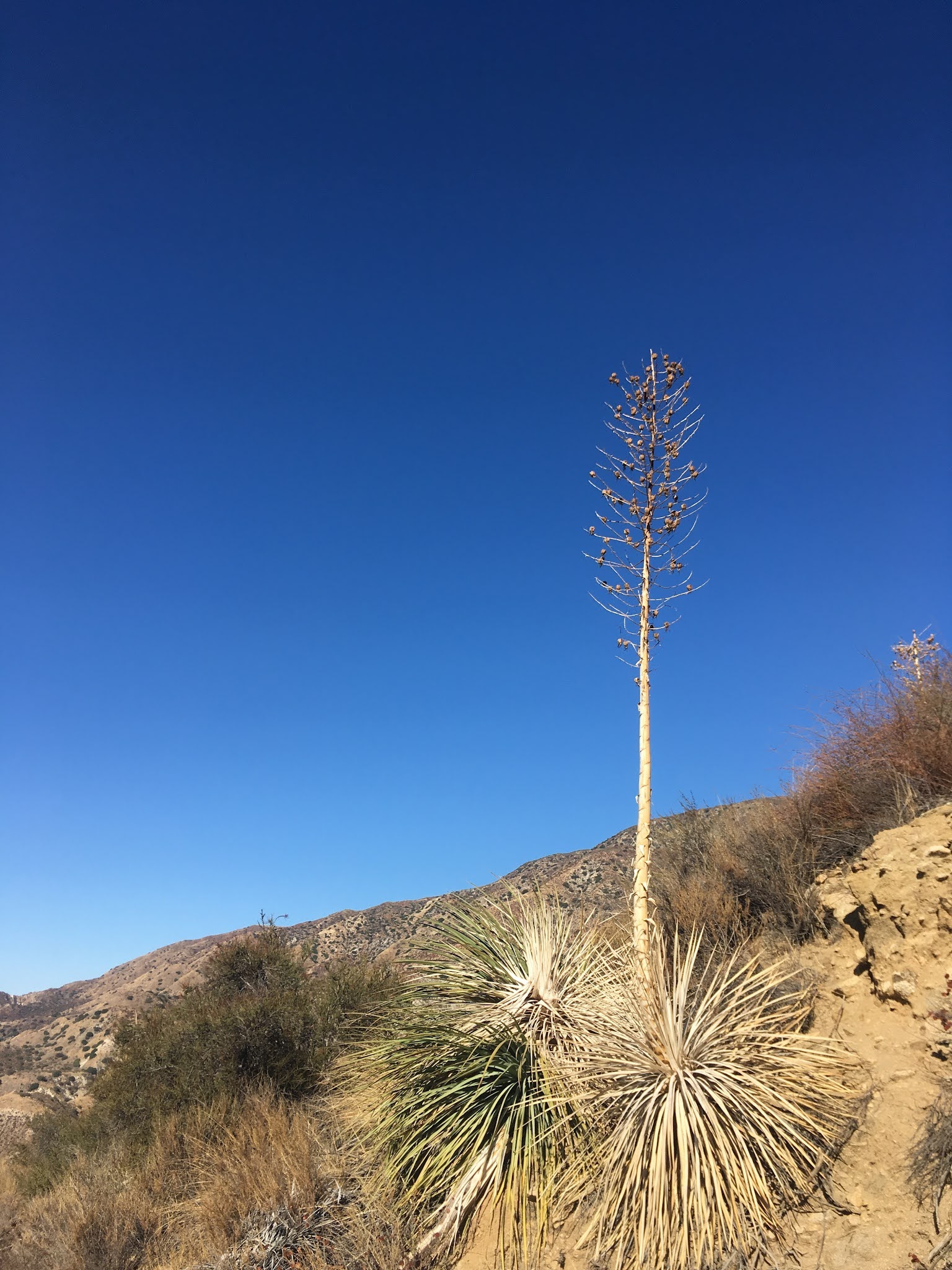
A surprise was waiting for me among pungent bushes of sage and manzanita - some yucca stalks, dried and lifeless were perfectly golden in the setting sun. So a poem came back home with me from that peaceful walk. 


Fall Yucca


Golden stems shine like beams of sunset

piercing the purple valley that sinks

into darkness under a soap-bubble sky.


The stems lean sideways, imperceptibly falling

- these are our leaning towers of Yucca in the desert 

valley that I make my home. I breathe deeply, delighted 


by the omnipresent sheen and sparkle of sonorous 

cicadas that rush to surround me with their scintillating

songs of summer, before rains silence them into sleep.


Long, narrow yucca leaves gather at the stems

like supersonic star-beams meeting at one point 

on the horizon, blurred by velocity of a Star Wars flight.


They burst out at dusk with a silvery glow 

of moonlight - then detach from their drying stems 

to crumble into the thick charcoal of the earth.


The yucca's white lily flowers have long turned into 

bunches of seed-pods - waiting to fall and germinate 

into spikes of sharp leaves that poke from the rocky soil 


with a promise and a certainty of survival – 

the next year's yucca.  Shadows reveal sparks

of icy stars above me – I walk home, content. 


My rock heart that I wrote a ballad about and kept placing on a little indent in a larger rock is gone, so I found another rock heart and placed it right there. This place I call the Rock Heart Valley, so it has to have its heart!  Nearby someone put together a tall cairn of rocks, so I took a photo  of it. 


I'm not the only one here interested in rock art. someone else put together a spiral to walk into and outside. I did that and got dizzy from turning inwards at smaller and smaller angles, until the whole valley was rotating around me, standing transfixed under the sapphire sky. 


The nights are cool these days, winter chill comes out right after sunset, though it still feels like summer in direct sunlight. Roses like it and after slumbering through the hottest months of the year, July through September, they finally started blooming again. I have several new, fragrant varieties to join the pink French Perfume that had as many as 30 roses simultaneously.  The smaller bushes have one or two, but so pretty in their rainbow colors and delicate, intoxicating scents.  Sometimes I stand in front of the rose bush and take 10-20-30 breaths of the rose perfume - aromatherapy done live!  Here's a new poem about the two-color rose, cream inside, blush pink outside, called the Double Delight. 


Double Delight


Gentle as dawn, clearing 

the sky of midnight nightmares 

my November rose smiles to herself 

rearranging the bluh and pink crinoline 

of petals folded into a heart –

her secret within


She tells me to laugh 

and laugh again, overflowing 

with childish joy, champaign bubbling 

in a crystal – while the air around me –

is heavy with cries of panic, anguish, hate.


“What of the news?” you say, 

“Who lived, who died, who suffered?”

I’m silent, exploring the inner landscapes 

that only music knows – the infinity 

of cellos, violins, and the lover’s gaze 

locked in the key of brightness.


I'm grateful for my Double Delight, I'm grateful for my pomegranates, here filled with thank-yous in so many languages. Gratitude is the virtue of blessings. 


Monday, July 10, 2017

The Declaration of Independence for this Summer

poets laureate smile
in stars and stripes - 
day of independence

It was so much fun to ride in the Independence Day Parade. Let's not call it the Fourth of July - it means nothing, just a calendar day, but "independence" - there is a lot of meaning in this little word.

village poets declare
independence day
for poetry in sunlight 

Here's the full text of the U.S. Declaration of Independence passed by the thirteen states on July 4, 1776 from http://www.ushistory.org/declaration/document/


IN CONGRESS, JULY 4, 1776
The unanimous Declaration of the thirteen united States of America

When in the Course of human events it becomes necessary for one people to dissolve the political bands which have connected them with another and to assume among the powers of the earth, the separate and equal station to which the Laws of Nature and of Nature's God entitle them, a decent respect to the opinions of mankind requires that they should declare the causes which impel them to the separation.

We hold these truths to be self-evident, that all men are created equal, that they are endowed by their Creator with certain unalienable Rights, that among these are Life, Liberty and the pursuit of Happiness. — That to secure these rights, Governments are instituted among Men, deriving their just powers from the consent of the governed, — That whenever any Form of Government becomes destructive of these ends, it is the Right of the People to alter or to abolish it, and to institute new Government, laying its foundation on such principles and organizing its powers in such form, as to them shall seem most likely to effect their Safety and Happiness. Prudence, indeed, will dictate that Governments long established should not be changed for light and transient causes; and accordingly all experience hath shewn that mankind are more disposed to suffer, while evils are sufferable than to right themselves by abolishing the forms to which they are accustomed. 

But when a long train of abuses and usurpations, pursuing invariably the same Object evinces a design to reduce them under absolute Despotism, it is their right, it is their duty, to throw off such Government, and to provide new Guards for their future security. — Such has been the patient sufferance of these Colonies; and such is now the necessity which constrains them to alter their former Systems of Government. The history of the present King of Great Britain is a history of repeated injuries and usurpations, all having in direct object the establishment of an absolute Tyranny over these States. To prove this, let Facts be submitted to a candid world.


  • He has refused his Assent to Laws, the most wholesome and necessary for the public good.

  • He has forbidden his Governors to pass Laws of immediate and pressing importance, unless suspended in their operation till his Assent should be obtained; and when so suspended, he has utterly neglected to attend to them.

  • He has refused to pass other Laws for the accommodation of large districts of people, unless those people would relinquish the right of Representation in the Legislature, a right inestimable to them and formidable to tyrants only.

  • He has called together legislative bodies at places unusual, uncomfortable, and distant from the depository of their Public Records, for the sole purpose of fatiguing them into compliance with his measures.

  • He has dissolved Representative Houses repeatedly, for opposing with manly firmness his invasions on the rights of the people.

  • He has refused for a long time, after such dissolutions, to cause others to be elected, whereby the Legislative Powers, incapable of Annihilation, have returned to the People at large for their exercise; the State remaining in the mean time exposed to all the dangers of invasion from without, and convulsions within.

  • He has endeavoured to prevent the population of these States; for that purpose obstructing the Laws for Naturalization of Foreigners; refusing to pass others to encourage their migrations hither, and raising the conditions of new Appropriations of Lands.

  • He has obstructed the Administration of Justice by refusing his Assent to Laws for establishing Judiciary Powers.

  • He has made Judges dependent on his Will alone for the tenure of their offices, and the amount and payment of their salaries.

  • He has erected a multitude of New Offices, and sent hither swarms of Officers to harass our people and eat out their substance.

  • He has kept among us, in times of peace, Standing Armies without the Consent of our legislatures.

  • He has affected to render the Military independent of and superior to the Civil Power.

  • He has combined with others to subject us to a jurisdiction foreign to our constitution, and unacknowledged by our laws; giving his Assent to their Acts of pretended Legislation:


  • For quartering large bodies of armed troops among us:

  • For protecting them, by a mock Trial from punishment for any Murders which they should commit on the Inhabitants of these States:

  • For cutting off our Trade with all parts of the world:

  • For imposing Taxes on us without our Consent:

  • For depriving us in many cases, of the benefit of Trial by Jury:

  • For transporting us beyond Seas to be tried for pretended offences:

  • For abolishing the free System of English Laws in a neighbouring Province, establishing therein an Arbitrary government, and enlarging its Boundaries so as to render it at once an example and fit instrument for introducing the same absolute rule into these Colonies

  • For taking away our Charters, abolishing our most valuable Laws and altering fundamentally the Forms of our Governments:

  • For suspending our own Legislatures, and declaring themselves invested with power to legislate for us in all cases whatsoever.


  • He has abdicated Government here, by declaring us out of his Protection and waging War against us.

  • He has plundered our seas, ravaged our coasts, burnt our towns, and destroyed the lives of our people.

  • He is at this time transporting large Armies of foreign Mercenaries to compleat the works of death, desolation, and tyranny, already begun with circumstances of Cruelty & Perfidy scarcely paralleled in the most barbarous ages, and totally unworthy the Head of a civilized nation.

  • He has constrained our fellow Citizens taken Captive on the high Seas to bear Arms against their Country, to become the executioners of their friends and Brethren, or to fall themselves by their Hands.

  • He has excited domestic insurrections amongst us, and has endeavoured to bring on the inhabitants of our frontiers, the merciless Indian Savages whose known rule of warfare, is an undistinguished destruction of all ages, sexes and conditions.


In every stage of these Oppressions We have Petitioned for Redress in the most humble terms: Our repeated Petitions have been answered only by repeated injury. A Prince, whose character is thus marked by every act which may define a Tyrant, is unfit to be the ruler of a free people.

Nor have We been wanting in attentions to our British brethren. We have warned them from time to time of attempts by their legislature to extend an unwarrantable jurisdiction over us. We have reminded them of the circumstances of our emigration and settlement here. We have appealed to their native justice and magnanimity, and we have conjured them by the ties of our common kindred to disavow these usurpations, which would inevitably interrupt our connections and correspondence. They too have been deaf to the voice of justice and of consanguinity. We must, therefore, acquiesce in the necessity, which denounces our Separation, and hold them, as we hold the rest of mankind, Enemies in War, in Peace Friends.

We, therefore, the Representatives of the united States of America, in General Congress, Assembled, appealing to the Supreme Judge of the world for the rectitude of our intentions, do, in the Name, and by Authority of the good People of these Colonies, solemnly publish and declare, That these united Colonies are, and of Right ought to be Free and Independent States, that they are Absolved from all Allegiance to the British Crown, and that all political connection between them and the State of Great Britain, is and ought to be totally dissolved; and that as Free and Independent States, they have full Power to levy War, conclude Peace, contract Alliances, establish Commerce, and to do all other Acts and Things which Independent States may of right do. — And for the support of this Declaration, with a firm reliance on the protection of Divine Providence, we mutually pledge to each other our Lives, our Fortunes, and our sacred Honor.

New Hampshire:
Josiah Bartlett, William Whipple, Matthew Thornton

Massachusetts:
John Hancock, Samuel Adams, John Adams, Robert Treat Paine, Elbridge Gerry

Rhode Island:
Stephen Hopkins, William Ellery

Connecticut:
Roger Sherman, Samuel Huntington, William Williams, Oliver Wolcott

New York:
William Floyd, Philip Livingston, Francis Lewis, Lewis Morris

New Jersey:
Richard Stockton, John Witherspoon, Francis Hopkinson, John Hart, Abraham Clark

Pennsylvania:
Robert Morris, Benjamin Rush, Benjamin Franklin, John Morton, George Clymer, James Smith, George Taylor, James Wilson, George Ross

Delaware:
Caesar Rodney, George Read, Thomas McKean

Maryland:
Samuel Chase, William Paca, Thomas Stone, Charles Carroll of Carrollton

Virginia:
George Wythe, Richard Henry Lee, Thomas Jefferson, Benjamin Harrison, Thomas Nelson, Jr., Francis Lightfoot Lee, Carter Braxton

North Carolina:
William Hooper, Joseph Hewes, John Penn

South Carolina:
Edward Rutledge, Thomas Heyward, Jr., Thomas Lynch, Jr., Arthur Middleton

Georgia:
Button Gwinnett, Lyman Hall, George Walton

white stars in indigo night
white stars at sunset 
crowned with independence at noon 

stars and stripes
everywhere
all in red, white, and blue

For me this day is especially meaningful, as my Mom died when I was riding in the parade in 2013.

the poets car
moves through
bright streets of Sunland

She loved to have fun, dress up, and celebrate. So she would have loved the fact that I was celebrating independence, as she was being liberated of her past, leaving the burdens behind.  When I have fun in the Parade every year, it is also on her behalf. Here we are, picking leaves in the Kampinos forest near Warsaw, in mid 1960s:


Sunday afternoon 
dressing up 
to pick leaves in the park

This photo reminds me of my love of trees, my beloved cousins on this planet. With a friend I was planning to create the Planetary Church of Plants, with one stated goal of protecting and planting trees.
Before it comes into being, here's my Declaration of Inter-dependence...

My Declaration 

I am a sovereign citizen​ of the galaxy

My heart goes out​ to the mountains​.​
My feet grow roots​ in the light​.​
My eyes touch​ heavenly stars​.​
I breathe gold air​ of goodness​.​
I drink lucid​ water of joy​.​
​Nourished by divine affection, 
I thrive, ​l​inked ​to all living beings​ -​
​snow crystals, seeds, ​trees, and sunlight​.​
​In ​harmony,​ we sing the chorale​ of dawn​.​
I choose to love all,​ live in love​.​

I am a sovereign citizen​ of the galaxy​.​


Adam wants my hat 
celebrating
stars and stripes forever


Friday, March 21, 2014

The Spring... Ahhh, The Spring...

Magic of Spring by Maja Trochimczyk

Here, The first day of spring. The Equinox. The day is as long as the night. From now on it will become longer until summer solstice in June. Ancient Persians celebrated it with the holiday of New Year, the Norooz, Nowrooz, or Nowruz in English. On the night before, they had a large bonfire and they jumped over the flames. The moment of passing through the flames was the moment of purification. The fire burned all evil in the past, all bad things, bad thoughts, bad emotions: the horrors, the failures, the hurts. Sins and regrets. Evil burden of rocks carried in the sack on our backs. The fire strengthened the spirit with new life-force, energy, pure light. It destroyed the evil past of dark shadows and gave birth to the light-filled future. Persians do it now, too. It is pre-Islamic custom, from an ancient Zoroastran religion, where forces of darkness and light always fought in the world, in people's souls and minds.

burn, burn, burn
darkness into light
 white fire

Cherry Tree by Maja Trochimczyk


Ancient Slavic peoples, including Poles, also had this custom, this ritual of jumping over the fire - only it was held at Summer Solstice in June, on the shortest night of the year. Once I learned about the Persians, I understood why. But I never did that, I'm afraid of fire. I'm not a jumper. Not a sports person, either, except for swimming and sailing. I'd love to have a sailboat on a lake, somewhere. Not on the ocean. I do not like salty water. I do not trust the ocean, I'm afraid of tsunamis. That's why I bought a house in the mountains, on high ground.

drowning
in an ocean of tears
dreams of sweet water

Sky Greeting by Maja Trochimczyk

All religions have this element of purification, cleansing the soul, healing in the spring. New light, new life. Freedom and joy. In Christianity we have the sacrament of baptism (I was baptized as an adult, so I remember clearly the moment of passing through from darkness to light), the confession (that one is scary, with so many corrupt priests), the Mass and eating light-filled bread (my favorite), and the yearly calendar of rituals - Christmas, the birth of light at Winter Solstice, and Easter, the triumph of light at Spring Equinox.

sun rises
a round loaf of bread
in pre-dawn sky

Constant Return I by Julian Stanczak (1965)

line follows line
gravitational waves
bend cosmos

In a Japanese religion, or spiritual practice of Sukyo Mahikari, the Carriers of Light, people use light to heal each other. The centers of the palms of your hands emit healing light, pure energy that can be directed at someone's head or body, various "knots" of toxic thoughts, toxins in the body. The light dissolves the knots, purifies. The palms tingle a bit when you do it. I went to a spiritual center several times and was purified in this way. I had lots of "knots" to disentangle, lots of toxins to remove, a lifetime of hurt.

I give you
light filled with light
what else?

Magnolia by Maja Trochimczyk

If pink wasn't pink
would you 
wake up, still? 

Ambika Talwar, Susan Rogers, Lois P. Jones and Maja Trochimczyk

Susan Rogers, a friend who is a member of this group, is a great poet. In our group, called the Spiritual Quartet and active for a while, we used to call her a "hummingbird" - for she constantly flickers around, is always in motion, always busy. We also had Lois P. Jones, the fiery "phoenix" reborn from the flames of self-destruction, and Taoli-Ambika Talwar, the proud and royal "peacock" (the bird is a national symbol of India, her home country).

birds scatter
feathers dance
on spring breeze

Who am I? My friends called me a "dove"  of gentleness, serenity, and love. I wrote so many love poems, and read them with such affection, I'm just filled with love, or so it seems... But the Dove is also the Holy Spirit, also the bird that Noah sent from his Arc three times to find dry land after the flood. Two times, it came back with nothing, but the third time it brought back a twig of green, for peace, for the end of the flood, for the spring.

above waves
a dove shines green
in sunlight


mirror says
to the sky
I win

A Brook and Spring by Maja Trochimczyk

orange cup
of nectar 
verdant dream


_______________________

Meanwhile... I went to the Colliding Rhymes Poetry Reading organized by a fellow Poet Laureate of Sunland-Tujunga, Joe DeCenzo. It was on March 16, at the McGroarty Arts Center, in Tujunga, a part of their Arts at Play Festival. I heard some of my most favorite poets - Sean Hill, a hip-hop artist with a heart of gold and the most astounding mouth capable of making sound effects and reciting a whole segment of hip hop, without a single curse!

Then, there was the surreal Just Kibbe, with his text-message-acronym poetry book and the ibis portrait, Jessica Wilson and Juan Cardenas, the bohemian lovebirds - a poetess and her flutist - and Neil McCarthy, still straight from Ireland, and still in his torn jeans and sandals... For this reading, Justin Kibbe repainted his car yellow - for sun, for Sunland - and asked poets to write on it. Here's my poem, based on a saying by Britta Muehlbach of Phoenix House.

Britta says:
"I fearlessly speak
my truth with love"
I smile, in silence


And here's another very short poem... that I saw, but did not write. I like it. We are what we do, after all...


Tulips in Descanso (FB Album)


Thursday, April 18, 2013

National Poetry Month - Celebrating My Poetry Circles (April 20 and 29)


Descanso Garden - Path of Shadows by Maja Trochimczyk

Have you ever had the feeling that you've done what you were supposed to do in life and everything else is a bonus, a desert of sorts? After publishing some of my most intimate and autobiographical poems in the last few years, I do feel that way. I've left the proof of my existence - on paper, and online - in a portrait of what I really think and who I think I am. It was such a welcome relief from the heavy-duty writing of musicology where I had to dig into other people's lives and thoughts, and play a guessing game about what they were about. Or, worse, as many musicologists do, impose my own theories and ideas onto my subjects, quote the most fashionable experts of the moment, and strive to make myself famous at the expense of those I wrote about.  I'm glad I don't have to anything, any more. . . So, in a way, I'm done, no reason to continue.

But wait, there's so much more! Having finished the egocentric trip of describing myself, I still have the whole world to write about, and there's plenty to do! Here's my poem about poetry writing, published last year by Apryl Skiles in her Edgar Allan Poet blog and her guest piece for another journal.

Descanso Garden - Fountain of Light by Maja Trochimczyk


Definition: Writing 

               in response to George Jisho Robertson’s essay “Path of Poesis”

It is not like splitting the match in four
or counting devils on its round head –
none of this matters, really

see the sunrise above Strawberry Peak
and Mount Disappointment shimmer
on the puffy underbelly of summer clouds

be dazed by bright ripples on a shallow canyon stream
shining like scales of a carp waiting to be killed
in a bathtub before Polish Easter

listen to the roosting birds at dusk,
the murder of crows covering tree branches
with angular shapes, dense Xenakis chords,

black clusters, dissonant, intense. They bathe
in the river, sit on a concrete bank with wet wings
outstretched, drooping with water, docile

like tattooed crowds resting, sweating
on sandy beach towels in Santa Monica,
waiting for a tsunami that will not come

shifting the gaze is important, from the navel
to cosmos – not how we fail in a multitude of ways,
but what graces hide in galaxies

that collide amidsts exploding supernovas,
on thousands of inhabitable planets
we’ll count but never touch –

we’ll touch but never count
the veins on the petals of the rose
shriveling from desert heat, just opened

Not us, then, look around, beyond,
catch what’s already gone, hold it
in your hand – the spark, the passing

(c) 2010 by Maja Trochimczyk

Petal and Raindrops in Blush by Maja Trochimczyk


 Let's focus on what's really far away - all these galaxies and clouds of interstellar dust - and on what's really close and often overlooked - the treasures found on daily walks. The spark of joy seen in someone's eyes. Apryl Skies just made this poem her "Poem of the Day" for April 18, 2013!  She previously published it on her blog, at Edgar Allan Poet: http://edgarallanpoet.com/Definition__Writing.html For the National Poetry Month last year, I also wrote an article that she published with the poem. How sweet! http://www.examiner.com/article/majatrochimczyk-poet-laureate-the-passing-of-laurels"

It is good to have friends. It is better to have poets as friends. For the National Poetry Month 2013,  I have been invited to three group readings: Westside Women Writers, Village Poets, and Rey Luminarias's Poets and Artists Reading.

Cycladic harp player from Getty Villa by Maja Trochimczyk

The reading by Westside Women Writers was held on April 17 at the Topanga Public Library on 122 N. Topanga Canyon Rd. The reading included individual sections and a group reading of poems inspired by an ancient, Cycladic sculpture of a harp player, from the Getty Villa antiquities permanent collection. The poems were written during the first field trip of Westside Women Writers, organized by Kathi Stafford and held on March 30, 2013 at the Getty Villa, Malibu. The Westside Women Writers, created five years ago by Millicent Borges Accardi, currently include, besides Millicent, Kathi and myself: Georgia Jones-Davis, Susan Rogers, Lois P. Jones, Sonya Sabanac, and Madeleine Butcher. 

Tujunga Wash by Maja Trochimczyk

The Village Poets of Sunland-Tujunga will appear at the La Crescenta Library on Saturday, April 20 at 2 p.m.  The library is located at 2809 Foothill Blvd., La Crescenta, CA 91214, tel. (818) 248-5313 (the parking is in the back). The reading's program includes poetry by Dorothy Skiles, Poet Laureate of Sunland-Tujunga, as well as fellow past poets Marlene Hitt, Joe DeCenzo, Maja Trochimczyk, Mari Werner and Beverly M. Collins. In addition to selections by each poet, the reading will include four poems read by a group - Sensations, Remembering, Enrollment, and The Veil, the Weave.  More information is posted on the Village Poets blog. 

Village Poets of Sunland Tujunga is a group of former Poets Laureate of Sunland Tujunga who organize poetry readings in their community, write poetry, and publish books, making sure that poetry life is rich and vibrant in the foothills. Every two years Village Poets organize a competition for the Poet-Laureate of Sunland-Tujunga and, in order to involve the local community in the selection of its Poet-Laureate, establish a Poetry and Literature Committee of Sunland-Tujunga which selects the next Poet. Dorothy Skiles is the current Poet-Laureate in our community (2012-2014). Another important project of Village Poets is the Monthly Village Poets Reading at Bolton Hall Museum in Tujunga, CA. The next reading, by Neil McCarthy, will be at the McGroarty Arts Center on Saturday, April 27, 2013. The upcoming readings are announced in local "good news" paper - The Voice of the Village. 


Reynald Romea Luminarias wrote a beautiful poem for my anthology Chopin with Cherries. I was very happy to include it in the book.


There Is No Other Love
                     
                              After Chopin’s Etude in E Major, Opus 10, No. 3

R. Romea Luminarias

                                                    —for Annie


November sunlight peers
Between leaf-veins. Oval windows.
Rose petals on velvet. Autumn vines our arms
Glazed with ripeness, steeped in unrestrained embrace.
Tongues stilled; drought-pained mouths this one now-love alone
 
Can heal. Our Love steers
Unknown universes’ oceans of shadows,
Maps red coral galaxies. Anemone-meteors swarm
Around us, stir hunger’s hull knifing waves, probing abysses.
There is no other love obtains the soul, breaks open steel and stone;
 
There is no other Love destroys this present, ancient drought, this fall
Stripped bare of songs, deprived of harvest; there is no other Love sees
Through storms of swirling fires; only this love, O this our Love alone:
No other Love ordains, builds up the spirit, breathes life into dry bones.
 
 
 In return, three years later, he invited me to present some of my poetry at his National Poetry Month celebration at the Pasadena Public Library, Wright Auditorium, April 29 at 6 p.m. The event, entitled "Co-Inspirators: Poets, Artists, Music-Makers" will present interactions between various arts. The Pasadena Library is located at 285 East Walnut Street Pasadena, CA 91101, tel. (626) 744-4066.


just Joey Rose by Maja Trochimczyk

Rey invited me to read three poems: "Memory Mirrors" (inspired by Susan Dobay's digital artwork, "Reminiscence" from her "Impression of China"), and "A Study with Cherries," and "How to Make a Mazurka" from the Chopin with Cherries anthology. For the first poem, Rick Wilson will accompany me on a Chinese flute from his exquisite and extensive flute collection. For the Chopin's pieces, celebrating his music as heard in my childhood, at my grandparents house in a Polish village, I will bring two Chopin music boxes... It is going to be a beautiful, beautiful event.

A Summer Rose Dream 

                  ~ inspired by Chopin's letter from Nohant


Rose petals float down 

Onto the desk covered with music 
Pages of notes and ink blots 

Chopin looks out the window 

A carmine blossom in her black hair
Exotic beauty at the ball 

He sees the eglantine roses 

The picket fence of long ago 
His sister smiling 

Fragrance spills on the velvet 

Of night, notes scatter 
On a canvas of his thoughts 

His fingers search for memories 

On smooth ivory keys 
Roses and nightingales, roses

(c) 2013 by Maja Trochimczyk


________________________________

Photos from Descanso Gardens, Tujunga Wash, and Roses from my garden.
(C) 2013 by Maja Trochimczyk

Sunday, November 4, 2012

On Virtues and Gratitude in Time for Thanksgiving

Liquit Amber Leaf in Sunlight, Photo (c) 2012 by Maja Trochimczyk

For my class on Ethics and Values in the Arts that I taught at the Pitchess Detention Center in Castaic, I tried to simplify the centuries of moral teaching into a clear scheme that's easy to visualize and remember. I came up with an idea of focusing on virtues, and selected Four Cardinal Virtues as the core. I enriched this framework with what I called the Four Moral Actions. Below are fragments of my introduction that outline some of these fruitful ideas. I end with a couple of poems on gratitude, that I'm gradually learning every day.

On Cardinal Virtues and Moral Actions

What is a Virtue? Virtues are character traits that help individuals orient their lives towards a greater good. Virtues help people act properly, morally. The word “virtue” stems from a Latin root, “virtus” – which, in turn, comes from the word “vir” – “man.” The dictionary definition brings together several related meanings:

  • 1. Moral excellence; goodness; righteousness.
  • 2. Conformity of one's life and conduct to moral/ethical principles; uprightness; rectitude.
  • 3. A particular moral excellence, like cardinal virtues
  • 4. A good or admirable quality or property: the virtue of knowing one's weaknesses.

A traditional list is that of the Seven Contrary Virtues which are opposites of the Seven Deadly Sins:
  • Humility – the opposite of Pride
  • Kindness – the opposite of Envy
  • Abstinence – the opposite of Gluttony
  • Chastity – the opposite of Lust
  • Patience – the opposite of Anger
  • Liberality – the opposite of Greed
  • Diligence – the opposite of Sloth
Its focus on the negative, the deadly sins merely mirrored in the positive attributes, has underscored centuries of moral education that centered on avoidance of evil and fear of punishment, instead of pursuit of the greater good for good’s sake. The purpose of virtues is to act more human, to help create and strengthen societal bonds based on love (trust, honesty, fairness) and to help each individual succeed in his or her pursuit of personal happiness.

In the 20th century, a French philosopher, Andre Comte-Sponville wrote a treatise about 18 different virtues, which included all the above Spiritual/Cardinal Virtues and more. This set of virtues appears in the context of his atheistic and humanistic philosophy: Politeness, Fidelity, Prudence, Temperance, Courage, Justice, Generosity, Compassion, Mercy, Gratitude, Humility, Simplicity, Tolerance, Purity, Gentleness, Good Faith, Humor, Love.

 The unusual list includes the “pre-virtue” of politeness with a surprising and the novel virtue of humor. The discussion of these virtues will be focused on their links to underlying values – physical, psychological or spiritual, and their expressions from the values of being useful, through being pleasurable, to being, to being spiritual.

Pomegranates, Photo (c) 2012 by Maja Trochimczyk

What about the Cardinal Virtues?

They were outlined in the classic antiquity by Aristotle and Plato:
  •  Courage (Fortitude), 
  • Wisdom (Prudence), 
  • Justice, and 
  • Moderation (Restraint, Temperance).
These “four cornerstones of the soul” have been taught to generations to create a moral framework for individual lives and create a balance between the excesses of each of these virtues appearing by itself, in isolation. In the four-part ethical framework presented here, the severity of Justice is balanced by the gentleness of Wisdom (Prudence), which, without the urgent sense of fairness could devolve into fear and inaction. The bravado of Courage (Fortitude) is balanced by the meekness of Moderation (Temperance, Restraint), which, without the passion of courage, may result in withdrawal and passivity.

The image of the “cardinal” virtues is related to the “cardinal points” on a map (North-East-South-West), as a compass for moral life. In a graphic representation, the virtues are located at 0, 90, 180, and 270 degrees on the circle, with the heart of an individual in its center. In another image, they form a circle around a central point and connect to one another; thus surrounding and protecting the core of one’s being.
The balancing act of practicing the cardinal virtues requires a focus on the present, on this infinitely small point in time in which we live, constantly moving from the past to the future. It is by paying attention to present actions, thoughts, and emotions, and by seeking the proper balance of justice with wisdom, and courage with moderation, that an individual may act in a virtuous way and may set a course of his/her life towards real happiness.

The four cardinal virtues, practiced in a way that they balance each other and help the individual remain in the center: courage will be tempered by moderation, wisdom will inform justice. The virtues will change the invisible attitude but will be visibly expressed in moral actions. The direction for the cardinal virtues, the “needle of the compass” are the three spiritual virtues: faith (in one’s own goodness and potential on the one hand and in the goodness of the world on the other), hope (in one’s ability to accomplish one’s goals in the future and in the benevolence of others who will be helpful and will share one’s successes and help on the spiritual path) and love (for oneself and others, spreading from within in concentric circles from the nearest kin and closest friends, to all people).

THE CORNERSTONE

Justice: Do what's right, what's fair.
Fortitude:  Keep smiling. Grin and bear.
Temperance: Don't take more than your share.
Prudence: Choose wisely. Think and care.
Find yourself deep within your heart
               In a circle of cardinal virtues
                                  The points of your compass
                                                    YOUR CORNERSTONE.
Once you've mastered the steps, new ones appear:
Faith:   You are not alone . . .
Hope:  And all shall be well . . .
Love:    The very air we breathe
                          WHERE WE ARE. . .
_____________________________________
The poem may be recited by a group of at least three participants -  the colors indicate individual voices and the text in black font and caps is said by the whole group. Try it!
_____________________________________

Liquit Amber Tree, Photo (c) 2012 by Maja Trochimczyk

Virtues in Practice: Moral Actions

In order to be fully effective and surround the individual with a protective circle that will ensure selecting the best option from thousands of possible choices, the Cardinal Virtues should be associated with a mirror framework of four Moral Actions that both modify and express them.
  • Compassion (Justice) – I am compassionate, I share pain
  • Forgiveness (Courage) – I am forgiving, I let go of pain
  • Generosity (Moderation) – I am generous, I share joy
  • Gratitude (Wisdom) – I am grateful, I thank for joy
I selected these four Moral Actions from a multitude of possibilities as echoes or reflections of emotions with which they are bound; these are the opposite of such actions that would result from fully giving in to negative emotions.Compassion or co-suffering is an antidote for anger and grief; it helps break the isolation and alienation caused by the negativity of violence (anger) or withdrawal (grief). Forgiveness breaks apart the toxic shame and fear that again, prevent us from integrating ourselves into whole and healthy individuals and connecting to others in a healthy, well-adjusted way. It is, by far, the hardest of all Moral Actions, as it is based on overcoming the consequences of profound traumas, seared in the memory of pain. Generosity reaches out to the others, while Gratitude permeates the person and all the individual actions with a spirit of thankfulness that lights it all up with joy from within.

The Moral Actions, when taken and practiced together, unify a person’s core being around positive, healing attitude that extend from self to others, from an individual self-definition, to the self-in-the-world. Compassion and Generosity breaks the isolation and create communities. Forgiveness and Gratitude have the greatest healing impact internally, when applied to oneself. Practicing these Moral Actions, based within Cardinal Virtues is a transformative act that results in the healing of an individual person while simultaneously healing the world. Through the practice of Virtue, the present moment is permeated with positive Moral Actions.

Justice is truly “fair” when it is based on compassion, defined as shared suffering, “feeling for/with the other,” or “I know your pain.” Courage to forgive is far more powerful than courage to fight, it is far more liberating than courage to merely endure and survive. Forgiveness gives rise to courage, courage to forgiveness. The generosity of sharing joy may be the one difference between a true saint and an ordinary moral person. For the ordinary person, lacking the convictions or the endurance of a saint, generosity is to be tempered by Moderation, all actions made within reason. True Wisdom arises from gratitude: we are deeply thankful for every opportunity to feel, live and share, grateful for every day, every breath. Immanuel Kant (1724-1804) expressed the feeling of universal gratitude in a beautiful maxim: “Two things awe me the most: the starry sky above me and the moral law within me.”

Intertwined with the Cardinal Virtues, the four Moral Actions form yet another protective circle of goodness. Compassion and Generosity are primarily directed outside the circle, towards others whose suffering we understand and with whom we share our gifts. Forgiveness and Gratitude are primarily directed inwardly. We heal ourselves first; we learn to be thankful for our own gifts first. Then we can turn towards the others. The image of oxygen masks falling down on the plane is appropriate here: the adult passengers have to put on, adjust and fasten their own masks first, and only later, while already able to breathe, they should turn to take care of others. We heal ourselves by forgiving ourselves first and by learning to be thankful for the little things in life. Then, we can go on and find a place, mission, or purpose for our future Moral Actions concerning others.

___________________________________

Liquit Amber Turning Colors, Photo (c) 2012 by Maja Trochimczyk


SONG OF GRATITUDE

Love’s gift cannot be given, It waits to be accepted
~ Rabindranath Tagore, “Fireflies”

I’m filled with gratitude. It makes me sleepy.
I’m ready to purr with contentment
like a stray cat that found its pillow.

The warmth of satiation shines
a smile plays in the corner of my mouth,
full of your kisses - the softest kind.

My lungs expand with fresh afternoon breeze
bearing a hint of orange blossoms
Too early for jasmine. I close my eyes.

I live in the moment when our togetherness
slipped from my fingers. I listen
to the monotone chant of the mourning dove.

I watch the ruckus of house sparrows
fighting for a crumb on a cement path
overgrown with weeds, sprouting through crevices.

Life is stronger than stone.

I’m grateful for each breath
filled with loving you. I rest
in this knowledge, this air...

The Good One, the All-Knowing Wisdom
will not deny my prayers. Shameless, insistent,
I’m the dove that refuses to be silent.

This is my song. This is my melody,
My thankfulness, my Amen.

Let it be, God, let him be. 


(c) 2009 by Maja Trochimczyk


Liquit Amber Leaves, Photo (c) 2012 by Maja Trochimczyk

_________________________________

A Box of Peaches

You locked your Wisdom in a gilded box
Placed dainty flowers where metal bars
Cross to hold them

You made a window for Compassion
To look out from onto the world
Glowing with the unseen

Would the talisman of the Smiling One
In your pocket save you? Draw luck
To your game of cards?

Let it be, let the ancient words fall
On a carpet of bronze petals on your path
Dappled with tree shadows 


Walk slowly through the magic
Orchard filled with an avalanche of peaches
Ripening in the sunset

Stoop down to pick one, feel its warmth
In your hand, taste the mellow richness
beneath the fuzzy, wrinkled skin

Say to no one in particular
The sun maybe, or the tree, or this late hour – 
Thank you, yes, thank you very much


(c) 2011 by Maja Trochimczyk

Pomegranates, Photo (c) 2012 by Maja Trochimczyk


___________________________________________

NOTE: Photos of pomegranates and Liquid Amber trees in Sunland, November 2012 by Maja Trochimczyk.  The peaches were too early. We ate them in July.