Showing posts with label McGroarty Arts Center. Show all posts

Friday, October 12, 2018

"Grateful Conversations" - A Poetry Anthology with Self-Portraits by Friends

Maja Trochimczyk with Dana Gioia and Grateful Conversations. Photo by Dawn Jenkins


"Grateful Conversations" - the newest anthology I edited with Kathi Stafford for Moonrise Press (2018) - contains poems by nine writers - calling themselves the Westside Women Writers due to the location of the founding members. The poets include Millicent Borges Accardi, Madeleine S. Butcher, Georgia Jones Davis, Lois P. Jones, Susan Rogers, Kathi Stafford, Sonya Sabanac, Ambika Talwar and Maja Trochimczyk.  This month, the anthology has seen its first public readings.  


Maja Trochimczyk with "Grateful Conversations" and Robin Coste-Lewis, Photo by Dawn Jenkins


The very first appearance of this anthology in public was during the "Gathering of California's Poets Laureate" - an event hosted by Dana Gioia, organized by the California Arts Council and held on October 6, 2018 at the McGroarty Arts Center in Tujunga.  I read my poem "In Morning Light" (which is also posted on Moonrise Press blog). I also presented copies of the anthology to Dana Gioia, California Poet Laureate and former chair of the National Endowment for the Arts, Robin Coste Lewis, Los Angeles Poet Laureate, and Anne Bown-Crawford, Executive Director of the California Arts Council. The reading was filmed so hopefully the book will make it into the documentary about Poets Laureate.


Stage and audience at McGroarty Arts Center

McGroarty's house, all lit up!

From Dana Gioia and Arts Council

From State Senator Anthony Portantino, also a poet.

The first public presentation of the "Grateful Conversations" anthology was supposed to take place on Sunday, October 7, 2018 at 5 p.m. at the Flintridge Bookstore and Coffeehouse, in La Canada.  Seven poets  presented their work (Lois P. Jones, Susan Rogers, Madeleine S. Butcher, Maja Trochimczyk, Kathi Stafford, Ambika Talwar and Sonya Sabanac) but all poets will be  represented, as work by Georgia Jones-Davis and the group's founder Millicent Borges Accardi was also read.


Photo by Lucyna Przasnyski.


Photo by Lucyna Przasnyski


Photo by Lucyna Przasnyski


Lucyna Przasnyski who took photos for this reading, is from Krakow, and her mother was born in the same city of Baranowicze, now in Belarus, then in Poland as my mother. She was particularly touched by my memorial poem for my mom, "On eating a donut at a Krakow airport" so I'll reproduce it here:


Donuts and pastries at an airport in Krakow
Photo (C) 2012 by Maja Trochimczyk

On Eating a Donut at the Kraków Airport


I am moved to tears by the taste of a donut
Polish donut at a Kraków airport

Puffy, oval, brown yeast ball with sticky white icing
of lukier, dotted with candied orange peel

And the aroma of the rose confiture, a delight
I found in a café with a pretentious English name

One “Morning Coffee” in an ancient city of a hundred
Kawiarnias – alive with the dark fragrance of kawa

That black powder looted from the Turkish army
After the victory of Polish cavalry ended the siege of Vienna

Ah, forgotten stories, secrets, tastes of my childhood
My mom’s lessons how to properly peel an orange

Cook slices in syrup, add just enough vodka to the dough
To keep grease away… I bite into the soft, white flesh

My eyes fill with tears I had swallowed
When I walked into her antique-filled condo

And I saw her - frail, dove-white, forgetful
A shadow of the boisterous woman I feared

She ruled over her family with iron resolve
And made perfect donuts with rosehips and orange

I cry over my donut on this cloudy morning
Grey Polish skies open to let sunrays through

A dazzling hole in heaven, like the triangular eye
Of the Trinity resting on a stack of puffy clouds

On the ceiling of the Baroque church on Skałka
The nation’s shrine with gold angels on sandstone walls

It saw generations pass on their pilgrimage
To the agate-columned altar and the eye of infinity

This Divine Eye looks at me from beyond
when I bite into the teary saltiness of my donut  

Sweet Polish donut at a Kraków airport –
Full, round donut as it should be 

(C) 2013 by Maja Trochimczyk


It is a fascinating experience to be a member of a writing group. Sometimes pleasant, sometimes harrowing, it is all up to the poets to be kind or harsh with each other.  The following poem was just written before the most recent workshop, and has been revised as a result of poets' comments. A line "teeming with life" was too hackneyed, the dedication caused too many questions so it was removed. 


Photo by Lucyna Przasnyski

For my "Self-Portrait" section I changed poems several times. The final solution was to write a new one ("In Morning Light") that became the closing poem of the anthology, due to its location. The poem was inspired by the quirks of the calendar in 2008. the Valentine's Day on Ash Wednesday, Annunciation on Palm Sunday, and Easter on April Fool's Day. No kidding. The other poems were selected to reflect my thoughts on our group, writing, my background from Poland, my inspirations and beliefs, a condensed portrait of my life in a couple of poems. I think it works. Some romantic, some nostalgic, some spiritual - the poems cover the gamut of my experience.  Two poems about writing, two poems about nostalgia for lost Poland, two poems about the history of Poland, one love poem, and two spiritual poems, one for public group performance and one to reflect about:

Photo by Lucyna Przasnyski

Here's the introduction to my self-portrait in "Grateful Conversations" - so much to be grateful about! 

Why, Write?
My self-introduction as a poet on my website opens with a statement: “Poetry is a way of life and a shortcut to the sublime...” An avid reader of poetry since my Polish childhood, I started writing in English after I emigrated to Canada and lost the ground under my feet — my family, language, culture... Yet, my loss became my gain, when I created a new family, found a new language, and discovered a new culture to contribute to in this New World of English. Indeed, to quote my old essay, “the flexibility, richness and focus of this language never cease to amaze me!” Writing in English is also helpful in creating a new identity: it is all “persona” writing as I try on my different poetic hats, and look in the mirror of words to see if I’m an Exile or a Queen.

 Since 1995, I have kept a personal poetic journal and gave all sorts of poems to my friends. I like illustrating them with my photographs, taken mostly in my garden and neighborhood of Southern California. In 2006, I decided to share my work at public readings and in publications, .I continued to write short poems, in a genre I called “freeway poetry” — composed in my head while commuting, and committed to paper upon arrival.  In 2010, I was selected to serve as the Sixth Poet Laureate of Sunland Tujunga; it still is my favorite title and I continue volunteering to promote poetry in my neighborhood, organize readings, and publish.

In the same year, thanks to the poetry anthology that I edited to celebrate Chopin’s bicentennial, Chopin with Cherries, I met Millicent, Kathi, and Georgia who all submitted beautiful work  for this romantic anthology.  Joining the WWW group was the next logical next step. We have shared our poetic discoveries and fascinations ever since; we have helped each other grow. Having to bring a new poem each month was sometimes a challenge, but mostly a joy of sharing and learning.

Personally, I never considered poetry a “career.” I‘m already a musicologist (Ph.D.)  and a grant writer; I do not need to make poetry into a job! Thus, I have avoided competitions and conferences, and initially wrote only for myself. Meanwhile, I discovered that having a roomful of people wait with bated breath for my next word was and is completely addictive. And the shortest way to finding myself in front of such an awe-struck audience is to workshop my poems with really talented poets.

In the following selections from 20 years of poetry-writing, I included self-portraits as an émigré, daughter, and lover, and a poem I wrote for Millicent, grateful for her charming and eccentric home with a rustic patio - daffodils in the spring, red-white-and-blue lanterns in the summer, and gold leaves in the autumn. Include in  my self-portrait a “responsorial” poem from my Into Light book of spiritually inspired verse and incantations. Over the years, I wrote a lot of dirges and plaints; in this book, I gathered my positive, inspirational poems. It is time to think of what I’ll leave behind and those types of poems are my little treasures to be shared with children and friends.

For me, poetry writing truly is about “Grateful Conversations” — with myself, with my friends, with the world… I am deeply thankful for the ten years and many hours of conversing with Westside Women Writers!"
  
~ Maja Trochimczyk

Photo by Maja Trochimczyk

The bulk of the book is dedicated to workshops - including one that I organized at the Norton Simon Museum. We wrote about the Mulberry Tree and it was magnificent! We also wrote about an ancient sculpture of the harpist from the Getty villa and many other topics, so you need to read the book to find out what's there. 


You can explore the anthology's poems and find out about the poets on Moonrise Press Blog http://moonrisepress.blogspot.com/2018/06/sample-poems-from-grateful.html

The paperback is available from Amazon.com

https://www.amazon.com/Grateful-Conversations-Anthology-Maja-Trochimczyk/dp/1945938226


The ebook with color photos is available from kobo.com

https://www.kobo.com/my/en/ebook/grateful-conversations-a-poetry-anthology


You can read the editors' introduction with the table of contents on Moonrise Press Blog http://moonrisepress.blogspot.com/2018/05/grateful-conversations-poetry-anthology.html


Monday, October 2, 2017

On La Tuna Fire and the End of the World as It Was


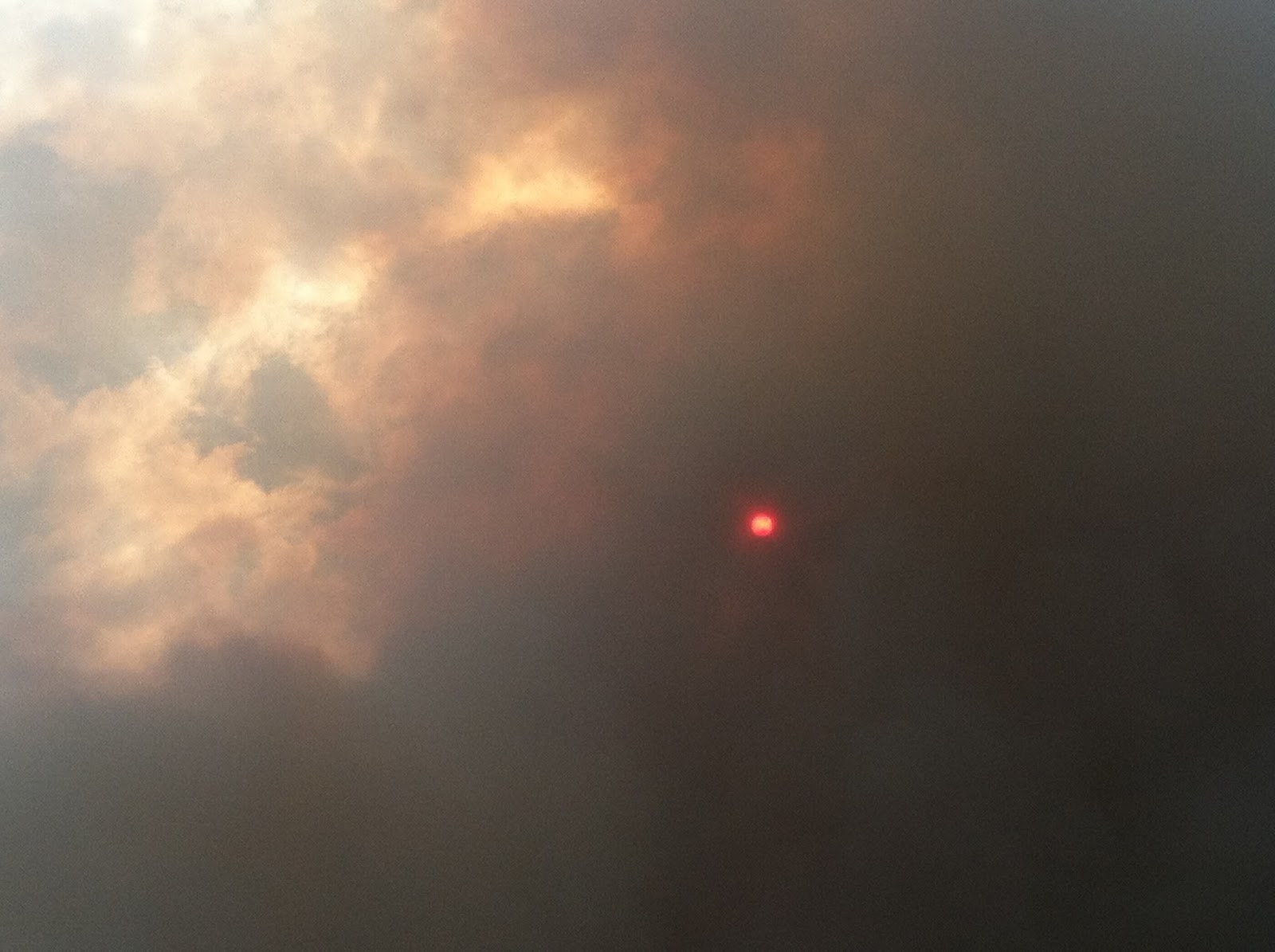
dragon eye of the sun
looks at the scorched earth -
wildfire 

Do charcoal hills scorched by wildfire make you think of the end of the world? Of return and rebirth, dust to dust, light into light? The sun is surreal, reduced by smoke to one, red eye... I lived through two wild wildfires in my Sunland neighborhood, the Station Fire of 2009 that burned down most of Los Angeles National Forest and surrounded us in our little city on all sides, and the La Tuna Fire of 2017 that burned the Verdugo Hills and the peaks and canyons on both sides of the 210 freeway. Only four houses were destroyed this time ("only" - tell it to the four families that lost everything!) and no lives were taken. But still... the black bare slopes remain.


charcoal on the left
charcoal on the right -
210 after fire

It could have been much worse, if not for bravery and endless work of over 1,000 firemen from the entire Southern California region. When I went swimming on Monday, I ran into firemen from Santa Barbara, Santa Maria, Montecito, Lompoc...They came to the pool to have a shower. Maybe they were called late to tame down the ever growing monster, spreading in four directions at once, maybe they did not see much action, still they were there to protect us.


flames dance and scorch
firemen dance with water among them
our hearts dance to thank them

Their bravery and dedication is beyond doubt - but, in fact, expected. They are all owed our unbounded gratitude, fire after fire, year after year. They risk their lives to protect ours.

 What was the greatest surprise for me in the La Tuna Fire was the bravery of about ten ordinary citizens who instead of sheltering in their homes, opted to save the cultural gem of the foothills, the McGroarty Arts Center on the slopes adjoining to the area that first started burning and continued through Friday, Saturday and Sunday, with flareups on Monday. 

Willow Bosco and her mother Austina, McGroarty Board member, stayed at the Center overnight; Willow, a delicate young student, with remarkable strength handled the hose, soaking the Center's roof and walls, and all the nearby trees with water. Volunteer firefighter Bill Myers brought the extra long hoses and used them, working along with other volunteers, whom I met on Sunday afternoon, to soak burning trees on Saturday and ensure that all vegetation and ground were thoroughly wet to prevent further flareups on Sunday. The fire came down the hill and some trees in the park surrounding the Center burst into flames. We were perilously close to losing this cultural landmark, the home of the former poet laureate of California, John Steven McGroarty. The flareups were extinguished thanks to heroic efforts of Willow, Austina, Bill and many others whose names I did not get... 

Ray Yocum, ceramics teacher was a fireman for three days.

Willow Bosco took out fires with water


Ray Yocum and Willow Bosco rest after two long days of fire-fighting.

Bill Meyers and Michelle Ramage
he  says  he "only brought the hose"
she that "only came with food"


Austina and Willow Bosco
Austina says she did not do  it, just the neighbors
and her beautiful, brave daughter

they smile, relieved
after red-black days of fighting fires -
they saved the foothills' gem  

Thank you to the heroes and heroines of the McGroarty Arts Center! Willow and Austina Bosco, Ray Yocum, Michelle Ramage from the McGroarty Arts Center, and the MAC's neighbors: Bill Meyers, Kenny Webb, Ben Grupp, Will Meyers, Chris Hall, and Curtis Cunningham.

Where was I? In my pomegranate and rose garden, editing a book, looking at clouds of smoke, watching the helicopters flying above every minute, back and forth, with water for the fire, and packing my personal music and poetry archive. Lots of manuscripts, early prints, signed books, letters, the family photo archives of my parents. So many suitcase of paper.


red bird in the sky
brings blue water to red flames
for victory of blue 

Paper, not gold. My jewelry was stolen earlier, half of it, at least... along with my real camera, photo backup drive, family heirlooms, and more. For the whole week I was searching through, checking the losses, so the fire was not the threat that it seems to have been. Clothes and electronics can be replaced, but who will repaint an artwork that took Toti O'Brien 18 years to make? Square by square, drawn and embroidered, it came into being to adorn my wall...


Sweet Relief by Toti O'Brien and its author.

treasure on my wall
eighteen years in the making - 
sweet relief

Such is life in the foothills in dry, fire-prone California: waiting for the next wildfire, packing precious documents to be saved in case the flames come too close, hoping that this one and the next one will pass us by... And admiring the mountains, or rather the bare hills and canyons, covered with the velvet of green grass in the spring, with the velvet of gold grass in the rest of the year.

I wrote several poems about these mountains, and here's an older one. 


Mountain Watch

They are a bit vain, aren’t they
these mountains of ours, still young.
They like being washed by the rain,
making themselves pretty for sunset.
Wet soil turns into a mudbath 
for these giant beauties.

When they stretch and practice
their dance moves, our houses crumble.
Water jumps out of toilet bowls.
Aunt Rosie’s favorite crystal vase
shatters on the floor. The mountains
shake boulders out of their skirts,
lose weight. Rocks slide into our backyards.

We stand watch. We are ready.
Neighbor calls neighbor: “Are you OK?” 
A friend you did not know you had
stops by. The danger looms. 

In ancient Rome, guards had to hold
one hand up, with the finger on their lips
in a sign of silence, attention. I read
about it in a book, standing on my shelf,
in a crowded row of treasures
I hauled across the ocean, from the 
old country to an unknown world.
I’d hate losing them to mud.

When the mountains dress in red
robes of fire, to dance in the night
rites of destruction, sometimes 
it is too late for treasures. An old man 
lost a hundred years of memories, 
when his family heirlooms –
pictures, tchotchkes – burned to ashes. 
His life spared, he still cries for what
he cannot not bring back. 

We are lucky. Storms came and went. 
The neighbors lived, the houses survived.
We were ready: moved out, moved in, 
moved out, moved in, awakened 
at midnight, sheltered by the goodwill 
of unknown friends. We watched. 
The storms passed. This was a good year.
We will watch. The aging beauties 
will dance again.


(c) 2010 by Maja Trochimczyk
http://poetrylaurels.blogspot.com/2010/10/in-praise-awe-of-mountains.html


I did not write that many poems about the end of the world, though I've been fascinated with disaster movies for a while, especially 2012, showing how the fabric of this world may be rolled back and unrolled again, in a different configuration. There are ends of the world happening on this Earth all the time, at all times. Every day, every time someone dies, it is the end of this world for that one person. And, sometimes, almost the end of the world for the people around them. 


A purple anemone of mourning
life and death, hurricanes and earthquakes -
the spark, the heart, survives

And what about the hurricanes that flatten whole islands? Tsunamis that wash villages and cities away? Earthquakes that fold tall buildings into stacks of pancakes? Or crazy people shooting innocents to scare the rest of us into submission, into slavery?  Yes, there are plenty of the ends of the world every minute.


Elijah's End


And the curtains of fire opened. 
And God walks through.
And I fall on my knees
Struck down by the might
Of his presence.

And the ground under my feet
Roars and trembles.
And God is with me.

In awe, I do not dare to look
Into the laughing beauty of his eyes.
And the gale changes into a breeze.
And God speaks in a whisper,
Sweetly announcing
The end of the world as it was.

And the sun stops in its tracks.
And the world explodes.
Filled with love, so much love,
It could not bear existing
For one more minute.

— now it ends --
— now it blossoms --
— now it grows again --


(C) by Maja Trochimczyk. Published in Into Light, http://www.moonrisepress.com/into-light-by-maja-trochimczyk.html


Easter Apocalypsis

—After "The Discovery of Heaven" by Harry Mulisch


It is coming. The angels know.
They dwell in their Piranesi castles,
twisted spaces where outside
is inside. They are not indifferent.
Not too smart for their own good.
Not cruel. They don't tell us.

The end is coming, it is near.
Not death, mind you, not that
ugly spinster without its twin.
No. The end of the end. Finis.
The satin fabric of a wedding dress
trails behind the veiled beauty
as she glides towards her beloved.

The river's end tastes of salt
in its own mouth, opened widely
into the waves of the ocean.
Nothing we can do will stop it.
Just stretch your fingers,
let the water cool your skin.

Why resist? Heraclitus
dipped his toes in this river.
Shape-note singers praised it.
Saints dove in and swam around,
luxuriating in incandescent glories
that passed us by.

The end is coming, flowing
swiftly down the slopes.
Let's sit on the porch, doze off
in honeyed sunlight,
before it, too, disappears,
transfigured.

Let us believe there will be
light enough inside us
—that kindling of kindness,
a half-forgotten smile—
to keep us afloat in the final flood
coming, coming to erase the world
and remake it, anew,

bejeweled.


(C) By Maja Trochimczyk, published in The Scream Online http://www.thescreamonline.com/poetry/poetry7-4/trochimczyk.html


Tuesday, March 26, 2013

Norooz, Passover, and Easter - New Life and Fire

Flames and Embers by Maja Trochimczyk
Fire and Fire

Whoever invented Easter Bunny that lays Chocolate Eggs on the lawn was not thinking through the rather dismal consequences of this wild leap of imagination... No matter, children are happily looking for chocolate confection scattered on the lawns of American suburbia... Would the popular-culture Easter be more memorable and dramatic, instead of just plain silly, if it included jumping over the bonfires, like the Persian purification rituals held at night on the Spring Equinox? 
Night Flames Burning by Maja Trochimczyk
On March 20, 2013, Persians around the world, as well as inhabitants of many countries in South-East Asia celebrated the holiday of Persian New Year dating back to the time of Zoroaster, three thousand years ago. This time of new beginnings, new hope and plans for new future, is marked by a 13-day holiday, with intense celebrations held on the 
night of the Equinox, when the day and night are equal and day starts to become longer than night. Families gather around bonfires and those brave enough to do it, jump over the fire with a prayer, to leave the old worries and troubles behind and leave them to burn in the fire, and to take into the new year the vitality and brightness of flames. In 2010, the UNESCO recognized the holiday of "Novruz" ("New Day"), added to the List of Intangible Cultural Heritage of Humanity.

Night Flames by Maja TrochimczykThe purification by flame is also a vital part of the Passover Celebrations, commemorating an ancient event of Exodus, the liberation of the Jewish people from Egyptian slavery. Before the solemnities can begin, each household is thoroughly cleansed and purified of all leaven bread and bread crumbs. On the last night before Passover, a search is conducted by candlelight, and the leaven bread remnants are burned before the celebrations can begin.  The fermentation of the leaven breads is a symbol of the festering of old memories, obsessive thoughts, regrets and guilt that need to disappear. A new beginning and true freedom of heart are not possible without leaving behind the burden of the past. What better way than burning the remnants of old, or jumping over the fire?

Christian Easter also focuses on fire at night. The Easter Vigil begins from starting a huge bonfire outside of the church and from blessing of the fire and of the Paschal Candle, marked with symbols of Alpha and Omega, the beginning and the end, and with the symbols of the year that it will serve the faithful, its flame a symbol of the burning presence of Christ. The congregants gather in darkness, broken only with the single flame of the Paschal Candle. This light spreads as more candles are lit, from one person to the next, until the entire congregation is a sea of flickering candle-lights. This is one of the most effective symbolic rituals of the Church - the drawing of spiritual light from ancient Fire, the sharing of Light from one person to the next, in unbroken chain of the faithful, each protecting his or her little flame and sharing it with his/her neighbor. 


The dove descending breaks the air
With flame of incandescent terror
Of which the tongues declare
The one discharge from sin and error.
The only hope, or else despair
Lies in the choice of pyre or pyre-
To be redeemed from fire by fire.

Who then devised the torment? Love.
Love is the unfamiliar Name
Behind the hands that wove
The intolerable shirt of flame
Which human power cannot remove.
We only live, only suspire
Consumed by either fire or fire.

T. S. Eliot - Little Gidding, from Four Quartets

Listen to Eliot's own reading of Little Gidding (16 minutes)


My meditations on the Divine Fire led my thoughts along a less elevated path, starting from a parking lot at my son's school:


Incandescent (Via Positiva)

How gently and lovingly
You wake in my heart,
Where in secret you dwell alone ~
         ~ St. John of the Cross 
            The Living Flame of Love

The car was pulling out of the parking lot
When friends texted my son —
A sixteen-year-old, six-foot baby
"Is that your sister, or your mom?
She’s hot!" He looked at me
And waved at them, laughing.

Consumed by divine flames
I was not careful. I did not close
All doors, all windows.
Fire got in.

The Divine Pyromaniac
Set the world aflame
Filled me with fire
Infinite.

I’m a conflagration of grace.
The presence shines brightly,
Dissolves, liquefies, forges
A new being — one
With the One
Beyond.

Translucent blaze
Engulfs me, suffuses all
With one feeling
One thought —

Fire flows through my veins —
Brightness — Fire


(c) 2012 by Maja Trochimczyk
Reprinted from Meditations on Divine Names (Moonrise Press, 2012)


The Eggs of Easter


In Polish homes, the week before Easter is the week of Spring cleaning - washing windows, curtains, throwing out unnecessary things, sorting through the clutter. The cooking begins in earnest on Good Friday, that is the day of most solemn and dramatic celebrations in the Church and the most austere Lenten meals at home - pickled herring and potatoes... 


Easter Basket 2011 by Maja Trochimczyk

For the Slavic peoples, Easter food is all about eggs: colored beautiful dark red by cooking them in onion-skins, and scraping patterns with needles.  Ukrainians, Poles, Russians, Slovaks, Czechs, Slovenians, and Serbians all have their traditional patterns of decorating Easter eggs. Thus, the new beginnings of the spring have another, equally ancient symbol: the egg. The Romans started things "from the egg" - ab ovo...  

On Easter Saturday, before the solemnities of the Easter Vigil, Poles bring beautifully decorated baskets of food and eggs to be blessed and later shared at Easter brunch. My basket is decorated simply with fragrant orange blossoms from my garden. 


Orange Blossom Bee - by Maja Trochimczyk

Since I have not written yet any poems about Novruz (or Norooz), Passover, Easter, Easter eggs, or even Easter Bunnies, let me wish everyone a wonderful celebration of new hope, new beginnings and a personal renewal in serenity and joy this spring. I'll sweeten my wishes with a little confection of a poem about one of my most favorite desserts, zupa nic. My mother used to make this ice-cream substitute when there were no ice-cream stands anywhere and a line would form for the rare supply of real vanilla ice-cream at the grocery stores. We had to make do without, thus learning the virtue of ingenuity.


The Taste of the Sky

My mother's zupa nic - soup nothing
had puffy clouds of egg whites
floating in a yellow sea
of delight. I chased them
with my spoon that perfect summer.

I'm floating now
in thinning blue
of Technicolor sky
a meadow for
ten thousand cloud sheep
I cannot count while they
cast shadows
on tidy little gardens
of tidy little houses
of tidy little people

They go about their daily chores
folding sheets, baking bread,
I'm cooking up a storm
of dreams that will soon vanish
like clouds in my soup nothing

The Taste of the Sky- after Magritte, by Maja Trochimczyk
The Taste of the Sky - After Magritte, Digital collage by Maja Trochimczyk

What else? If you want to read more about Polish holiday food in poetry, my "mazurka" and "mushroom" poems are posted on the Village Poets Blog, in a report from the March 2012 "Bite Me" Art Exhibition at the McGroarty Arts Center in Tujunga. The Village Poets Poetry Reading held on March 16, 2013 also included poetry about food read by Dorothy Skiles, Marlene Hitt, Joe DeCenzo, Bryan Story, Alice Pero, and Rick Wilson (who read verse by Kathabela Wilson).

http://villagepoets.blogspot.com/2013/03/bite-me-art-exhibit-at-mcgroarty-arts.html

http://villagepoets.blogspot.com/2013/03/more-poetry-at-bite-me-art-exhibition.html

_____________________________________________

Photos of fire, Easter basket, orange blossoms, and yellow sky (C) by Maja Trochimczyk