Showing posts with label Heaven. Show all posts

Sunday, June 2, 2013

On Irony and Love Songs with Grapefruit and Pomegranate

Doves and grapefruit by Maja Trochimczyk

Some people… wrap themselves in a thick blanket of irony of sarcasm and greet every expression of sentiment or affection with a sneer. We’ve all seen our share of these tough guys and gals, who curse or ridicule every expression of what really matters. “How banal, how boring!” they say, when they hear a sweet love poem, like the one below (first published in the Emerging Urban Poets 2010 Calendar). I remember, I was like that, too, deeply wounded and hiding my pain under a mask of worldly indifference. There was no hope, no future, only the reward for work done in the present. All love declarations I heard were a gigantic lie. The Universe was wrong, all around me. We lived in Hell. Or so I thought.  In my new life vision the Hell part has been upgraded to the level of Purgatory, the place of atonement, relentless testing, endless life exams. Yet, there is hope, there is love, and there are glimpses of Heaven.


The concept of “irony” (from the Greek term εἰρωνεία eirōneía, “pretended ignorance”) is a great invention of romantic heroes, starting from Lord Byron, who protected their vulnerability with an armor of disaffection, finding themselves alienated from the whole world. It still is a useful literary device, but why is it wrong to be ironic in life? To spend your life so well armored, that no real emotion may pierce it? That’s exactly why. This separation from others, this distance, alienation, is the plunge of the soul into the emptiness of a spiritual void. Ugly things become possible: indifference, cruelty, unwillingness to help others, to care for anyone at all, but your own career goals or physical comfort. 

Grapefruit tree by Maja Trochimczyk

I was going to say I “hate” irony but that’s not true, I do not hate anything, nor anyone. I have pity instead. I consciously cultivate in myself an ability to be filled with love and compassion for everyone. (Do I fail in that? Of course, but it is not giving up that matters…) The moral choice of refusing to be ironic, in life or art, may have unpleasant consequences. Some “real” poets would think me silly, and my love poetry sappy and trite, as I happily write a next sweet line while listening to the rich mezzosoprano of Patsy Cline or Ella Fitzgerald, warm as liquid honey: “I’ll be loving you… always… with the love that’s true… always….” 

These words were once addressed to a real person, just as my encounter in the garden really happened… but I don’t think we need to know such details, to feel refreshed and nourished by love.

The bitter-sweet pink grapefruit and the baby pomegranates from my garden are a perfect illustration of our topic for today.


Pomegranate in May by Maja Trochimczyk

A Portrait in Brackets

               “… you promise eternity almost, from the embrace.”
                     Reiner Maria Rilke, The Second Elegy, Duino Elegies

I love every hair on your head
every wrinkle, the round scar
in the middle of your forehead
like Cain’s mark – you are
the chosen one, the untouchable

The little freckles on your nose
shine – endearing, childlike
It was supposed to be
summertime when they came
Here’s summer all the time, already

My love stirs for your full, half-open lips
waiting for my kisses, as I caress
the sharp contours of your cheeks –
I hold them in my cupped hands
looking straight into your eyes

There is no world
only us and the birdsong
at noon in my garden

I love the quiet confidence
of your fingers, skillful hands
like my father’s – solid, able
to fix things, take care of me

I touch your skin, tracing a line
down the nose, soft lips, and chin
I brush against the prickles
of your goatee, before reaching
a sweet spot on your neck

Below your shoulders, under
the smoothness of hard muscles
the bell of your heart welcomes me
The blood sings in your veins, love
surges towards me – I do I do I do

I rest my head on your chest
and listen to your heart
that beats and beats and never
stops playing the music 

© 2009 by Maja Trochimczyk. Published in 2010 Calendar, Emerging Urban Poets, Pasadena.

Stages in Life of a Pomegranate by Maja Trochimczyk


A Lesson for My Daughter


After a ruby-colored glass of Merlot
I told my daughter the secret of the Universe.
I solved it at noon, by the river

Questions, as I thought, do not matter
The right answers to life are “Yes”
And “I Love You”

If you build a circle of “Yes” all around
Affirming who you really are
You will be safe

If you say “I Love You” to everyone
near you –  very quietly, so they can’t hear
but you know

You will walk in a sphere of gladness
That no insult or curse
May pierce

You will find yourself hidden deeply
Where love blossoms, laughter bubbles
And joy overflows


© 2006 by Maja Trochimczyk 

____________________________________________________________

This article and two poems are published in the June issue of The Voice of the Village.

Photos from my garden - grapefruit and pomegranate.

Thursday, April 21, 2011

Easter Wishes and Awakenings

Who said that Easter is about pastel flowers, cute rabbits that lay eggs and are made of chocolate, and fluffy dresses with matching hats? Medieval sculptors, carving the emaciated body of Christ, covered with realistic wounds and blood droplets, had an entirely different vision. Mary of Magdalen had a vision, too: the gardener, she thought, but it was He, and she realized her mistake only when He said, "Noli me tangere..." - "Do not touch me..."

Our love wants to be physical, fluffy, tangible, warm, sensuous. It is very hard to imagine a different kind of love, something greater, unique and universal, human and divine, always the same and always new. The true colors of Easter are the intense reds of the blood spilled on the Cross; the intense purples of coagulated droplets and the sorrow of Good Friday, a day of absence; the dazzling gold shine of flames of a new fire during Easter Vigil; and the brilliance of Easter bells ringing, ringing up to Heaven on that astounding, joyous morning, when all, finally, is well, once for all.

Instead of Easter wishes this year, I wrote a poem about the end of the world. It is really Harry Mulisch's fault. He should not have written that novel about the Discovery of Heaven, which is, actually, about the Discovery of Hell - unseen and distant God takes His Commandments back from the unfaithful, sinful humanity, leaving the traitors to their chosen fate in the Kingdom of Satan. That's what Mulisch's imagined and convincingly described. In the novel, the astronomer who finally discovered Heaven is killed by angels with a meteorite, so he fails to share the secret.

His son becomes the new Messiah, finds the stone tablets, as blue as the lapis-lazuli of his eyes, and takes them up to Heaven, floating in the air, surrounded by a whirlwind of Hebrew letters detached from the holy precepts that were ignored and disobeyed for far too long.


Here's my "Easter Apocalypsis" illustrated, appropriately, with a fading, dying rose.

Easter Apocalypsis

~ After "The Discovery of Heaven" by Harry Mulisch

It is coming. The angels know.
They dwell in their Piranesi castles,
twisted spaces where outside
is inside. They are not indifferent.
Not too smart for their own good.
Not cruel. They don’t tell us.

The end is coming, it is near.
Not death, mind you, not that
Ugly spinster without its twin.
No. The end of the end. Finis.
The satin fabric of a wedding dress
Trails behind the steps of a beauty
Gliding towards her beloved.

The river’s end tastes of salt
In its own mouth, opened widely
Into the waves of the ocean. Nothing
we can do will stop it. Just stretch
Your tired fingers, let the water
Cool your skin.

Why resist? Heraclitus
Dipped his toes in this river.
Shape-note singers praised it.
Saints dove in and swam around,
Luxuriating in incandescent glories
That passed us by.

The end is coming,
Flowing down the slopes.
Let’s sit on the porch, doze off
In honeyed sunlight, before it
Disappears, transfigured.

Let us believe there will be
Light, enough light inside us
- That kindling of kindness,
A half-forgotten smile -
To keep us afloat in the final flood
Coming, coming to erase the world
And remake it, anew, bejeweled.


Now, it would not be fair to all the chocolate lovers out there, if my Easter wishes were limited to this brief vision of the end of the end, a cosmic catastrophe that we will survive only if we allow ourselves to focus on the unbearable lightness of being, the heart of the heart. That happens when we awaken from non-being to an awareness that only what's within truly lasts, that the least tangible of our possessions - a fleeting moment of kindness, a gesture of compassion and comfort - is an eternal treasure, a sapphire hidden in ashes and dust.

I found a treasure this year, I found a friend. I also found a poem in a painting by another friend - a painting I like so much I would love to find myself inside it. Susan Dobay, a Hungarian artist is both spiritual and earthly, a hostess who laughs with her guests and feeds them regional specialties, but scolds them for being too loud when a poet reads something she'd like everyone to pay attention to (even if she is sometimes too busy making sure they listen, to do it herself).


Awakenings

~ after a painting “City Whispers” by Susan Dobay

First to wake: the maple tree.
Up and up, sprouting from a seedling.
With a crown of burnished gold, white
diamond crystals for winter –
It slept through blizzards to flourish
dressed in pinks and celadons.

Second awake: the girl.
Watching the trees from her bed
Or her wheelchair. She cannot go far
Into the streets, filled with noise.
Protected by smooth glass panes
She sees the buds on each twig
Fill out until they burst
Into carmine, wrinkled bows
Small and shiny, maturing
As they change into the green.

The third: a robin calling out
To his friends, dispelling darkness
With his shrill fluted motives.
The spring is woven from his calls,
Warmed up in red feathers on his chest.
He came late to scratch the ground
For a worm to peck, a beetle.
The looping birdsong measures
The coming of days. It floats up and up,
Above the rooftops.

The girl touches her curly blond hair
Growing longer, straighter
As the nurse braids it each morning.
The life, the light, she wishes
For this power to come in.
Make her walk, yes, make her walk.
She stretches up and up.
Outside, city whispers.

It was a distinct pleasure to read this poem while being accompanied on a flute by Rick Wilson: his music rose up and up in the middle two stanzas, appearing after a silence and allowing the tranquility of the sick girl's room to speak for itself at the end. In some way, it was my best reading with music. Rick was truly inspired. Susan Dobay and Mira Mataric said they identified with that handicapped girl, whose longing for wholeness and health is our longing, at other times expressed in the search for perfectly decorated chocolate eggs, tulips and the new spring dress for Easter.

In Poland, we used to say "Wesolego Jajka!" as if an Egg could actually be Joyous. Maybe we have to return "ab ovo" - to the beginning and start anew, with a rediscovered capacity to experience real joy? Before God takes his Commandments back and leaves us all to the dreadful fate of non-existence, without the source of all being? You know, that one: Beauty, Goodness, Truth.

Let the Easter bells ring, ring, and ring.

Alleluia! Pangue lingua gloriosi...


Pangue lingua sung by Coro de Cámara Abadía

___________________________________________________

Illustrations:


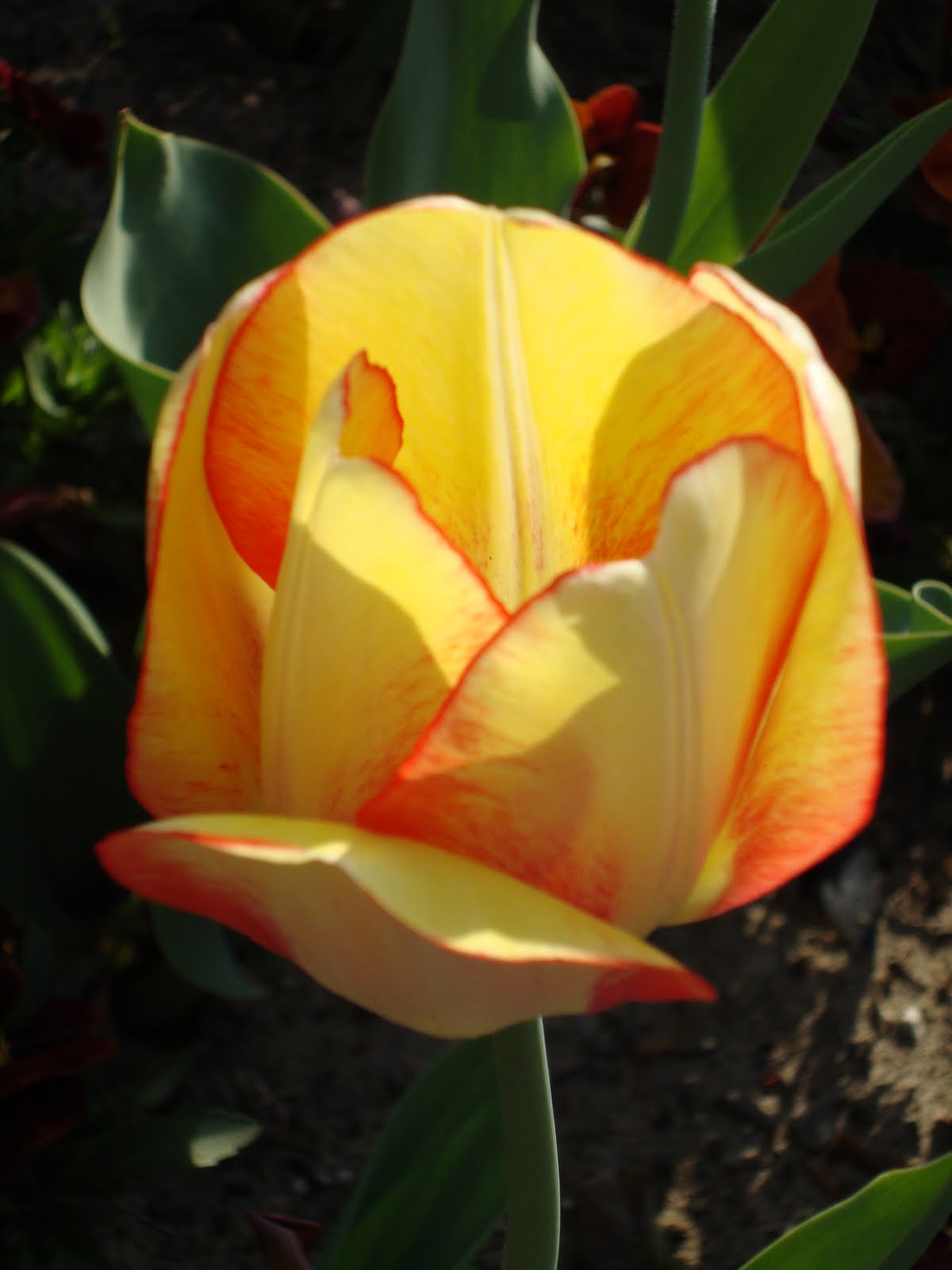
Photographs of flowers (C) 2010 by Maja Trochimczyk

Susan Dobay's Painting "City Whispers" - the poem "Awakenings" is a part of Kath Abela Wilson's poetry book project dedicated to the art of Susan Dobay.

Two recordings of bells from Il Duomo (Cathedral Santa Maria del Fiore) in Florence, Italy. From YouTube.com.