Showing posts with label poetry about music. Show all posts

Tuesday, January 9, 2018

The Music of Paderewski and Gorecki in Washington, D.C.

Photo by Marcin Szerle.

In early January 2018, I was honored by an invitation to present two Polish composers at the 75th Annual Meeting of the Polish American Historical Association. At the Awards Ceremony held on January 6, 2018 at the Residence of the Ambassador of Poland, Prof. Piotr Wilczek, I discussed "Poland 1918-2018: Remembering Ignacy Jan Paderewski" and quoted many poems written for the great pianist composer. The full text of this speech is reproduced on my Chopin with Cherries blog, so there is no reason to reproduce the whole here.

Vintage postcard of "Improwizacya" - Paderewski playing Chopin. early 1900s.

During, the reading, I was accompanied by Paderewski himself, from a CD of piano roll recordings, played on a modern Steinway, and professionally recorded. The Minuet, Melodie, Legende, and Nocturne written by Paderewski were followed by two Rhapsodies by Franz Liszt, and provided the shifting moods for the recitation of lofty and ardent poems (though a bit old-fashioned to modern ears) written by luminaries of  American culture.

To decorate the stage for my Paderewski and Poland's presentation, I unrolled two piano rolls by Paderewski, one with his portrait and a copy of his signature - and fixed them in place with a box of vintage Paderewski postcards, chocolate gold coins, and some jewels. This was to symbolize the multiple types of "gold" associated with the pianist of "gold-red" hair... and riches collected through his music and given away to charitable and patriotic causes... The piano rolls are very original stage decoration... and you can find lots of them on eBay!


Paderewski piano rolls and vintage postcards- stage setting for the poetry presentation.

 How Paderewski Plays 
by Richard Watson Gilder (1906)


I.
If words were perfume, color, wild desire;
If poet's song were fire
That burned to blood in purple-pulsing veins;
If with a bird-like trill the moments throbbed to hours;
If summer's rains
Turned drop by drop to shy, sweet, maiden flowers;
If God made flowers with light and music in them,
And saddened hearts could win them;
If loosened petals touched the ground
With a caressing sound;
If love's eyes uttered word
No listening lover e'er before had heard;
If silent thoughts spake with a bugle's voice;
If flame passed into song and cried, "Rejoice, rejoice!"
If words could picture life's hopes, heaven's eclipse
When the last kiss has fallen on dying eyes and lips;
If all of mortal woe
Struck on one heart with breathless blow by blow;
If melody were tears and tears were starry gleams
That shone in evening's amethystine dreams;
Ah, yes, if notes were stars, each star a different hue,
Trembling to earth in dew;
Or, of the boreal pulsings, rose and white,
Made majestic music in the night;
If all the orbs lost in the light of day
In the deep silent blue began their harps to play;
And when, in frightening skies the lightnings flashed
And storm-clouds crashed,
If every stroke of light and sound were excess of beauty;
If human syllables could e'er refashion
that fierce electric passion;
If ever art could image (as were the poet's duty)
The grieving, and the rapture, and the thunder
Of that keen hour of wonder, -
That light as if of heaven, that blackness as of hell, -
How Paderewski Plays than might I dare to tell.


II.
How the great master played! And was it he
Or some disembodied spirit which had rushed
From silence into singing; and had crushed
Into one startled hour a life's felicity,
And highest bliss of knowledge—that all life, grief, wrong,
Turn at the last to beauty and to song!
Paderewski's contacts with Richard Watson Gilder (1844-1909) resulted from the latter's long-lasting friendship with the Polish actress Helena Modrzejewska. Gilder, the editor of the Century Magazine, published numerous volumes of poetry and that many of his poems dealt with other arts, painting, acting, and music.  The Polish pianist became a good friend of the poet, considering Gilder's house to be his "real home during those first years in America." There, Paderewski had the opportunity to meet Mark Twain and Andrew Carnegie, among other members of American society. Gilder was also among the first Americans creating the myth of the Archangel Paderewski, a spiritual genius.


For some reason, I have not been able to write anything about Paderewski. I think I have been angry with him for destroying his compositional talent and career to serve a political cause, of restoring Poland's sovereignty. Finally, urged by my colleagues at PAHA, I penned a short ditty:


Maja Trochimczyk recites Paderewski-themed poetry, Photo by Marcin Szerle.
Residence of the Ambassador of Poland, Prof. Wilczek, January 6, 2018.


Paderewski in Gold
 by Maja Trochimczyk (2018)

Gold halo of curls on his portraits
Gold crowns of Polish kings above his keyboard
Gold riches in his bank account
Gold heart beneath it all
 
The gleam of a gold ring on his finger
The gleam of brilliance in his eyes
The gleam of fame bright around him
Gold heart beneath it all

The dream of making music in his youth 
The dream of happiness at his prime
The dream of free Poland on concert stages
Gold heart beneath it all

Made of gold, making gold, pure gold
of  kindness - Paderewski  the immortal 
asks us to love music, love Poland 
and to always follow his noble path of gold
January 6, 2018
(c) 2018 by Maja Trochimczyk


Maja Trochimczyk reciting Paderewski-themed poems, photo by Marcin Szerle.
Residence of Poland's Ambassador, Prof. Wilczek, Washington, D.C. January 6, 2018.


My second presentation was a paper on "The Myth of the Third Symphony: Gorecki in California" presented on January 5, 2018 during a PAHA session on Americans on Poland. I I discuss this presentation and my "Gorecki in Context" book on the Moonrise Press Blog.

Photo by Marcin Szerle

The presentation focused on the performance history of the Third Symphony Symphony of Sorrowful Songs (composed in 1976, world-famous since the Nonesuch recording of 1992, and conducted by Gorecki himself in Los Angeles).  The author organized his visit and ensured that the composer, who was not thrilled about metropolitan performances, but rather interested in small-town ambience of "ordinary people" was comfortable and able to express his unique musical vision.  Among other aspects of the Third Symphony, its use of the lullaby as an expressive and melodic model was pointed out and illustrated by singing the Polish lullabies. 

The lullabies are characterized with limited melodic outlines, reduced to three or two notes, slow repeated motion, that may be associated with rocking a baby to sleep. The step-wise semitonal motion in Bzi-bzi-bzibziana is cited in the strings in the opening of the Third Movement of the Third Symphony. It is the same rocking motion that underlies the movement of trauma victims, calming themselves by rocking back and forth, to recover from shock by returning to the state of ultimate comfort, being held in the mother's arms. The same slow, steady motion is of walking in a funeral procession - these associations co-exist in a unique way drawing from universal human archetypes, to form a music that appeals to everyone, everywhere... 

Photo by Marcin Szerle


Thursday, December 17, 2015

On Polish Christmas in the Notre Dame Cathedral,and Ladies, and Cherries, and Music Boxes


The Cathedral floats up 
above  my leopard prints and faux fur
its stones polished by time 

There was a surprise waiting for me at the Notre Dame Cathedral in Paris this November. After I waited in a long line in the rain, with colorful umbrellas and a watchful eye of fatigue-clad soldiers with machine guns, the clock struck one: https://www.youtube.com/watch?v=1gPa4eWk8Sg (read about it in the previous post, Thanksgiving in Paris).


Then, inside the stone monument defying the passage of time, I saw the stained glass windows, the breathtaking heights of the main nave.  I walked around and listened to the music, swirling beneath blues and reds of the stained-glass windows: I heard the Kyrie Eleison, Christ Have Mercy, Lord Have Mercy: https://youtu.be/2ZsOBsT-pwo


Finally, a  medieval Alleluia filled the air.... I walked around the back of the main nave, from one stained-glass window chapel to the next.


Why "stained"-glass?
There are no stains on the rubies and cobalts
of Notre Dame air


Is the twirling ribbon
of stone embroidered with more finesse
than the lead-framed glass?

See more pictures on the Picasa Web Album:

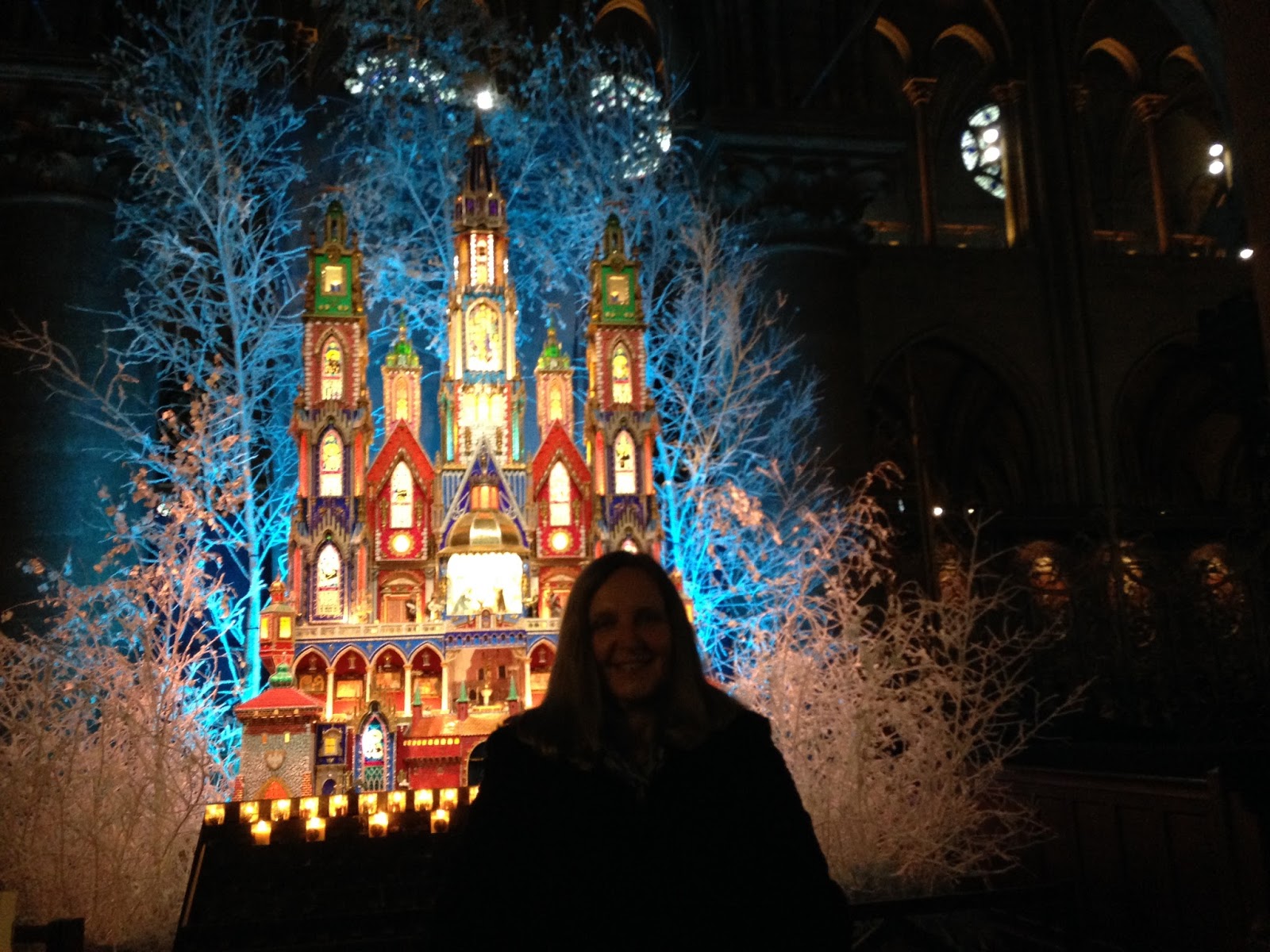
And here it was, my delightful surprise. A tinfoil and paper monument of massive proportions: Szopka Krakowska, the Nativity Scene in a fantastic scenery of multi-towered Castle or Gothic Cathedral as envisioned by folk artists from Krakow, Poland.  The minuscule Nativity scene in the heart of the building, surrounded by Polish folk dancers, and characters from folk tales. Pan Twardowski on his rooster, flying to the moon... Angels, three Kings, everyone...


I find Poland in Paris
bright tinfoil towers of a Nativity Scene 
among the grey stones of Notre Dame

I was in Paris for a reason: to read a paper, research, talk... (my Szymanowska Conference Report is on the Chopin with Cherries Blog). At end of the 3rd International Symposium "Maria Szymanowska and Her TIes" was the closing salon, "An Invitation to the Dance," I read poetry by 19th century Polish poets, and verse of my own. I loved being accompanied by improvisations of extraordinary pianist, Edoardo Torbianelli, who has music spilling from under his fingers. I was going to say: from his sleeves, but he rolls them up tightly, so that nothing can spill....


https://www.youtube.com/watch?v=5AlQMa9NlEo. Poetry Reading at the Salon "Invitation to the Dance" at the close of the Maria Szymanowska Conference in Paris, November 27, 2015. Edoardo Torbianelli improvises on Johann Alois Graff pianoforte from 1825 and I read my poem "A Study with Cherries" in Polish, from the Chopin with Cherries Anthology (2010).  Recorded by Alicja Bialek-Guillemette.

Here are the words, in English and Polish:

"A Study with Cherries"

          After Etude in C Major, Op. 10, No. 1 and the cherry orchard
                of my grandparents, StanisÅ‚aw and Maria Wajszczuk

I want a cherry,
a rich, sweet cherry
to sprinkle its dark notes
on my skin, like rainy preludes
drizzling through the air.

Followed by the echoes
of the piano, I climb
a cherry tree to find rest
between fragile branches
and relish the red perfection –
morning cherry music.

Satiated, sleepy,
I hide in the dusty attic.
I crack open the shell
of a walnut to peel
the bitter skin off,
revealing white flesh –
a study in C Major.

Tasted in reverie,
the harmonies seep
through light-filled cracks
between weathered beams
in Grandma’s daily ritual
of Chopin at noon.
_________________________________________

in Polish translation by Maja Trochimczyk

"Etiuda z Czereśniami"

 Inspiracja Etiuda C-Dur, Op. 10, No. 1 i wisniowym sadem mojego dziadka i babci, StanisÅ‚awa i Marianny Wajszczuk

A ja chcę czereśnie
Słodziutkie czereśnie
Chce poczuć ciemne nuty soku
Na mojej skórze
Jak krople deszczowego preludium
W mżawce poranka

W obłoku fortepianu
Wspinam się na czereśnię
Szukam ukojenia wśród kruchych gałęzi
Cieszę się doskonałością czerwieni
Czereśniową muzyką od samego rana

Nasycona, śpiąca
Chowam się w ciemnościach strychu
By łupać orzechy, obierać gorzką skórkę
Odsłaniać biały miąższ
Studium w tonacji C-dur

SmakujÄ™ marzenia
Akordy płyną przez szpary
Starych belek wypełnione światłem

To codzienny rytuał mojej Babuni
Popołudnie z Chopinem

(c) 2010 by Maja Trochimczyk

English version published in Chopin with Cherries: A Tribute in Verse (Moonrise Press, 2010)

Photo by Alicia Bialek-Guillemette

I also read 19th century poems  written to Maria Szymanowska by Count Henryk Rzewuski (A Menu of her Dinner) and Julian Ursyn Niemcewicz (Praise of Szymanowska's Talent).  I read them in Polish with a summary in English. The first one was quite funny, a full humorous menu, the second properly laudatory.  Here they are: https://www.youtube.com/edit?video_id=g7NnuFrBtDQ

And, of course, at the end, I read my poem inspired by Leonardo da Vinci's "The Lady with an Ermine" and the theme poem for the salon, "An Invitation to the Dance" -  a lovely trifle, written in the form of a dialogue, on the  intertwined themes of love and dancing...

https://www.youtube.com/watch?v=TI-LHJYgwbk


Below are the texts of the two poems recited at the Salon, the closing event of the 3e Maria Szymanowska Colloque, in Paris at the Academie Polonaise de Sciences, on November 27, 2015. I am accompanied on Johann Alois Graff pianoforte by Edoardo Torbianelli,who improvised renaissance style music for the Leonardo poem, and some sweet arpeggios for the Dance poem. Recorded by Alicja Bialek-Guillemette on November 27, 2015.

The Lady With An Ermine

~ after Leonardo da Vinci's portrait of Cecilia Gallerani, in the Czartoryski Museum in Krakow

Her eyes follow me around the room
with that secretive smile she shares
with her famous cousin.

Filled with the knowledge of what was, what will be
she slowly caresses the smooth warm ermine fur.

"Tesoro, amore mio, sii tranquillo, ti amo"

Leonardo’s brush made a space for her to inhabit,
a grey-blue sky painted black much later –
she was pregnant, her son – a Sforza bastard,
the white ermine - the emblem of her Duke.

Sheltered by Polish royalty, she revealed
her charms only to their closest confidantes.
In 1830, exiled in a precious wood box, to Paris,
In 1919, returned to taste the Polish freedom.

"Amore mio, sii tranquillo, ti amo"

In 1939, hidden again, found by the Nazis
for Hitler’s last dream, the Linz Führermuseum,
Art among red flags and swastikas, flourishing
in the dark cavern of his mind. Never built.

Berlin, occupied Krakow, Governor Frank's
hunting lodge, Bavaria. The Red Army's closing in.
Train tracks. Crisp winter air. American soldiers,
The cameras of Monument Men.

"Sii tranquillo, ti amo"

Back home in Krakow, she is safe
in the recess of a museum wall. Under a muted spotlight,
Children play a game:Walk briskly from right to left,
don’t let your eyes leave her eyes, see how she is watching you.

Her eyes follow me around the room
Filled with the knowledge of what was, what will be
she slowly caresses the smooth warm ermine fur.
She knows that I know that she knows.

"Amore mio, ti amo"

_________________

* Tesoro, amore mio, sii tranquillo, ti amo" - fragment of a love letter in Italian, "Sweetheart, my love, be  quiet, I love you"

(c) 2015 by Maja Trochimczyk


Leonardo da Vinci, The Lady with an Ermine


An Invitation To The Dance

And the angels are dancing.

Did you say dancing? Yes, dancing. Making somersaults
and jumping two hundred yards in the air.

Air? Are they here? I thought they lived in infinity,
Or eternity, or the great beyond, or whatchamacalit.
No. Here. They are laughing their heads off.  Giggling,
smiling, smirking, guffawing. Laughing.

What’s so funny? Nic. Nada. Naught.
It is just that they are so happy.
So incredibly,  exorbitantly, blissfully happy.

Why?  Oh, because of that quirky thing
from the country song.

What thing? Don’t you know? Have you not heard
that love conquers all?  That love triumphs
over lies, fear, anger, shame and despair?
That it is? Love is. True love. Our love…

It blossoms in us, through us.
It opens its petals.  The world is more tranquil,
serene in the luminescence of our love.

New stars are born and cherries are sweeter when we
are together, immersed in this love. When we
find it. Return to it. Share it. Cherish it. When we
are not giving up. No matter what. No matter how hard.
No matter how late.  It is soo simple, very simple.

Impossible? Yet, it is here to stay.

So what about these angels, then…
Oh, yes. Would you like to go dancing with the angels?
 Boogie-woogie, waltz, tango or salsa?

(c) 2015 by Maja Trochimczyk

With Szopka krakowska in the Notre Dame Cathedral, Paris

After coming back home, it was time for Christmas and New Year Wishes. I picked a rose, beautiful striped antique one, Rosa Mundi, the Rose of the World that grows in my beloved Descanso Gardens in La Canada. With a green background it was exactly what I needed. Forget medieval cathedrals... here's something real, something that grows:


With the snow and all white
Without the snow and all green
With lights and garlands and spice
May your holidays shine from within!

Happy New Year 2016!


But the stanza I wrote sounded trite and tired to my ears, so unaccustomed to rhyming. Where did this silly rhyme come from?

On a sunny afternoon, I went shopping to my favorite thrift store and found a bunch of music boxes, playing English carols, more or less out of tune. I picked the best ones to add to my ever - growing collection.  Silent night, A little drummer boy, Saint Nick... I thought of the previous owners, who died and left their treasures unattended, waiting to be rescued from the pile of old teddy bears, and damaged Santas. Was it a warm-hearted, cookie-baking Grandma? Was it a lonely, sentimental spinster? Are there still spinsters (what an ugly word!) in 2015?

Time for another Christmas poem, then, this one with music boxes and memories of happy childhood, from one generation to the next...

A Santa music box - snow globe  with toy bird whistles from Poland.
.

A Music Box Christmas

I wind the spring on the music box
Silvery specks swirl in the snow globe

The twinkling of “We Wish You a Merry Christmas”
Fills the air. Santa on the rooftop falls into the chimney.
Are you ready for the holidays?  With Scottish whisky cake
Polish makowiec, or American apple pie? Will you cook
Tamales on Christmas Eve, your family gathered
Around steaming pots, laughter mixed with hearty flavors?
Will you roast turkey with fixings on Christmas? Will you
Nibble slices of chocolate oranges, after unwrapping gifts?
Taste walnuts and sesame snaps from your stockings?

I wind the spring on the music box
Silvery specks swirl in the snow globe
Memories of home swirl before me

Sparkling lights shine in the colored tinfoil of Szopka Krakowska,
Its fantastic church towers rise in their Gothic splendor
Above a Nativity Scene and figurines from Polish folk tales.
I make cranberry sauce with diced pears and apples
The way my Mom taught me. Do I still know how
To chop figs and dates into finely-ground poppy seeds
Boiled in milk, re-fried with honey? The favorite flavors
Float away with OgiÅ„ski’s polonaise, Farewell to the Homeland.
Under the blazing California Sun, I taste the exotic desserts
Of Poland’s eastern borderlands, where cultures mixed
And worlds mingled – Poles, Lithuanians, Tartars, Jews –
Cornflower blue skies and shimmering gold of rye fields.

I wind the spring on the music box
Silvery specks swirl in the snow globe
I make a promise to myself

This Christmas, I’ll read a novel, wrapped in a plush blanket
And a Santa hat. I will walk alone in the park, come back
To the empty house and watch The Lord of the Rings,
The epic battles of the elements, good versus evil,
Good versus evil  - twirling and waltzing like the silvery
specks in my Santa snow globe. I will sing along “We Wish
You a Merry Christmas” and remember a Nativity Play
With my daughter - an angel waving a green pine bough
Singing in a sweet chorus of children’s voices:
“We swish you a Merry Christmas and a Happy New Year!”

© 2015 by Maja Trochimczyk

Szopka Krakowska with toy bird-whistles from Krakow, Poland, 
on my mantelpiece in California.


Saturday, November 12, 2011

On Szymanowska's Satin Slippers

I went to Paris in September, came back changed in October. An astounding city, full of history and charm. My purpose was to talk about Maria Szymanowska and visit and photograph places associated with Chopin. I found his grave and put a poem from "Chopin with Cherries" there. I went to the church where his Funeral Mass was held, with Mozart's Requiem (St. Madeleine) and I wondered about his empty chair and white evening gloves at the Bibliotheque Polonaise near the Notre Dame Cathedral.

The purpose of my trip was to give a paper about Maria Szymanowska, a Polish virtuoso composer-pianist, who preceded and inspired Chopin with her brilliant style, etudes, mazurkas and songs... Szymanowska (1789-1831) died young, too; Chopin was 39 when tuberculosis finally defeated him. Szymanowska - at 42 - went quickly, of cholera in St. Petersburg. But first she managed to enchant Goethe, who wrote for her a poem entitled "An Madame Marie Szymanowska (Aussohnung)." Known as "Aussohnung" (Reconciliation) it was included in the Trilogie der Leidenshaft, inspired by the sixty-year-old poet's tragic infatuation with a young girl, Ulrike. Szymanowska's music, her empathy and beauty helped the aging poet return to his senses. (I write about recent research into her life and work discussed at the Maria Szymanowska Colloque in Paris in my "Chopin with Cherries" blog).

At the conference, I presented the first version of my poem about Szymanowska. After making some changes, I read it for the workshop of Westside Women Writers group and I received comments from Millicent Borges Accardi, Kathi Stafford, Georgia Jones-Davis and Sonya Sabanac. Here's the third version of this work in progress. I want to capture her life as I see it - she was dazzling, inspiring, enchanting, and disappeared all too quickly.


The Shooting Star

Reflections on Maria Szymanowska (1789-1831)

“He brought a horse to her bed, that’s why” – they said.
“No, he did not let her play. She left…”
“Not the only one, mind you.”
Rossini wrote: “Madam,
I equally adore your modesty and talent.”
“At least she was a mother – that redeemed her.
Three children, two daughters, that sort of thing.”
“Did she love them? Was she doting?”
“Didn't she leave them for three years
To play her music?”

“Did she travel alone?” Always with her sister –
Paris, London, Dresden, Marienbad.
Devastated by Ulrike’s youthful charms,
Goethe found comfort in Maria’s nocturnes,
Reconciliation in the kindness of her voice.
He saw Das Ewig Weiblich.
He wrote Die Aussöhnung.

A Roman Goddess?
Wearing the latest London fashions?
She was the Queen of Tones for Mickiewicz,
the Polish bard. A friend of Prince Vyazemsky.
The Court Pianist of the Tsarinas.
A Warsaw brewer’s daughter,
She rose to royal heights,
Shining with the brilliance of her art.

She was elegant, refined
In her pristine muslin gowns,
With sleek belts and jewels.
Her satin slippers dared to
Outlive her by two hundred years.
They sit on a shelf, laughing.
She’s gone. Her daughters,
orphaned in a fortnight of cholera,
Are gone, too. So are
Their daughters’ daughters.

What remains of this dazzling life?
A gold bracelet with a cut sapphire?
A handful of songs, etudes and dances
Scattered along the way? Sweet melodies
Frozen in the air above vast plains
Of snow drifts and tundra?
The sparks of a shooting star
Falling across our dark winter sky?


________________________________


Lithograph based on a portrait by Maria Szymanowska by Jozef Oleszkiewicz, 1825. Framed print from the collection of Bibliotheque Polonaise in Paris.

Maria Szymanowska's satin evening slippers and an image of Warsaw's Grand Theater of Opera and Ballet. Paris, Bibliotheque Polonaise.

Portrait of Maria Szymanowska by Aleksander Kokular, Rome, 1825. Copy, original in the collection of the Adam Mickiewicz Museum of Literature, in Warsaw, Poland.