Showing posts with label Leonardo. Show all posts

Thursday, December 17, 2015

On Polish Christmas in the Notre Dame Cathedral,and Ladies, and Cherries, and Music Boxes


The Cathedral floats up 
above  my leopard prints and faux fur
its stones polished by time 

There was a surprise waiting for me at the Notre Dame Cathedral in Paris this November. After I waited in a long line in the rain, with colorful umbrellas and a watchful eye of fatigue-clad soldiers with machine guns, the clock struck one: https://www.youtube.com/watch?v=1gPa4eWk8Sg (read about it in the previous post, Thanksgiving in Paris).


Then, inside the stone monument defying the passage of time, I saw the stained glass windows, the breathtaking heights of the main nave.  I walked around and listened to the music, swirling beneath blues and reds of the stained-glass windows: I heard the Kyrie Eleison, Christ Have Mercy, Lord Have Mercy: https://youtu.be/2ZsOBsT-pwo


Finally, a  medieval Alleluia filled the air.... I walked around the back of the main nave, from one stained-glass window chapel to the next.


Why "stained"-glass?
There are no stains on the rubies and cobalts
of Notre Dame air


Is the twirling ribbon
of stone embroidered with more finesse
than the lead-framed glass?

See more pictures on the Picasa Web Album:

And here it was, my delightful surprise. A tinfoil and paper monument of massive proportions: Szopka Krakowska, the Nativity Scene in a fantastic scenery of multi-towered Castle or Gothic Cathedral as envisioned by folk artists from Krakow, Poland.  The minuscule Nativity scene in the heart of the building, surrounded by Polish folk dancers, and characters from folk tales. Pan Twardowski on his rooster, flying to the moon... Angels, three Kings, everyone...


I find Poland in Paris
bright tinfoil towers of a Nativity Scene 
among the grey stones of Notre Dame

I was in Paris for a reason: to read a paper, research, talk... (my Szymanowska Conference Report is on the Chopin with Cherries Blog). At end of the 3rd International Symposium "Maria Szymanowska and Her TIes" was the closing salon, "An Invitation to the Dance," I read poetry by 19th century Polish poets, and verse of my own. I loved being accompanied by improvisations of extraordinary pianist, Edoardo Torbianelli, who has music spilling from under his fingers. I was going to say: from his sleeves, but he rolls them up tightly, so that nothing can spill....


https://www.youtube.com/watch?v=5AlQMa9NlEo. Poetry Reading at the Salon "Invitation to the Dance" at the close of the Maria Szymanowska Conference in Paris, November 27, 2015. Edoardo Torbianelli improvises on Johann Alois Graff pianoforte from 1825 and I read my poem "A Study with Cherries" in Polish, from the Chopin with Cherries Anthology (2010).  Recorded by Alicja Bialek-Guillemette.

Here are the words, in English and Polish:

"A Study with Cherries"

          After Etude in C Major, Op. 10, No. 1 and the cherry orchard
                of my grandparents, Stanisław and Maria Wajszczuk

I want a cherry,
a rich, sweet cherry
to sprinkle its dark notes
on my skin, like rainy preludes
drizzling through the air.

Followed by the echoes
of the piano, I climb
a cherry tree to find rest
between fragile branches
and relish the red perfection –
morning cherry music.

Satiated, sleepy,
I hide in the dusty attic.
I crack open the shell
of a walnut to peel
the bitter skin off,
revealing white flesh –
a study in C Major.

Tasted in reverie,
the harmonies seep
through light-filled cracks
between weathered beams
in Grandma’s daily ritual
of Chopin at noon.
_________________________________________

in Polish translation by Maja Trochimczyk

"Etiuda z Czereśniami"

 Inspiracja Etiuda C-Dur, Op. 10, No. 1 i wisniowym sadem mojego dziadka i babci, Stanisława i Marianny Wajszczuk

A ja chcę czereśnie
Słodziutkie czereśnie
Chce poczuć ciemne nuty soku
Na mojej skórze
Jak krople deszczowego preludium
W mżawce poranka

W obłoku fortepianu
Wspinam się na czereśnię
Szukam ukojenia wśród kruchych gałęzi
Cieszę się doskonałością czerwieni
Czereśniową muzyką od samego rana

Nasycona, śpiąca
Chowam się w ciemnościach strychu
By łupać orzechy, obierać gorzką skórkę
Odsłaniać biały miąższ
Studium w tonacji C-dur

Smakuję marzenia
Akordy płyną przez szpary
Starych belek wypełnione światłem

To codzienny rytuał mojej Babuni
Popołudnie z Chopinem

(c) 2010 by Maja Trochimczyk

English version published in Chopin with Cherries: A Tribute in Verse (Moonrise Press, 2010)

Photo by Alicia Bialek-Guillemette

I also read 19th century poems  written to Maria Szymanowska by Count Henryk Rzewuski (A Menu of her Dinner) and Julian Ursyn Niemcewicz (Praise of Szymanowska's Talent).  I read them in Polish with a summary in English. The first one was quite funny, a full humorous menu, the second properly laudatory.  Here they are: https://www.youtube.com/edit?video_id=g7NnuFrBtDQ

And, of course, at the end, I read my poem inspired by Leonardo da Vinci's "The Lady with an Ermine" and the theme poem for the salon, "An Invitation to the Dance" -  a lovely trifle, written in the form of a dialogue, on the  intertwined themes of love and dancing...

https://www.youtube.com/watch?v=TI-LHJYgwbk


Below are the texts of the two poems recited at the Salon, the closing event of the 3e Maria Szymanowska Colloque, in Paris at the Academie Polonaise de Sciences, on November 27, 2015. I am accompanied on Johann Alois Graff pianoforte by Edoardo Torbianelli,who improvised renaissance style music for the Leonardo poem, and some sweet arpeggios for the Dance poem. Recorded by Alicja Bialek-Guillemette on November 27, 2015.

The Lady With An Ermine

~ after Leonardo da Vinci's portrait of Cecilia Gallerani, in the Czartoryski Museum in Krakow

Her eyes follow me around the room
with that secretive smile she shares
with her famous cousin.

Filled with the knowledge of what was, what will be
she slowly caresses the smooth warm ermine fur.

"Tesoro, amore mio, sii tranquillo, ti amo"

Leonardo’s brush made a space for her to inhabit,
a grey-blue sky painted black much later –
she was pregnant, her son – a Sforza bastard,
the white ermine - the emblem of her Duke.

Sheltered by Polish royalty, she revealed
her charms only to their closest confidantes.
In 1830, exiled in a precious wood box, to Paris,
In 1919, returned to taste the Polish freedom.

"Amore mio, sii tranquillo, ti amo"

In 1939, hidden again, found by the Nazis
for Hitler’s last dream, the Linz Führermuseum,
Art among red flags and swastikas, flourishing
in the dark cavern of his mind. Never built.

Berlin, occupied Krakow, Governor Frank's
hunting lodge, Bavaria. The Red Army's closing in.
Train tracks. Crisp winter air. American soldiers,
The cameras of Monument Men.

"Sii tranquillo, ti amo"

Back home in Krakow, she is safe
in the recess of a museum wall. Under a muted spotlight,
Children play a game:Walk briskly from right to left,
don’t let your eyes leave her eyes, see how she is watching you.

Her eyes follow me around the room
Filled with the knowledge of what was, what will be
she slowly caresses the smooth warm ermine fur.
She knows that I know that she knows.

"Amore mio, ti amo"

_________________

* Tesoro, amore mio, sii tranquillo, ti amo" - fragment of a love letter in Italian, "Sweetheart, my love, be  quiet, I love you"

(c) 2015 by Maja Trochimczyk


Leonardo da Vinci, The Lady with an Ermine


An Invitation To The Dance

And the angels are dancing.

Did you say dancing? Yes, dancing. Making somersaults
and jumping two hundred yards in the air.

Air? Are they here? I thought they lived in infinity,
Or eternity, or the great beyond, or whatchamacalit.
No. Here. They are laughing their heads off.  Giggling,
smiling, smirking, guffawing. Laughing.

What’s so funny? Nic. Nada. Naught.
It is just that they are so happy.
So incredibly,  exorbitantly, blissfully happy.

Why?  Oh, because of that quirky thing
from the country song.

What thing? Don’t you know? Have you not heard
that love conquers all?  That love triumphs
over lies, fear, anger, shame and despair?
That it is? Love is. True love. Our love…

It blossoms in us, through us.
It opens its petals.  The world is more tranquil,
serene in the luminescence of our love.

New stars are born and cherries are sweeter when we
are together, immersed in this love. When we
find it. Return to it. Share it. Cherish it. When we
are not giving up. No matter what. No matter how hard.
No matter how late.  It is soo simple, very simple.

Impossible? Yet, it is here to stay.

So what about these angels, then…
Oh, yes. Would you like to go dancing with the angels?
 Boogie-woogie, waltz, tango or salsa?

(c) 2015 by Maja Trochimczyk
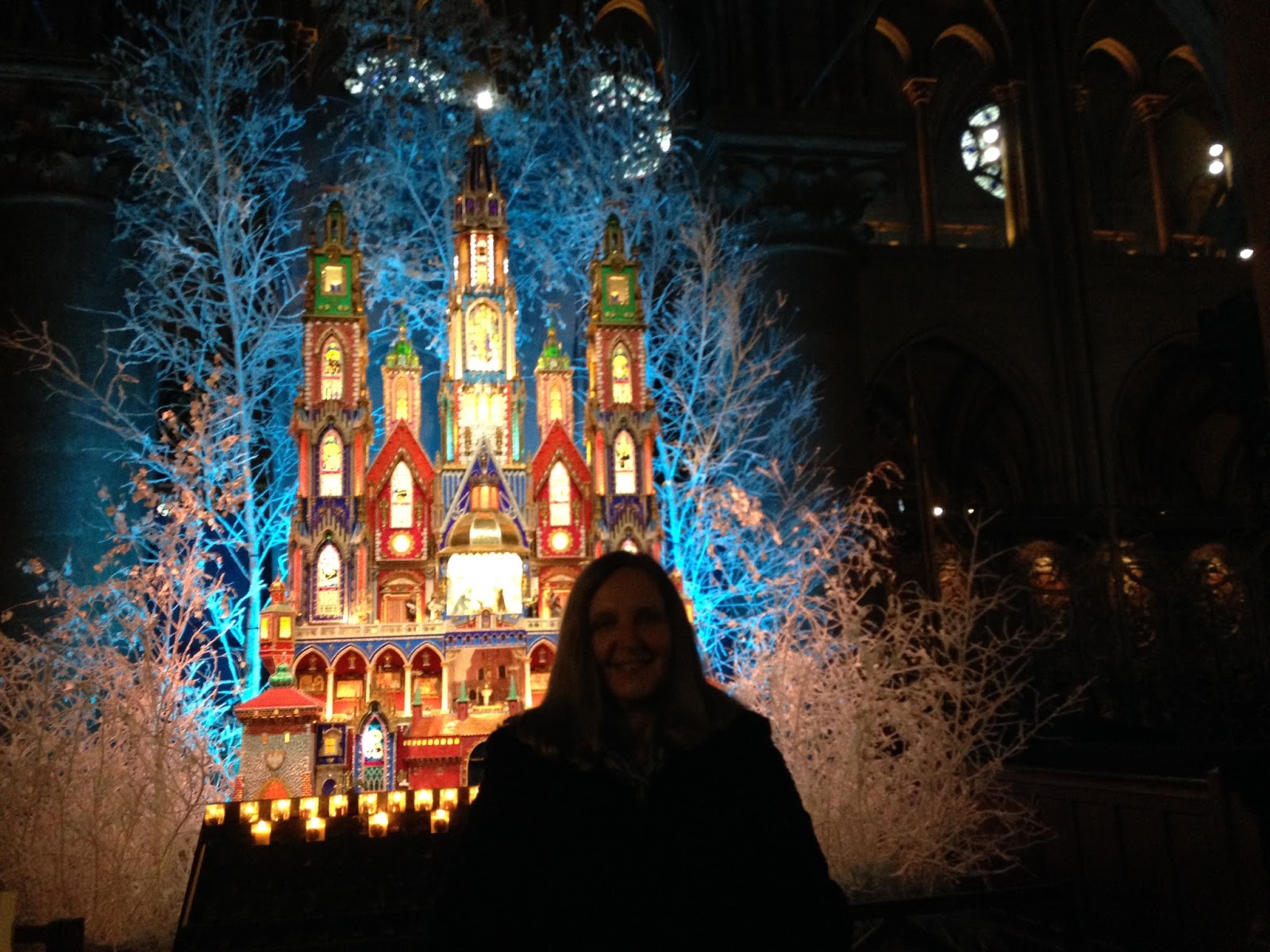
With Szopka krakowska in the Notre Dame Cathedral, Paris

After coming back home, it was time for Christmas and New Year Wishes. I picked a rose, beautiful striped antique one, Rosa Mundi, the Rose of the World that grows in my beloved Descanso Gardens in La Canada. With a green background it was exactly what I needed. Forget medieval cathedrals... here's something real, something that grows:


With the snow and all white
Without the snow and all green
With lights and garlands and spice
May your holidays shine from within!

Happy New Year 2016!


But the stanza I wrote sounded trite and tired to my ears, so unaccustomed to rhyming. Where did this silly rhyme come from?

On a sunny afternoon, I went shopping to my favorite thrift store and found a bunch of music boxes, playing English carols, more or less out of tune. I picked the best ones to add to my ever - growing collection.  Silent night, A little drummer boy, Saint Nick... I thought of the previous owners, who died and left their treasures unattended, waiting to be rescued from the pile of old teddy bears, and damaged Santas. Was it a warm-hearted, cookie-baking Grandma? Was it a lonely, sentimental spinster? Are there still spinsters (what an ugly word!) in 2015?

Time for another Christmas poem, then, this one with music boxes and memories of happy childhood, from one generation to the next...

A Santa music box - snow globe  with toy bird whistles from Poland.
.

A Music Box Christmas

I wind the spring on the music box
Silvery specks swirl in the snow globe

The twinkling of “We Wish You a Merry Christmas”
Fills the air. Santa on the rooftop falls into the chimney.
Are you ready for the holidays?  With Scottish whisky cake
Polish makowiec, or American apple pie? Will you cook
Tamales on Christmas Eve, your family gathered
Around steaming pots, laughter mixed with hearty flavors?
Will you roast turkey with fixings on Christmas? Will you
Nibble slices of chocolate oranges, after unwrapping gifts?
Taste walnuts and sesame snaps from your stockings?

I wind the spring on the music box
Silvery specks swirl in the snow globe
Memories of home swirl before me

Sparkling lights shine in the colored tinfoil of Szopka Krakowska,
Its fantastic church towers rise in their Gothic splendor
Above a Nativity Scene and figurines from Polish folk tales.
I make cranberry sauce with diced pears and apples
The way my Mom taught me. Do I still know how
To chop figs and dates into finely-ground poppy seeds
Boiled in milk, re-fried with honey? The favorite flavors
Float away with Ogiński’s polonaise, Farewell to the Homeland.
Under the blazing California Sun, I taste the exotic desserts
Of Poland’s eastern borderlands, where cultures mixed
And worlds mingled – Poles, Lithuanians, Tartars, Jews –
Cornflower blue skies and shimmering gold of rye fields.

I wind the spring on the music box
Silvery specks swirl in the snow globe
I make a promise to myself

This Christmas, I’ll read a novel, wrapped in a plush blanket
And a Santa hat. I will walk alone in the park, come back
To the empty house and watch The Lord of the Rings,
The epic battles of the elements, good versus evil,
Good versus evil  - twirling and waltzing like the silvery
specks in my Santa snow globe. I will sing along “We Wish
You a Merry Christmas” and remember a Nativity Play
With my daughter - an angel waving a green pine bough
Singing in a sweet chorus of children’s voices:
“We swish you a Merry Christmas and a Happy New Year!”

© 2015 by Maja Trochimczyk

Szopka Krakowska with toy bird-whistles from Krakow, Poland, 
on my mantelpiece in California.


Friday, September 25, 2015

Give It All Away... Love and Light Poetry Workshop with Jessica and Juan

You give it away and it magically grows back so you have more of it . . . What is it? Not money, because it does not grow on trees. . . and not any physical possessions . . . For Jack Weber it is love, and he came up with 15 reasons to prove it: http://wakeup-world.com/2015/09/10/15-reasons-to-give-your-love-away-today/.  On September 23, 2015 I read this essay divided into three voices, with Jessica Wilson and Juan Cardenas, as a part of a Poetry Workshop "Give It All Away..." This paradoxical recipe works very well, if applied with sincerity, so, the advice to our listeners, residents at Phoenix House Venice, was to go, "have at it..."
Maja Trochimczyk, Juan Cardenas, Jessica Wilson, Akilah Templeton

Though called "Poetry Workshop" and filled with poems, our event was actually not very poetic, not in the sense of learning the craft of writing poetry. . . Our focus was content. September is the National Recovery Month and we decided to celebrate it by sharing words of wisdom, inspiration, and positive thinking. Words of truth, love and light.  Before the reading started, I went around the room to shake hands with everyone in the audience. It is a very important gesture of connection and affirmation. While shaking hands you have to look the person straight into their eyes. This is where you meet and know each other. this is the connection of love.


Jessica M. Wilson, the President of the Los Angeles Poet Society, accompanied by her husband, flutist and poet Juan Cardenas, led the way with poems from her new book, Serious Longing, published this year by Editions du Cygne in Paris. Surrounded by soft tones of the flute, she continued the reading with an inspiring poem printed in the program:

EpiTantriChord            

I am a Poet of the
Cosmic chord -- I say, “luz”,
Maja calls it, “love”.

Perception and digital signals, dials us up
one by one.
We are here; empty.

Come and fill us up,
just don’t feel us up; we’re tired
of being used,
tired of being consumed.
Trash bag over our young and we don’t even want to look
to see its face. An atrocity.

A lone 93-year-old man who’s loved so,
as to sacrifice decades of his life for a cause of millions...
and here he makes breath
for only few to ever see.
Broken chord.
Chain-link to every human’s ghost.
A known unknowing of our eternity.


JESSICA M. WILSON is Navajo Indian Poet from East Los Angeles, CA. She has an MFA in Writing from Otis College of Art and Design and a BA in Creative Writing and Art History from University of California, Riverside. She began the Los Angeles Poet Society as an answer to bring the LA literary 'scene' into light - so there would be transparency between Poets and Poetry Venues, Publishers, Musicians and Artists and all creatives. To bring the community together, she is Founder and Host of the Literary Series: Writers' Row, Writer Wednesday, SoapBox Poets Open Mic, and the Salon @ NoHo. Jessica is a Poet Teacher with California Poets in the Schools, and believes in the power of the word! She is also a member of the 100 Thousand Poets for Change and the Revolutionary Poets Brigade in Los Angeles.

Her final poem was a call to action, inspiring her listeners to acknowledge and speak their personal truth: 

Power

I can imagine the earth in a field of words.
I make new ethics; blow them into the winds to meet the people.

I can influence the direction of the sparkling tide
by tapping my finger
on its surface.

In an exhale of sighs, I can signal traffic
to travel another way.
Flashing bulbs
of green and yellow merge from my palms.
They taste like nectarine
and nourish us.

I can blow the dust of glass
into new cities of neon lights
and dark clouds.

I am able to resist because someone has to.
If you question nothing,
why have a mind to think?

I can do something because I really never liked
waiting around
for a show to start.
I am the show.
We are the actors on this world-set of made up dreams,
fantasy nodes, truths we shear from the trees and towers.

We are the truth.
Let us show it always.
Let us be truth.

Jessica M. Wilson


JUAN CARDENAS, who was ten when he came to the U.S. from Mexico,  is a flutist, vocalist, poet, activist, and educator to the bilingual community, specializing in teaching poetry and music to the youth. He is a Poet Teacher with California Poets in the Schools, working with native Spanish speakers and youth of diverse cultural backgrounds. Juan is also part of the 100 Thousand Poets and Musicians for Change, and the Revolutionary Poets Brigade - Los Angeles. This is what he says about the tole of creativity in his life:

"Literature and creative expression were the gateway to discovering who I was, it made the everyday living simpler to understand, and school a lot easier to handle; not to mention motivating. I am able to see how poetry impacted my life at a young age in a positive way. I am now aware of the different directions my life could have gone as I see today’s youth. As an immigrant growing in a Latino community, I first-handedly felt  the lack of literary outlets in the community. Unfortunately, I still feel its presence in North Hollywood. I would like to be the bridge to the community to literal creative arts."


After the presentations by Jessica and Juan it was my turn. First, I led my listeners in a five-minute Meditation on Light that I created, based on a variety of inspirations. Then, I read three poems with love as the theme, my favorite subject.


© 2015 by Maja Trochimczyk, Ph.D


I followed the meditation with an ancient Druidic Blessing of Light from Ireland, that I used for my Christmas Wishes this year. Indeed, this is the Year of Light!

May the blessing of light be on you 

Light without and light within.

May the blessed sunlight shine on you

And warm your heart till it glows like a great peat fire.


Meditation on Light


Close your eyes. Take a deep breath. Relax. Imagine a bright, golden-white light right above your head, a miniature sun, or a star. Its golden rays shine all around, through you. You are surrounded, enveloped, protected by light. You are safe.


Now, the light shines inside you; its rays penetrate your whole body. All shadows disappear. There is no regret, fear, anger, sorrow. There is no guilt, no shame. Only light. The rays are everywhere, light is everything.


Now, the bright star descends into you; invite the light to enter and fill you. It shines in your brain, inside your head. You see it in your mind's eye. Light particles scatter and flow in waves. You are all light. All thoughts are pure light. There is no darkness. Only light, only peace. 


Now, the light star comes further down and settles in your heart. You have a small sun shining in the middle of your chest. It stays there. The pulsating sun-heart is moving the golden white, dazzling light into all the parts of your body. Your blood and veins are full of light.  Its warm glow spreads all over.


The streams of light flow through all your organs, muscles, skin. The light rays purify, heal, and cleanse. They flow to the tips of the fingers, the tips of the toes, eyes, ears, mouth, nose... the top of your head and the soles of your feet, all over your body. The light is energizing. It is good. All good. You are thankful, full of joy. You feel calm, peaceful, serene. 

You rest in the golden glow of the light. You say YES to the light, YES to the life this light brings. Here you are, a bright, living, pulsating star, made of stardust and starlight. 

Here… Now… In this moment…. Next… You are light. You are peace. You are love.

Still.... silent ... serene... Breathe deeply. Breathe in, breathe out... Breathe in, breathe out... 

You rest in the tranquil rhythm of your heart – a bright, pulsating golden sun.

The sun of gratitude, the star of joy, the light of love. 


(c) 2015 by Maja Trochimczyk (revised in 2016 and reposted on this blog; published in Into Light)


We can find light and love in many places. In our hearts, in the hearts of our family and friends, in the arts.  The story of Leonardo's Lady with an Ermine is fascinating, an enchantment that survived through the ages.  It is a miraculous painting that appears to look at you, as if it were alive.

Leonardo's Lady with an Ermine, Poland's Chartoryski Museum

The Lady with an Ermine

~ after Leonardo da Vinci's portrait of Cecilia Gallerani, in the Czartoryski Museum in Krakow

Her eyes follow me around the room
with that secretive smile she shares
with her famous cousin.
Filled with the knowledge of what was, what will be
she slowly caresses the smooth warm ermine fur.

"Tesoro, amore mio, sii tranquillo, ti amo"

Leonardo’s brush made a space for her to inhabit,
a grey-blue sky painted black much later –
she was pregnant, her son – a Sforza bastard,
the white ermine - the emblem of her Duke.

Sheltered by Polish royalty, she revealed
her charms only to their closest confidantes.
In 1830, exiled in a precious wood box, to Paris,
In 1919, returned to taste the Polish freedom.

"Amore mio, sii tranquillo, ti amo"

In 1939, hidden again, found by the Nazis
for Hitler’s last dream, the Linz Führermuseum,
Art among red flags and swastikas, flourishing
in the dark cavern of his mind. Never built.

Berlin, occupied Krakow, Governor Frank's
hunting lodge, Bavaria. The Red Army's closing in.
The train tracks. Crisp winter air. American soldiers,
The cameras of Monument Men.

"Sii tranquillo, ti amo"

Back home in Krakow, she is safe
in the recess of a museum wall. Under a muted spotlight,
Children play a game:Walk briskly from right to left,
don’t let your eyes leave her eyes, see how she is watching you.

Her eyes follow me around the room
Filled with the knowledge of what was, what will be
she slowly caresses the smooth warm ermine fur.
She knows that I know that she knows.

"Amore mio, ti amo"


_________________

* Tesoro, amore mio, sii tranquillo, ti amo" - fragment of a love letter in Italian, "Sweetheart, my love, be  quiet, I love you"

(C) 2015 by Maja Trochimczyk

http://www.maryevans.com/poetryblog.php?post_id=7032

In the second poem, the entire house has joined me, fifty voices repeating every line after I said it. I actually asked the listeners just to repeat the words in caps, or so I thought. But they had the text in the program and started from the beginning, one phrase after another. Why not? It turned out fantastic! The poem became very dynamic and energized. It came alive. I'm always going to read this poem in this way.

The poem is built around the kernel of basic daily meditations based on four phrases: I'm sorry, Please forgive me. Thank you and I love you.  I recently encountered these phrases on the Stillness in the Storm blog where I find poetic inspiration. The radio host Ted Mahr of Out of This World Radio, recounted a story of the poisoned water of Fukushima. Human-made radiation after the nuclear disaster is spreading around the globe, poisoning all living beings in the Pacific Ocean. Poisoning the waters, the source of life is a terrible thing that we did and now have to fix it.

According to Dr. Masaru Emoto, the creator of the Emoto Peace Project in Tokyo, Japan, we should pray and send our thoughts to the ocean's waters to heal them. At the shore of the ocean, we should gather daily, in a group, and say the following prayer, three times in a row:

Prayer to Fukushima Waters 

Water, we are sorry
Water, please forgive us
Water, we thank you
Water, we love you

I took these basic phrases that can also be found in the most Catholic of rituals, the Mass, starting from "sorry" Confession at the entrance, asking for forgiveness in Kyrie Eleison - Christe eleison and leading to the rite of Thanksgiving in the Eucharist, and the sharing of peace with everyone in Communion, eating the bread of light and love...  So here, my version:

Repeat After Me

Yes, you can find it. /Your way out./
It is so simple. /First you say:/

I AM SORRY – I’m sorry too./
We are the guilty ones,/ we are all at fault!
What happens next? /The door opens./
We stop at the threshold and say:/

PLEASE FORGIVE ME, I FORGIVE YOU./
Forgiveness erases all your guilt,/
all my fears, all our sorrows /– the burden
of dead thoughts is lifted./ See?/
We float up into brightness./ We are
sparks of starlight, /a constellation
dancing in the sky/ as we say:/

THANK YOU,/ THANK YOU VERY MUCH./
Filled with gratitude for every cloud,/
leaf and petal, /every breath we take,/
every heartbeat, /we are ready, at last,/
to say what’s the most important:/

I LOVE YOU, MY LOVE./
I give you all the love/
of my tired, aching heart./

I LOVE YOU, MY LOVE.
I give you all the love/
of my grateful, tranquil heart./

(c) 2015 by Maja Trochimczyk

Inspired by the success of the group performance of this poem, that turned truly uplifting and inspirational, I then turned to my favorite "group reading" poem - that is written on the page in color font, divided into four voices, intertwining into the fabric of one call to action: "Break the veil, undo the knots, free the mind... to see the blessings of infinity, to hear the music of sing-song lullabies, calming us ... for awakening in grace... when the Veil and the Weave are gone."  

This religious poem, entitled The Veil, the Weave, was inspired in equal measure by a quote from prophet Isaiah (its content) and the revolutionary poetry of Vladimir Mayakovsky (its form). It was first posted on this blog for Black History Month in 2014  and was copied in my previous post this September 2015. It was recently read by four poets at the Rapp Saloon in Santa Monica (hosted by Elena Secota). I was joined by the voices of the wonderful Susan Rogers, Ambika Talwar, and Melissa Studdard.


Maja Trochimczyk, Susan Rogers, Ambika Talwar and Melissa Studdard at the Rapp Saloon. 

I previously read it at various events of the Spiritual Quartet, a group of four female poets (Lois P. Jones, Susan Rogers, Ambika Talwar, and myself) of diverse religious and spiritual traditions, Judaism, Catholicism, Sukyo Mahikari, Scientology, Eastern mysticism... We presented our poetry at readings in Southern California, including one in March 2011 at the Bolton Hall Museum in Tujunga (a Village Poets Reading).  Unfortunately, I read this poem by myself then, not having yet come up with this inspired idea of converting the poem into a chorus of voices and a call to community action...

Maja Trochimczyk with Lois P. Jones and Ambika Talwar (L) and with Susan Rogers (R).

But there is always the next time, and now, we have poems that can be woven into a network of luminous voices. Why? 

To quote Ambika Talwar, "because poetry is a bridge to new worlds... So you can live beauty of your deepest awakening passion and be fulfilled!"


Wednesday, February 12, 2014

Leonardo's Lady with an Ermine, the Royal Castle, and the Monuments Men


The Royal Castle in Warsaw in 2013.

There is a new feature film, fact-based and shocking, about the destruction, looting, and recovery of artworks by the Nazis. George Clooney's "The Monuments Men" is a work of fiction, but "The Rape of Europa" - a 2006 documentary that first brought these issues to the world's attention, is not.  I found its depiction of the whole scale purposeful robbery and vandalism conducted by Germans in the whole Europe to be fascinating, with lots of unknown footage and mind-boggling examples. The four countries that are at the heart of the story were treated differently by the race-obsessed Germans: the artwork of the inferior, "slave" Slavic races of Poles and Russians could, or should, be destroyed, the artwork of Italy and French just stolen. Modern art was destined for destruction everywhere, but "classics" had a chance - especially if they could be integrated into the mythology of the "Aryan" race.

Ruins of Warsaw's Royal Castle in 1945.

Apparently, the mass murderers from the NSDAP and SS were ardent admirers of high quality antiques and masterpieces of Western art. So much so, that they took and hid these pieces for their own "consumption" and for placement in their own "museums." A lot of that art was looted from Jewish owners, targeted and systematically stolen, while the owners were murdered. Some paintings and sculptures were taken from state museums, some from palaces of aristocrats and kings, some from art galleries. Nothing was sacred.

The Castle Square (Plac Zamkowy) in the Old Town of Warsaw.

Poland, the first target of Hitler, the nation destined for physical extermination and cultural annihilation, suffered some of the most grievous losses of WWII.  It never surrendered, did not form a "colaborator" government that worked with the Nazis, like the Vichy in France. The Holocaust of Jewish Poles and Polish Jews is a crime without parallel. But the suffering of Poles was immense, too. Poland lost 3 millions of its Jewish citizens and 3 million of its Polish inhabitants. The destruction of Polish culture was a particularly significant goal for the Nazis, along with the killing of the cultural and national elites - officers, professors, artists, the clergy. Anyone with a brain and a position of power could become a target. Members of my mothers' family were on the list: two priests, Karol and Feliks Wajszczuk, ended up in Dachau, one survived, one was killed - for supporting the underground resistance.

In 1944, the Royal Castle and the whole city of Warsaw were systematically destroyed, holes drilled into walls, stuffed with dynamite, and exploded; fire-throwers used to set the interiors and libraries aflame. Poles rebuilt what they could after the war, recovered  some artwork, not all - it was returned by American Monuments Men, by the Soviet government. But many important pieces disappeared without a trace. The destroyed buildings were reconstructed, the originals irreparably lost.  I used to go to music school in the Old Town, Music High School named after Jozef Elsner, the teacher of Chopin. The school was on Miodowa street and the best way was to take the tramway no. 26 and go through the W-Z Tunnel, under the old town. When I was coming back from my lessons I looked up into the empty window hole in the last wall of the palace, pointing towards heaven, lonely, damaged, forlorn.  I still remember its angular shape next to the full  moon, above the rooftops of the old town. I was happy to see it rebuilt; it took many years. But the palace looked too new for me, and still does. It is a simulacrum, a model, not the real thing.

_________________________


In 1944, a beautiful song was written by a Polish-Jewish popular music composer, Albert Harris, a farewell to the dying city. He composed it in Italy, at Monte Cassino, as a member of the Polish army that was fighting at the Nazi stronghold. Harris joined the General Anders' Army that was formed from Polish refugees, and prisoners in the Soviet Union, then joined the British army in liberating Italy. After the war, the soldiers were scattered around the world. Britain did not want them, they went to Canada, Australia, the U.S.. Harris ended up in America. His Warsaw song became so popular after 1945, that it was even translated into Danish and became one of Denmark's greatest hits.

http://www.youtube.com/watch?v=SEwIkP6H3es = Albert Harris, Song about My Warsaw (Piosenka o Mojej Warszawie), in Polish, recorded by W. Sypniewski in 1945, illustrated with pictures of Warsaw in 1939 and after its liberation.


http://www.youtube.com/watch?v=RGH-Ffbvubg = Albert Harris, Piosenka o Mojej Warszawie in Danish, recorded in 1946.

______________________________

The famous portrait by Leonardo of the Lady with an Ermine was one of the most notable recoveries of the Monuments Men. An image of the mistress of Italian Duke Sforza, painted in 1490, the portrait belonged to the Czartoryski family of aristocracy and kept in their private museum in Krakow, Poland. After being stolen and hidden, it returned to Poland, thanks to its discovery by the Monuments Men of General Eisenhower - art historians sent along with troops to organize the recovery and restoration of stolen or damaged artwork. They found the Lady in a hunting lodge of Nazi ruler of Poland, General Governor Hans Frank. It was then returned to Poland to the museum of its original owners, the Czartoryski family, and then "nationalized" - now it is found at the other Royal Castle of Poland, Krakow's ancient Wawel Castle (the kings moved to Warsaw in the 17th century, and Wawel was not destroyed, so its old walls are really old...).

The painting's story is quite convoluted, its beauty - still astounding. I decided to write a poem in praise of its beauty and history. Here it is, a brand new reflection on Leonardo's gift to the world.


The Lady with an Ermine


Leonardo’s brush created a vessel for her to inhabit,
a grey blue sky they painted black much later –
she was pregnant, her son – a Sforza heir, 
her lover – a Duke, a white ermine – his emblem.

In 1830, with her Polish princes, she went
into exile through Dresden to Paris, locked
in a box of precious wood. She came back. https://mail.google.com/mail/ca/u/0/images/cleardot.gif

In 1940, hidden again, she was safe until Nazis 
found her – Governor Hans Frank fell in love,
in a palace he had stolen in Kraków, 
in a hunting lodge he had built in Bavaria. 
The Red Army was closing in.

She felt a slight discomfort in the crisp winter air
when American soldiers held her up, 
for the cameras of Monuments Men.

Another train ride. The navy darkness of a museum wall.
Under a muted spotlight, schoolchildren play a game:
Walk briskly from right to left, don’t let your eyes  
leave her eyes, see how she is watching you.

Her eyes follow me around the room
with that secretive smile she shares
with her famous cousin. She sees my delight,
caresses  the smooth, warm ermine fur.

She knows that I know that she knows


© 2014 by Maja Trochimczyk, written on February 11, 2014

This is the first draft of the poem, subsequently revised and posted on this blog in 2015, 
http://poetrylaurels.blogspot.com/2015/09/give-it-all-away-love-and-light-poetry.html

as well as on the Mary Evans Photo Depository, in their poetry blog:  
http://www.maryevans.com/poetryblog.php?post_id=7032

There is a recording of me reading this poem in Paris: 
https://www.youtube.com/watch?v=TI-LHJYgwbk


If you need to read love poetry on Valentine's Day or its weekend, visit Moonrise Press Blog for sample poems and a series of links to other poetry of love and reflections on Valentine's Day and types of love, and its folly. 

http://moonrisepress.blogspot.com/2014/02/poetry-of-valentines-love-and-roses.html