Showing posts with label nostalgia. Show all posts

Sunday, November 26, 2023

To Be the Editor or Author, That is the Question! California Quarterly 49:4

California Quarterly Vol. 49, No. 4, Winter 2023. Cover Art: Popocatepetl, Spirited Morning—Mexico by Marsden Hartley (1877-1943). Oil on board, 25x29 in. Smithsonian American Art Museum, Gift of Sam Rose and Julie Walters, 1932

I recently had the pleasure of editing the California Quarterly, Volume 49, Number 4, Winter 2023,  and selecting work by 42 poets. I found 58 poems that fit on the allotted pages of the journal and selected a classic American painting by Marsden Hartley for the cover. The full table of contents is posted on CaliforniaStatePoetrySociety.com blog:

 https://www.californiastatepoetrysociety.com/2023/11/contents-of-california-quarterly-vol-49.html

In my list of publications the majority of books are edited, I like reading work by others and juxtaposing their insights into a rich tapestry of voices, a counterpoint of humanity as it were. I could write more by myself, but seldom have the motivation to do so. Among my music history books, only three were written entirely by me: my doctoral dissertation on space in music, a study of Polish Folk Dance in California (by Columbia University Press) and a history of the Modjeska Club that I preside upon and that recently celebrated its 50th anniversary. The rest are collected or co-authored volumes. 

Among my poetry books also there are quite a few anthologies with contributions by up to 90+ poets. The most recent book, Crystal Fire. Poems of Joy and Wisdom, had 12 contributors. It is nice to put the insights by different people side by side to see the threads that join their work, and note the differences. When working with poems for anthologies I ask for more submissions than could be published and select what I like the best. The choice is simple: I like it or I do not like it. It is not a value judgment of the quality of the poem or the poet. It is my own taste that comes into play. 

If I like too many poems by one poet, I try to publish more than one, or select what fits what the emergent, overall theme of the issue. In the Winter 2023 issue of the California Quarterly the obvious theme of winter, snow, cold, farewells, was juxtaposed with the theme of rain, because there were so many "rain" poems among the submissions.  So in my editor's note, reprinted below, I start from a quote from a "rain" poem by Leopold Staff that also imitates the regular pattern of raindrops in its rhythm.

In English, the most common Greek meters are iamb (short-long), trochee (long-short), dactyl (long-short-short) and anapest (short-short-long). In Polish with its preferred penultimate-syllable accent, the most common is amphibrach (short-long-short), with a name that means "short-on-both-sides."  Leopold Staff uses this meter throughout his "rain" poem - and its repetitiveness serves as an illustration of the noise of the rain in a beautiful example of onomatopoeia, but also captures the endless dreariness and melancholy of loneliness. I'm often alone but very seldom lonely, so to me it is a very distant poem. I do not cite it as a whole... In the reprinted note below, I marked up the accents that align themselves into a regular pattern, repeating throughout.

Popocatepetl, Spirited Morning—Mexico by Marsden Hartley (1877-1943). Oil on board, 25x29 in. Smithsonian American Art Museum, Gift of Sam Rose and Julie Walters, 1932

 EDITOR'S NOTE

“O szyby deszcz dzwoni, 

deszcz dzwoni jesienny 

 I pluszcze jednaki, 

miarowy niezmienny...” 

                                                                                                    (Leopold Staff, Deszcz Jesienny)

In Leopold Staff’s poem I memorized at school, the onomatopoeia of “sh” and “ch” sounds (“sz” and “cz” in Polish) illustrates the sound of rain. I do not know how to translate it into English while keeping the sound, the rhythm, and the meaning intact. It is difficult to make transition from one language to the next… 

Why do we love or hate rain? There are several rain poems in this issue—by serendipity, perhaps. In northern countries, when drizzle falls too often from gray, overcast skies, rain is associated with melancholy, sorrow, and depression (O’Sullivan, Sapp, and Beynon). It became a stereotype. Just think of Disney movies, when the heroine starts to cry… 

In hot, desert countries, rain brings with it blessings of food, life, and love (Rosenheim, Skaldetvind, Stuart). What about snow, then? A blessing or a curse, depending on how much snow falls, for how long. Under the northern lights, it is a view to behold (Luisi). In Chinese movies snowflakes caught in lovers’ hands signify the abundance of affection. In northern countries, we have the “White Christmas” – though the event giving rise to this holiday took place in the desert, under a palm tree. 

What matters is the celebration of “now” – as in the poem by W.C. Gosnell, or The Night Heron by Jennifer M Phillips: “Open your fist. There is nothing to grasp.” Phillip Jason wisely advises the reader that all experiences are meant to “turn you into good.” Yes, we should cherish our days “without thorns” (Jane Stuart), when stars blink in Morse Code that “nothing is over” (Zanelli) and angels make “you sing / And sing and sing / Like a joyful child.” 

During winter holidays, whether skiing, cooking, or wrapping gifts, we become like children, engrossed in the moment, watching a blue balloon, “rising into a sky” (Machan). If we cannot let go of sorrow, we may find solace in dreams (Hitt, Fraley), or prayer (Silberstein, DiOrio). Per Quantum Entanglement (Hammerschick), we are all One, anyway…

In addition to poems that moved me, this issue presents the winners of the 36th Annual Poetry Contest. It is clear that the taste of the Contest Judge, Anna Maria Mickiewicz, is markedly different from mine. This diversity is a gift to be cherished.

Maja Trochimczyk California Quarterly

Los Angeles, California  Volume 49, Number 4


Marsden Hartley, Yliaster (Paracelsus), 1932, oil on paperboard mounted on particleboard, 25 1⁄4 x 28 1⁄2 in. (64.1 x 72.4 cm.), Smithsonian American Art Museum, Museum purchase made possible by the Smithsonian Institution Collections Acquisition Program and by George Frederick Watts and Mrs. James Lowndes, 1988.53


OUTSIDE, TONIGHT

A cold evening rain—
wind-soaked shadows, purple pine
clumps of clinging moss

...invisible wind
warmed by sparkles of sunlight,
cooled by winter's rain

A soft fallen snow
drifting over evergreen
floating through the night


 ~ Jane Stuart, Flatwoods, Kentucky

Just like Leopold Staff, Jane Stuart looked out the window and saw a rainy landscape, slowly turning into one of snow, I like poems that capture the moment, the lyrical "now" in few words evoking an image that carries in it its own emotion. 

My own poem, written specifically for the California Quarterly, was inspired by a photograph I saw somewhere of a snow lotus, that looked quite bizarre and otherworldly to me, so I wondered if it would be worth my time to travel to the Himalayas to see these rare blossoms with my own eyes. In a stream of consciousness, I then thought about traveling to all the other countries, and being faithful just to one, or two, and of course back to the flowering meadows of my childhood and the inevitable skylark above. This is what the engineers of our fate want to deprive us of, the wide open spaces of fertile fields, the peaceful meadows, life in the countryside.

A garden filled with birdsong is a great substitute for a childhood meadow, so I love my life in California. Why should I travel then? If all I love is right there? When the plandemic started and injections became mandatory I decided I'd rather not go anywhere ever again. It was my own choice so I did not travel for quite a while, I can drive around LA, go to the ocean, go to a concert, and I tend to leave my phone at home, with humorous conversations with my car, yes car, that puts messages on its screen telling me to not forget my phone, and frantically trying to connect to other phones it detects nearby... So funny. The car that talks.  So weird. The car that keeps track of what I do and what I carry with me. Welcome to the dystopia of electronic leashes, smart 15-minute cities, and totalitarian control. 

San Gabriel Mountains, California. Photo by Maja Trochimczyk


THE SNOW LOTUS


White, like starfish skeletons
deep in the ocean, snow lotus blooms
in a barren Himalayan valley.
Do I have to touch its smooth petals
to live my life to the full? Do I have to
learn 200 anthems of 200 nations,
celebrate their independence 200 times?
Countries I'd never visit, even in my dreams.

It is good enough to learn just one valiant
anthem, a “call to arms” mazurka—or maybe
two—in my case of abandoned childhood
meadows, sprinkled with stokrotki daisies,
maki, chabry i rumianki—I was lured away
by exotic beauty, the bright bougainvillea,
with her myriad butterfly eyes. Too late I saw—
though different, it was still the same.
 
I sing a new anthem among strangers
at a concert—words flicker in darkness
on the screen of my phone—I am supposed
to take it everywhere with me—my car said so,
and keeps looking for it, when I go out
without my electronic leash.
So, I'll leave
alone cold, limp petals of the snow lotus,
bewilderingly alien on its gravel plane.

I'll dream of watching clouds float by—
scoops of meringue in the pristine blue,
pierced by skylark's song cascading
onto fields of May-green barley. There is
no reason to go anywhere but inwards—

on the one journey into the silent glow
of stokrotki meadows within my heart.

 ~ Maja Trochimczyk, Los Angeles, California

"Stokrotki" are small white daisies scattered over Polish lawn and meadows; white with gold center, they are lovely, and make the grass more interesting; white clover does the same, but stokrotki are prettier. "Maki, chabry, i rumanki" - poppies, cornflower, and chamomile daisies are three common field flowers from Polish countryside, often depicted together as an unofficial symbol of the Polish nation in red, blue and white.  Are they prettier than the rare and exquisite snow lotus? Depends who's looking... 

Rumianki in a Polish field, Trzebieszow, photo by Maja Trochimczyk, May 2023

Maki, or wild poppies in a field of rye. Trzebieszow, May 2023, Photo by Maja Trochimczyk

Chabry, or cornflowers in a field of wheat, Trzebieszow, May 2023, Photo by Maja Trochimczyk

Jayne Jaudon Ferrer wrote an exquisite simple poem to all her readers asking them to do what I used to do so often during my Polish childhood: go outside, for a walk, stroll, or hike. Enjoy being close to nature, to what's real and what's around you.

PETITION


Morning comes and,
with it, headlines
blaring hate and carnage
and suffering and sadness
and depravity and duplicity
and defeat.

Turn off the TV.
Put down the paper.
Walk outside.
Give yourself up
to fresh air and sunlight,
to butterflies and birdsong,
to growing things and
grazing things and
hope.
Rise above,
be lifted up,
inhale
and hold on,
hold on.


Jayne Jaudon Ferrer

Greenville, South Carolina


Clouds in a Polish countryside. Trzebieszow, May 2023. Photo by Maja Trochimczyk

Saturday, June 2, 2012

The Old Towns in Warsaw, Krakow, Gdansk...

Returns, in thought or reality, to the landscapes of childhood, constitute an important poetic inspiration. I had a chance to re-visits the landscapes of my youth during the travel to Poland in May and June 2012. It was a sentimental travel back to my roots and more than a few of my "favorite things."

First, Warsaw: this is where it all began. The house I spent my childhood in is gone, demolished to make room for the widening of the street of Powstancow Slaskich. The fields on the other side of the street have been turned into a huge "osiedle" (subdivision) with thousands of inhabitants in ugly apartment blocks. There is a massive signboard in the exact spot where our house once stood and the cherry tree once grew. The little street, "alejka" is still there, lined with yellow iris of our neighbors.

My childhood is gone, of course, but it was a strange feeling to see its material traces erased. I asked a high-school friend to drive me through the narrow streets of Osiedle Przyjazn, where the faculty of the Warsaw Polytechnical University used to live after the workers who built the Palace of Culture had returned to the Soviet Union. Quite a few houses still stand, the streets are lined with maple trees, I remember walking on the curb, picking up the yellow leaves...

My favorite part of Warsaw, the Old Town is still there, though - "still" is a wrong word here, since it was completely destroyed after the Warsaw Uprising and rebuild after the war. The enormous effort of reconstruction of downtown Warsaw ended only with the reopening of the Royal Castle in the early 1980s. I was there before that. I remember the last ruined wall standing with just one window at the top, in the sea of ruins. I used to go to a music school right there and looked up to and through that window at the night sky, while waiting for a tram to take me home. The trams are there, too, painted red and white. It was hard, and still is, to get used to the red square building of the old/new Royal Palace. It still strikes me as something that does not quite belong where it stands, where it once stood. It was gone for just thirty years, but I lived with that gap, and now it is there again, an apparition from before my time.

Filled with tourists and school groups of kids who jump into the puddles the Old Town in Warsaw is very much alive. It is also very lively and completely swarming with schoolkids in Krakow, where I went to a conference on emigration at the Jagiellonian University. In contrast to Warsaw, this Old Town is completely "old" - all buildings, churches, and lecture halls of the university where we held our sessions are real and ancient, though many have recently been restored and repainted. The city is lovely at all hours of day and night, marked by the trumpet call from the tower of Kosciol Mariacki, to the four corners of the world. The "hejnal" is interrupted in the place where the original melody was cut short by an arrow from a Tartar invader, back in the 12th century. History runs deep there - and it suffuses the city and its inhabitants with the warm glow of benevolence. Somehow, it seems, there are more friendly folk, willing to go out of their way to help everyone, in Krakow than in any other city on the planet. Maybe walking through these streets mellows their spirit?

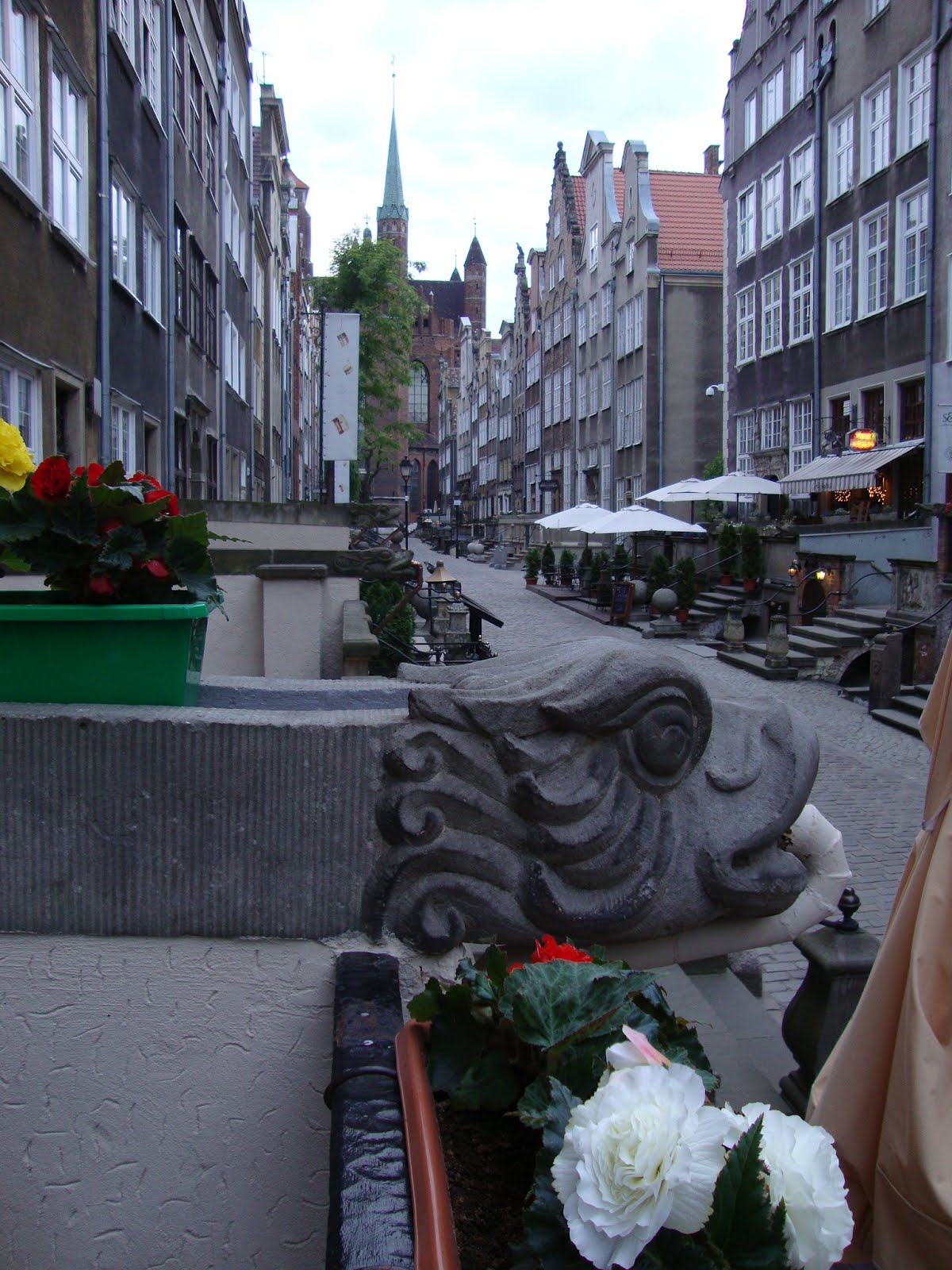
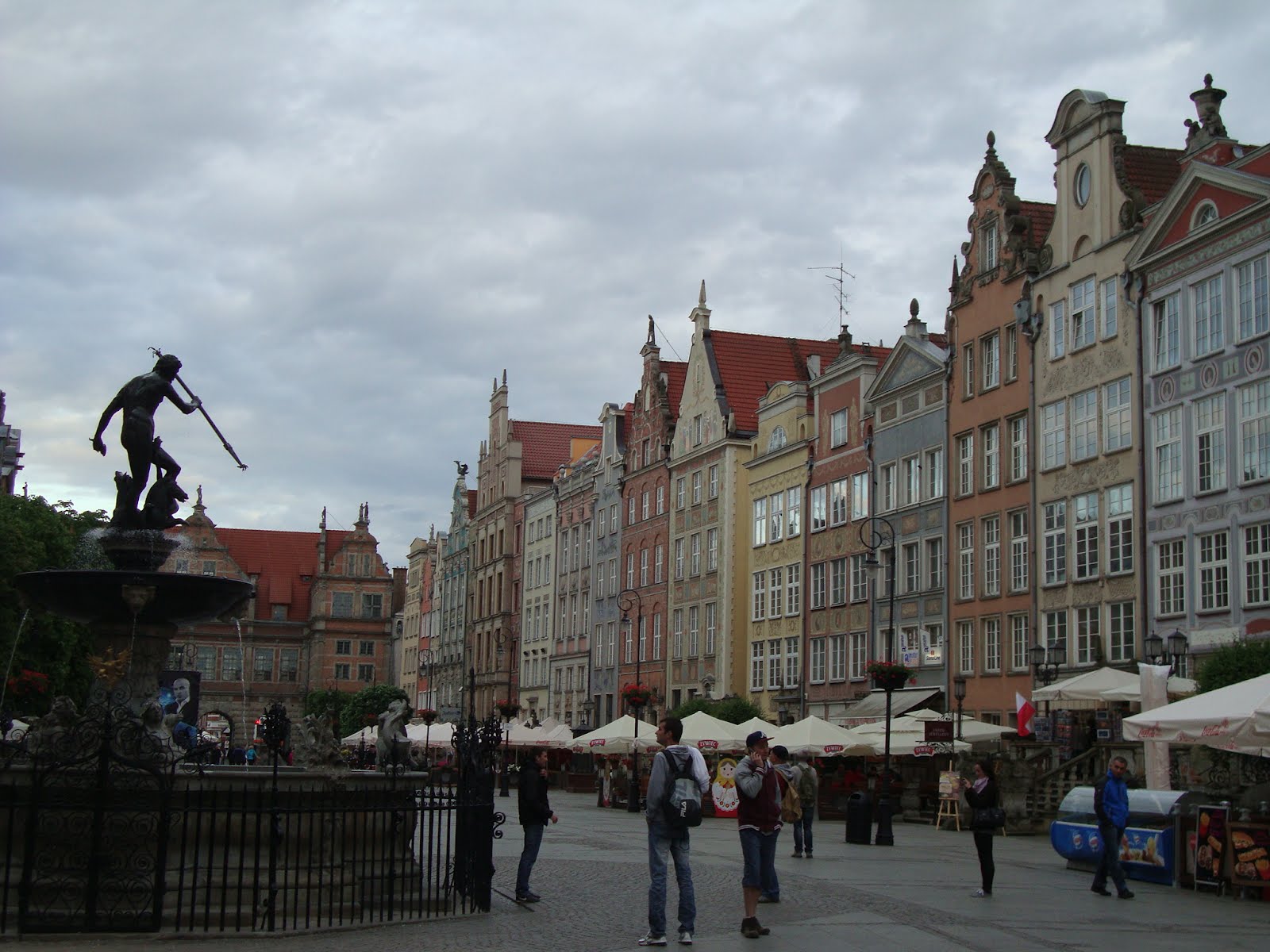
Finally, Gdansk. I travel there to a conference at the University of Gdansk, East and Central Europe in Exile: Patterns of Transatlantic Migration, organized by a large group of partners, headed by the indefatigable Dr. Anna Mazurkiewicz. I'm to speak about exiled composers, but before that happens, I revisit the sites of my own exile and those of my family. The residents are justifiably proud of the recently completed restoration efforts that transformed the Old Town of this Hanseatic sea-bound city, into a real gem filled with amber necklaces and artwork. After my poetry reading on "Aliens in California" (illustrated with photographs and artwork of my California friends) and before the conference begins, I walk through the narrow, streets lined with peaked houses all decorated and colorful. It is much more beautiful than I remember from my childhood at my aunt's home. At that time, in late 1960s and early 1970s, large swaths of the Old Town were still in ruins, only the main street and a couple of side streets were restored, while across the Moltawa river you could see the empty holes of the window, roofless brick walls. It was a scary place then, with so many areas barren, a real wound of the war. But it is completely different now...

My mother's aunt, Jadwiga Hordziejewska and her uncle, Dominik, lived there, after forced resettlement from their estate in what is now Belarus and used to be Soviet Union, near the lake of Switez, and Mickiewicz's hometown of Nowogrodek. They lost everything in that move, everything except for the one cow my uncle took with him to Oliwa. They used to walk through the parks and streets of the city for many years, an old gentleman in his top hat and the prize-winning Holstein black and white cow... He refused to speak to anyone, Ciocia Jadzia worked to support the family, while her husband grieved, frozen in the past, unable to accept the present.

The builders of these old towns, and those who restored them to their colorful and welcoming charm, tell us that we should cherish the past, though never forget what pain was wrought upon us.

Thus, we should always cherish the little flower of "niezapominajka" - forget-me-not. In an old children's verse it is "growing at a stream, looking at me with its blue eyes, and whispering modestly: "do not forget me."

We should not forget what made us who we are. I talked about remembering and being either petrified by grief, loss and guilt, or just remembering the past moments, as beads on an necklace. I even wrote about that lamp I photographed in Jelonki, Warsaw, with the snowflakes twirling in its yellow glow. This poem first published in Miriam's Iris is a suitable tribute to a travel back in time and into the future of being an emigre in California. On the occasion of this long, sentimental trip through my favorite landscapes, I decided to reproduce it for my readers.

Prelude - Water Charms

I.

The hummingbird builds its nest.
Its thin beak – the stem
of a multicolored jewel
sparkling in the sun
(a copy of its own similitude) –
holds the glistening body aflutter.

Rose bushes wear diamonds,
well-polished – their colors change
with the breeze
like the bird’s shiny feathers.

My Californian garden
tries to seduce me
with precious necklaces
and melliferous strains
from the mocking bird
hovering above
the scent of gardenias.

“All right” – I say –
“Don’t play games with me.
I’ve seen it all before.”

II.

Pearls scattered on the meadow
tremble on the blades of grass,
hide in the hearts of clover.

The sun shines straight through their ovals,
translucent, in a bright shade of green.
Stalks bend under their glassy weight.

Tempted by curiosity,
I destroy their perfect balance,
depriving the world
of its well-deserved splendor.

The droplets fall
to the ground and disappear.
How shall I ever be forgiven?
My wickedness – unthinkable.

III.

Dead leaves seek shelter
under thin panes of glass.
Ice covers pools of rainwater.

The stillness mocks past intimacy
when noisy reds, yellows, and browns
flew up from under my feet
in an autumn park
of maples and poplars.

I changed the future of the world
with one step of my boot:
the pane cracked,
the air bubbles shifted,
a the harmony was gone.

With glee I crushed the worlds
that did not need me.

I shudder when I look back –
a trail of footsteps
filled with muddy water,
dirt splattered on the geometry of ice.

IV.

The magic of white butterflies
twirling in the glow of street lamps
makes me dizzy. The black sky turns.
Bright spots move faster still.

I’m afraid. They chase me –
larger – whiter – denser
stars, monsters, snowflakes?
My scarlet fever began that night. V.

Winter morning reveals its treasures.
Leaves, cones, twigs, tree-trunks,
even pebbles on my path
wear bristling coats of crystal ice.

The pearl-grey sky is a bride’s dress,
waiting to burst open with new life.

The clouds settle on their beds.
Houses, bushes, roofs, fences,
dress in white muffs,
scarves and blankets.

The fence boards,
stiff like British soldiers,
present puffy hats to the Queen.

I admit it. I cut their heads off
with my red-gloved hand,
leaving behind a line
of headless corpses –
oh, silent horror!

VI.

The damage that cannot be undone –
melting the universe of beauty
with one breath
that changed a snowflake
into a dirty spot on my glove.

Slowly walking into
the immaculate field of whiteness,
I scarred the snow’s pristine expanse
with clumsy footmarks.

VII.

Again: plunging into
the smooth expanse of a lake,
I broke its sleepy obsession
with mirroring the evening sky.

I paid for my guilt with exile –
a foreign country, a borrowed name.

Crystals do not charm me in the desert
where Joshua trees parody my gestures
of praying for snowflakes
by stretching their twisted limbs
into the purple sky.

No hope for maki, chabry, and rumianki.
My childhood flowers
won’t be found on the meadow
painted yellow by the spring
across the barren slope
I see from my kitchen window.

VIII.

I’ve dreamed of being happy
in the sweet impossible,
with Italian cypresses, ice plants,
and a white fence around my house.

But my memories trap me.
Only the hummingbird
floats around, twitching its tail
like a miniature goldfish.

Maki – wild, red poppies (Papaver rhoeas); chabry – blue Centaurea cyanus, and rumianki – white chamomile daisies, grow in the meadows and fields of Poland and throughout central Europe.

________________________

And here's my bouquet of "niezapominajki" from the Royal Baths Palace at Lazienki Krolewskie. Do not forget me, or so they say...

Tuesday, June 14, 2011

Father's Day on the Beach

Did you notice how children want you to admire them when they are doing something special? I used to sit in my garden and watch my son jumping on the trampoline. As it turned out, I had to watch him, I could not read my paper instead, because the moment I lowered my eyes he’s cry out from the air, “Mommy, Mommy, look at me, look how I jump. Did you see what I did? Oh, you are not looking…”

Their childhood passes so quickly: they grow up, graduate from high school, from college. Then, they move away. We are left alone, wishing that we looked at them when they asked. (I’m glad I did). In June we celebrate graduations and the Father’s Day. Here’s a poem I wrote about a father and his little daughter playing on the beach. That daughter might have been me, on the distant, cold shore of the Baltic Sea. My father did not like water, but I spent hours swimming. I even knew how to swim backwards…

On the Beach

Daddy, Daddy! Look at me!
Look how I jump! Higher than the waves!

Daddy, look! I caught a fish!
Oh, it got away…
Don’t worry, Daddy, it’s okay,
I can be a fish.

Look, I’m swimming.
I’m a fish now and you are a shark.
Try to catch and eat me!
Let’s play fish!

Na-na-na-na-na
You can’t get me

You can’t get me
Na-na-na-na-na


Wow! That was a big wave!
Salty! I swim backwards now.
Did you know I can swim
backwards like a crab?

Watch out! I got you!
The crab caught the shark
and ate him! I win! I win! I win!

Let’s walk along now,
Maybe we’ll find
pretty seashells for my room.
Maybe we’ll find a pearl.
Will you make me a crown with my pearl?
I’ll be a real pearl princess.

I love you, Daddy, I love you so much!
I’ll always be your princess!

Daddy, Daddy! Look!
I found a pearl!

© 2008 by Maja Trochimczyk


For a companion piece to this childish monologue of a five-year-old, I picked a “geometric” poem, structured in two parts with a “horizon” line in between, just like the paining it was inspired by. (“Linea in aurea” means “line in gold” – almost, it is not correct Latin, but sounds good. “On the Beach” also has this pivotal central point in the little girl’s song, so there’s a structural similarity in two vastly different poems.)

For some reason, a beautiful, geometric painting by my favorite Hungarian painter, Susan Dobay, called “Sunset,” reminded me of pearls. Maybe it was the memory of the shining surface of water at dusk, an expanse of brilliance against the quickly graying sky. But the geometric transformation made this image a beach from an alien planet. Pearls are, according to one legend, made of a mother’s tears that fell into the water and became jewels, shining with sadness. There is something melancholy in their glossy sheen. They also lose their luster when not worn, for they have to be touched by warm human skin to stay shining and brilliant.

The subdued colors of Susan’s “Sunset” are quite melancholy, just like the pearls. I created a subdued mood by repeating the “sibilants” – shell, sunset, shelter, sun, sadness, sand, shore, silver… The word “shell” has another meaning in the last line: “shell-shocked” means “deeply traumatized.” One consequence of trauma is a tendency to escape from reality, another is compulsive control over one’s surroundings, continually organized in perfect order, just like the waves in Susan’s painting. That’s what makes this image so sorrowful and full of meaning for me, ten years after the death of my father from gunshot wounds. A home invasion robbery I wish I could forget. Or, maybe today I’ll wear another string of pearls…


Shelled Sunset

~ after a painting by Susan Dobay

In a parallel universe
umbrellas are made of seashells
and shelter suns from the glare
of the waves – daintily, stealthily
threading lines through more lines
ad infinitum. The air breathes
with golden contours of silence
after sadness danced away
on the sand, at the shore,
above silver waves – twirling,
circling towards the horizon.

Linea in aurea in linea
Line after line after line

You have to tread carefully here,
not to be snared by metallic vines
that multiply, moving into calm.
You have to be cautious – so close
to the heart of sorrow in this cosmos
of resignation, dignity and absence,
where waves petrify into shells,
the rhythm of their frozen crests
echoing the pearl-gray patterns
that blossom in the foreign,
distant, shell-shocked sky.

© 2009 by Maja Trochimczyk

_________________________________________________________

Photos and poetry (c) 2008-2011 by Maja Trochimczyk
"Sunset" by Susan Dobay, used by permission

Sunday, October 31, 2010

My Sky - A Poem of Found Images

I like seeing light in the world, permeating little things, enchanting. I notice its presence with a child's wonder, seeing the world for the first time, as if it did not exist before I looked. Raindrops on leaves are an endless fascination. There is nothing as happy as the grass, covered with dewdrop diamonds in the morning after a short summer rain.

In one old children's poem, shape-shifting clouds take the forms of endlessly changing desserts, stacks of cakes, ice-cream, whipped cream... Unlike the hungry, boy dreaming of sweets, Dyzio Marzyciel (The Dreamer), I don't see food above my head, only magic. The transformation of our world from the profane, ugly and boring to the sacred, saturated with quiet charm may happen anytime, anywhere.

In an instant, I see footsteps of the Greek goddess, Demeter, in another, I am moved to inhabit a painting... It takes just a bit of effort, after eyes are washed of the unwanted images of distress, chaos, pain. I still remember that stain of blood on the sidewalk in Venice, left after a suicide. I still see faces distorted by hate. I want to erase these memories with raindrops on rose leaves.

Some of my roses have impenetrable surfaces, keeping the raindrops round, jewel-like. Other ones absorb moisture in an instant, the drops spread out into amorphous blobs and disappear.

My life, my words, may be one or the other, visible or invisible, remembered or forgotten. I do not know what will happen when I'm gone. Now, this is my time to write, to record the beauty I discover. I am a witness to what I want to see. I could write about the rotten cans and layers of graffiti marring the landscape of the riverbed, and that rusty jeep that was sitting on the shore for years, gradually losing parts to the homeless, selling it off, bit by bit for scrap metal. OK, maybe I'll write about that jeep and the homeless. I already started, but that poem is still unfinished. Too dark, maybe? Too hopeless?

Today, it is time for something sweet. Isn't Halloween the day for treats?

MY SKY

A Poem of Found Images by Maja Trochimczyk


I live inside a painting
by Rene Magritte.


My river is made of silver,


my sunsets of tiger stripes.


I make my own rainbows.


My roses sing in the morning


to a sweet tune of water droplets


playing on the edges of leaves.


Spherical, crystal-clear globulets


of white light adorn each green surface,


like a handful of diamonds scattered


by Demeter, the goddess of plenty.


Water shines in full sunlight -


a child's memory, innocent and pure -


glistening before the breeze stirs,


droplets fall and petals begin their journey


crumbling into dust.