Showing posts with label Paris. Show all posts

Monday, December 7, 2015

On Dali's Silver Towers of Eyes

Daum Variations on Dali at Espace Dali in Paris

Maja Trochimczyk with Hanna Kulenty and the Crowds of the Basilica Sacre Coeur

Maja Trochimczyk with Alicja Guillemette-Bialek and Dali

So many blessings, so many delights discovered in Paris... in the Espace Dali in Montmartre. While hordes of tourists are satisfied by a trek up the hill to the Sacre Coeur Basilica and down the side streets to the art market square, faux restaurants and all the faux artistes, we took a turn around the corner to an empty street, past an empty restaurant: Espace Dali with a show of modern interpretations of his sculptures in multicolored, liquid glass.


an empty bistro 
silences crowded Paris street
outside of time

In part, I did know what to expect: melting clocks, women with drawers in their bodies, and giraffes on fire.

melting clocks
go on pretending -
too solid for time


"to melt or not to melt" -
this is the question only
snails may answer


bronze leaves
deny the right of time 
to melt in your eyes


wings seen unseen
I multiply into a twin shadow
of a double goddess

I did not know about the eyes, though. I guess, they are too far beyond the ordinary, even the extra-ordinary-ordinary...  There are several drawings and sculptures of multiple eyes on display in the museum. I was fascinated by the Architecture of Eyes, a relief sculpture made of silver metal and blue artificial eyes, some with eyelashes, some without. 

The whole stack of these eyes has an other-worldly, apocalyptic impact, making one think of Cherubim and the Divine Vessel described by Ezekiel, with its wings folding into each other, and the multitude of open eyes on the rim of its wheels... A strange world, a strange world indeed where eyes are buildings and buildings are made of eyes...


After Dali

If your eyelids do not shine silver
In a tower of endless repeats,
If your lips do not bloom in a sofa,
Too pouty to be touched or kissed
If your snails do not grow larger than tigers,
And your clocks do not melt onto your trees,
What are you doing  in the Espace Dali
on Montmartre? Lost in this crooked house
On a crooked alley, up a crooked hill
That twists time into a pretzel of potentiality
Where elephants grow spider-thin legs
Running after endless flames of giraffes.

Eyes watch blue eyes
Folding into the silver
Rings of recurrence

You have to really look to see that reality
Of impossible presence beyond limits
Where Everything is One and One is 
Everything and you are in the leaves 
And petals open in you and the Earth 
Under your feet sighs through your lungs 
And your heart beats with the waves 
of the ocean

Eyes watch blue eyes
Folding into the silver
Rings of recurrence

                                When birds welcome the sun
Rising in your garden that morning, you know
You hear their song, singing Yes, it is always
Yes in the eyeless ears of the birds
In the bluest eyes of silvery turrets
In Dali’s architecture of eyes

When birds welcome the sun
With the waves of the ocean,
You know.  Everything is One
One is Everything
You hear their song, singing Yes,
Always Yes in the bluest of Yes
In the Time’s Yes, the unfolding
Architecture of Eyes.


eyes watch blue eyes
folding into the silver
rings of recurrence


eyes watch blue eyes
folding into the silver
rings of recurrence


And still... Ambika Talwar saw something else:

flashing walls
folding doors
see eyes creep
do not fall asleep
how can you awaken?

_______________________________________________


Photos from the Espace Dali in Paris by Maja Trochimczyk, Photos from Paris by Alicja Guillemette-Bialek and Martin Majoor.  Artwork includes fragments from Architecture of Eyes by Salvador Dali, Paris Espace Dali.
(c) 2015 by Maja Trochimczyk

Friday, October 5, 2012

October is a Funny Month...of Timelessness and Lilies

Clouds in California - Eaton Canyon, Pasadena, September 2012

In Canada, October is the month for Thanksgiving, but in China, Cyprus, Croatia, Germany, Nigeria, Portugal, Taiwan it is the time to celebrate national holidays. In America we have the Columbus Day and a whole month to come up with the most outreageous, bloody or scary Halloween costumes...

Global October celebrations also include the birthday of Mahatma Ghandi, Free Thought Day, World Food Day, Apple Day, Spirit Day, Halloween, and All Souls Day, among many others. There is something different to celebrate in each country in this month of harvests and remembrances of death and dying. 

One of my favorite, nostalgic and melancholy celebrations of October is the annual visit to a cemetery. Families visit the graves of their loved ones, bring candles and prayers. Thousands of candles flicker in the rain, wet leaves shuffle under the feet, the air is scented with smoke and memories of days past... people gone... happiness subdued by absence... I must say that I rather liked it, these dark evenings among the ancient crooked tombstones of Poland...

Cemeteries are different under the brilliant California sun that banishes melancholy. But it is good to remember our place in the stream of time, a raging torrent that becomes more violent every day. Death and life, farewells and welcomes. New babies are being born and cherished. Life goes on...  For October, I selected a poem on cosmic time and timelessness as it is reflected in the transience and beauty of our lives. Someone said that the best way to walk it is to keep one feet in time and the other in timelessness...

Timelessness
© 2008 by Maja Trochimczyk

Yes, there is time
Yes, there is weight
of the rocks on the skin
of the earth making
It harder to breathe
for the beast of eons

Yes, there are clouds
Yes, there is air
cut with wispy stripes
of whiteness wishing,
willing itself into being,
into solid forms that
dissolve in the merest
breeze, flee into nothing

Yes, there we are
Yes, matter stays
atoms, prions, electrons
dance in an endless cycle 
of DNA spirals, molecules,
blades of grass and gravel

Yes, there is time
to watch, to catch
the transient beauty
of living in red harmony
blood circling in our veins,
rock dust changing into stars


______________________________________


POETRY UPDATES:

My most recent publications include "The Rite of Passage" that appears in the Epiphany Magazine, Issue 16 (October 2012), accompanied by three photographs of mountains, clouds and roses. The poem celebrated my 2011 vacations in the High Sierras of Calfiornia. I love the clarity and jewel colors of montain lakes!

  • Epiphany Magazine, monthly poetry and photography magazine, October 2012 issue - "The Rite of Passage"  
Then, my poem "The Unseen" inspired by teaching arts and ethics in a Los Angeles County Jail, was selected by the online site and print yearbook, Van Gogh's Ear:
The first two poems of the cycle "Among the Lilies" - "Water Lily I" and "Water Lily II" (inspired by Claude Monet's paintings at L'Orangerie) were selected by Marie Lecrivain for her section in the annual mammoth Lummox Journal. The next two "Water Lilies" are a fitting follow up and are reprinted below. These poems are my souvenirs from my trip to Paris in October 2011.

  • Lummox  Magazine, a poetry anthology published by Lummox Press, ISBN 978-1-929878-38-3
    Perfect bound, Trade Paper, 230 + pages; $30, $25 (includes shipping from the publisher)
    http://www.lummoxpress.com/journal.html

Fragment of Water Lilies by Claude Monet, L'Orangerie, Paris, 2011 photo by Maja Trochimczyk
                   Lilies by Claude Monet, L'Orangerie, Paris


Water Lily III
(c) 2011 by Maja Trochimczyk

He keeps the colors royal
Vermillion and scarlet
The breeze shifts, scattering the patterns
Cleansing the air
From distant traces of mustard gas 

The breath and the brushstroke are one
He is the wind, moving through the garden
Made to be painted
Fading

Fragment of Water Lilies by Claude Monet, L'Orangerie, Paris, 2011 photo by Maja Trochimczyk
                       Lilies by Claude Monet, L'Orangerie, Paris


Water Lily IV
(c) 2011 by Maja Trochimczyk

Lily pads float up into indigo
Gathering like birds before winter
Pulled by the gravity of belonging
They fall into the night

Blossoms and cicadas
A nightingale’s song swirls above their sleep
A cricket counts the brushstrokes

Stiff fingers ache
It is good he had the ponds dug out
Life is good

Fragment of Water Lilies by Claude Monet, L'Orangerie, Paris, 2011 photo by Maja Trochimczyk
                         Lilies by Claude Monet, L'Orangerie, Paris

_________________________________

Photo Credits:
Photo of clouds at Eaton Canyon, Pasadena, CA, September 2012 by Maja Trochimczyk
Photos of fragments of Claude Monet's Water Lilies at L'Orangerie in Paris, October 2011, by Maja Trochimczyk

Sunday, September 2, 2012

Three Postcards from Paris of Ron Libbrecht

Maja Trochimczyk Reads "Three Postcards" at Bolton Hall Museum, 2012
Last October I went to Paris for a week as a guest of the Polish Institute and one of the speakers at the International Conference on Maria Szymanowska.

After coming back I saw Ron Libbrecht's watercolor from Paris and a series of ekphrastic poems was born. Hilda Weiss of Poetry LA recorded them and posted on the site and on YouTube. The poems and the inspirational paintings were also published in a monthly online journal, Quill and Parchment, vol. 100, July 2012.


THREE POSTCARDS FROM PARIS

~ inspired by Ron Libbrecht's watercolors and a trip to Paris


Pont Neuf, Paris by Ron Libbrecht
 1. A New View of Pont Neuf, Paris

It is not that I do not want to rest here
On this greenest of grasses
In the shadow of massive branches
Of London plane trees, platane commun,
Maple leaf planes, Platanus hispanica,
It is just that my geography is as confused
As that of the tree – Polish, Canadian
Californian – everything I see
Carries multiple shadows of things remembered
Doppelgänger of memories
Like that park with a sandbox and benches
By the Zoo in Warsaw where we ate white clouds
Of candy-floss under the poplars
Discussing the shape of spots on the neck
Of the giraffe and hippopotamus’s awful teeth


2. The Tower and the Crane

After I filled my eyes with the splendor
Of stained glass rainbows at La Sainte Chapelle
An orgy of royal fleur-de-lis
With cranes and ravens carved into the floor
Medieval creatures waiting for a sign
To spread their wings in flight

Exhausted by history
I looked for a bench not smelling of urine
Under the sky’s pure crystal
Watercolor birds from the pages of Audubon
Stopped me at a bouquiniste’s stand
Near Quai Voltaire

Should I get the crane for a blessing of long life?
Or a kingfisher? Hopkins said they “catch fire,
Dragonflies draw flame”

To each their own – I choose a poster
With the flags and balloons
Of the 1889 World Fair
They billow and float around the edifice
Of stainless steel, Eiffel's glory

I know, I know – the stone carvings
Of beaks, claws, and beady eyes
Will outlive me and my paper Tower


Paris, Watercolor by Ron Liebbrecht
3. Paris, October
 
On the way back
To the Institute Polonais
Not far from the twisted flames
Where Princess Diana died
In the tunnels under Pont d’Alma
I walk by a maple and a young oak
Encircled by wrought-iron fence
An oasis of gold and bronze
Among the streets, cars, metal rivers
Of the 16-eme Arrondissement

Sales are brisk at Chanel and Versace
During the Paris Fashion Week
Charcoal and diamonds are in style
The black-clad models look indifferent
Not one of them dressed
In the splendor of lilies
The richness of autumn leaves

I wonder

Sheltered by sunlight,
We find refuge from cosmic wind
And the gnashing of teeth
In the darkness outside
___________________________________________

Paintings by Ron Libbrecht, copied by permission.
YouTube Reading by Poetry LA: Maja Trochimczyk at Bolton Hall, February 2012

Publication: Quill and Parchment, vol. 100, July 2012


Friday, February 10, 2012

On Pursuit of Happiness - from Paris to Monrovia

For the Voice of the Village, February 2012 issue, I wrote the following column. My term as Poet Laureate of Sunland Tujunga is coming to an end, so I thought about what happened in the last two years. . .

Poetry … in pursuit of happiness

As a new citizen (American for mere two years), and a resident of Sunland for just fifteen years, I was delighted to have been elected the Sixth Poet-Laureate of Sunland-Tujunga in March 2010. English is my second language, so it was quite an honor. During my “Passing of the Laurels” Ceremony in April I was wearing a silly grin almost the whole time: I was so excited! I picked my motto for the two years in office to be “Poetry ... in pursuit of happiness."

There are many rights enshrined in constitutions of different countries; only in America do we have the pursuit of happiness. Many people came here for that reason and I am one of them. As a professional music historian, I spent years finding out and explaining what others thought – why the composers created the music they did, what did they try to say… It was – and is – a worthwhile occupation, but there is no comparison with writing my own poetry, about what I think and, what’s at the core of my being, what I feel. “The moment you feel, you’re nobody-but-yourself” (e.e. cummings).

I feel calm and safe when wondering in Tujunga Wash, taking pictures and scribbling notes for my poems. There are so many things you can say about the sublime beauty of the mountains and the river. I feel proud to have found a place where I am at home among friends, where I can be, for once, for all, “nobody-but-myself.” Sunland-Tujunga is a wonderful, homey, friendly community, with amazing history and talent. The natural surroundings, the colors of clouds in the sky, the infinite variety gardens – this is all breathtakingly beautiful, but the greatest treasures of our neighborhood are its people. This is why we have Watermelon Festivals, Bolton Hall Museum, Village Poets Readings, Fourth of July Parades, art exhibitions, and community papers. Time for some “love poems” for our neighborhood… one illustrated with my photo, and one with a painting by Susan Dobay, Musicscape 12. (www.susandobay.com)

_______________________________


I already posted here one of the two poems from the column, "My Sky" (I live inside a painting by Rene Magritte...), which I had illustrated with a variety of photographs I took in the Tujunga Wash and in my garden.

The other poem belongs in a set of four inspired by paintings by Susan Dobay. These particular light blue paintings are incredibly happy and whimsical. Looking at them fills me with happiness that can be felt but rarely. Reading poems with music by Rick Wilson improvised to accompany my voice was one of these unique, unforgettable moments of complete and perfect happiness. The sun was golden, in that four o'clock hour that fills the day with ripeness of things well done. The friends as attentive as they could be. The host, Susan Dobay was asking impatiently if I'll read my "Awakenings" that she's so fond of... Kathabela was spectacular in her light turquoise outfit with shiny mirrors on the skirt. Rick's playing was inspired. I think that making art makes life worth living.

Thanks to my poetic and artistic friends, I have found happiness in Sunland and Monrovia. The painting for this poem is above and on the cover of the book, "On Awakening" edited by Kathabela Wilson for Poets on Site and including poems by many poets, inspired by seven of Susan Dobay's paintings. That one, of a large tree, reminded me of a children's game. . .


See, how we dance?


Simon says – “grow”
and our roots reach for water
our branches for the sun

Simon says – “blossom”
and our pink petals open
in a gold mist of newness

Simon says – “sing”
and we let the breeze whisper
with hummingbirds, jewels, leaves

Simon says – “fly”
and we turn and turn again
in swirling clouds, voiceless music, dancing

____________________________________________


Hilda Weiss and Wayne Lindberg of Poetry LA have recently visited Bolton Hall Museum in Tujunga, to record Featured Reader Just Kibbe and local poets. As one of the co-hosts of the Village Poets Open Reading on January 22, 2012, I was recorded as well.

I presented my Three Postcards from Paris which will appear in Quill and Parchment later this year. The postcards are about my visit to Paris on the occasion of the Maria Szymanowska Conference in October 2011. There's nothing about Chopin in my postcards, except that he lived in Paris and I walked some of the same streets. I had visited his grave at that time, but I did not write a poem about it.

Poetry L.A. posts videos on YouTube and links on their website. Thanks a lot to Hilda and Wayne! This is their labor of love. They are not paid for it and they spend countless hours documenting the state of poetry in L.A.

As for the fruits of my own labor, I had already rewritten the central poem and reorganized them, moving the first one to the end. Maybe it will not be moved, in the final version. I'm still figuring out the flow. The current one is fine, too - ending on a humorous note.

Maja - Three Postcards from Paris

Tuesday, December 13, 2011

Christmas Wishes with Roses and Ivy


It is that time of the year again. Christmas. The stack of cards waits for my pen and a moment of stillness. Maybe an afternoon on the sunny patio would allow me to reconnect with friends and family? There is so much to do, so many parties to go to. I have to remember not to start thinking of holiday-ing as a chore, one more thing to do when there is no time, no time at all. It is nice to send cards, at least to sign them, if not write something original for every addressee. We are all interconnected through a network of thoughts and affection, but tend to forget about its importance in days filled with the daily business of busy-ness.

I was asked to read some poems at a party and realized that I have not written my annual Christmas poem yet. It came to me in the rain, when I could barely see the road ahead and the sky was heavy with darkness.


Did you know?

Some Christmases are rainy
Tears fall from overcast sky
On lonely crowds in hospitals
And prison yards

Sometimes Christmas is icy
Frozen under the pale moon
Changing faces into lifeless
Shadows at night

Some Christmases are scarlet
And green like fir garlands and hearts
Warmed by barszcz and hot chocolate,
Evenings by the fire

Sometimes Christmas is white
Snowflakes melt on my gloves
The thin wafer of opłatek we break
Shelters us in good wishes

Some Christmases are sparkly
With the tinsel of laughter
Giggling children unwrap gifts
Magic in the morning

My Christmas is golden
Like that first star of Wigilia,
Warm kisses with kompot and kutia
Blessings under the tree

© 2011 by Maja Trochimczyk

I paired this poem with a photo I took this October at the Notre Dame Cathedral in Paris. I liked the open window, looking out through the multitude of shapes and colors onto a simpler, luminous world.


The picture became the cover of my Christmas card, and I paired it with the collage for the poem of "Rosa Mystica" - already posted here, but included below in the image pages. I also reprinted my last year's holiday poem, "Rules for Happy Holy Days" as a reminder about the importance of holidays. This poem was written for my last year's Christmas wishes. These Rules are timeless.


Rules for Happy Holy Days

Don’t play Christmas carols
at the airport. Amidst the roar
of jet engines, they will spread
a blanket of loneliness
over the weary, huddled masses,
trying not to cry out for home.

Don’t put Christmas light on a poplar.
With branches swathed in white
galaxies, under yellow leaves, the tree
will become foreign, like the skeleton
of an electric fish, deep in the ocean.

Clean the windows from the ashes
of last year’s fires. Glue the wings
of a torn paper angel. Brighten
your home with the fresh scent
of pine needles and rosemary.

Take a break from chopping almonds
to brush the cheek of your beloved
with the back of your hand,
just once, gently. Smile and say:
“You look so nice, dear,
you look so nice.”

© 2009 by Maja Trochimczyk


Since the year 2012 is supposed to be the last year of this Earth in existence in its present form, I figured I'll reprint, as a farewell of sorts, the "Apocalypsis" poem written for Easter, as well as some lovely poems that I enjoyed writing and reading this year: "A Jewel Box Sunrise" and "On Mushrooms." Below is the complete card with all the poems I selected to share for the holidays this year.


_____________________________

Poetry, photos and design (c) 2011 by Maja Trochimczyk

You can print out a little booklet from the .jpg images of the poems, each stretched to a full page 81/2 by 11 in., sideways.

Saturday, November 12, 2011

On Szymanowska's Satin Slippers

I went to Paris in September, came back changed in October. An astounding city, full of history and charm. My purpose was to talk about Maria Szymanowska and visit and photograph places associated with Chopin. I found his grave and put a poem from "Chopin with Cherries" there. I went to the church where his Funeral Mass was held, with Mozart's Requiem (St. Madeleine) and I wondered about his empty chair and white evening gloves at the Bibliotheque Polonaise near the Notre Dame Cathedral.

The purpose of my trip was to give a paper about Maria Szymanowska, a Polish virtuoso composer-pianist, who preceded and inspired Chopin with her brilliant style, etudes, mazurkas and songs... Szymanowska (1789-1831) died young, too; Chopin was 39 when tuberculosis finally defeated him. Szymanowska - at 42 - went quickly, of cholera in St. Petersburg. But first she managed to enchant Goethe, who wrote for her a poem entitled "An Madame Marie Szymanowska (Aussohnung)." Known as "Aussohnung" (Reconciliation) it was included in the Trilogie der Leidenshaft, inspired by the sixty-year-old poet's tragic infatuation with a young girl, Ulrike. Szymanowska's music, her empathy and beauty helped the aging poet return to his senses. (I write about recent research into her life and work discussed at the Maria Szymanowska Colloque in Paris in my "Chopin with Cherries" blog).

At the conference, I presented the first version of my poem about Szymanowska. After making some changes, I read it for the workshop of Westside Women Writers group and I received comments from Millicent Borges Accardi, Kathi Stafford, Georgia Jones-Davis and Sonya Sabanac. Here's the third version of this work in progress. I want to capture her life as I see it - she was dazzling, inspiring, enchanting, and disappeared all too quickly.


The Shooting Star

Reflections on Maria Szymanowska (1789-1831)

“He brought a horse to her bed, that’s why” – they said.
“No, he did not let her play. She left…”
“Not the only one, mind you.”
Rossini wrote: “Madam,
I equally adore your modesty and talent.”
“At least she was a mother – that redeemed her.
Three children, two daughters, that sort of thing.”
“Did she love them? Was she doting?”
“Didn't she leave them for three years
To play her music?”

“Did she travel alone?” Always with her sister –
Paris, London, Dresden, Marienbad.
Devastated by Ulrike’s youthful charms,
Goethe found comfort in Maria’s nocturnes,
Reconciliation in the kindness of her voice.
He saw Das Ewig Weiblich.
He wrote Die Aussöhnung.

A Roman Goddess?
Wearing the latest London fashions?
She was the Queen of Tones for Mickiewicz,
the Polish bard. A friend of Prince Vyazemsky.
The Court Pianist of the Tsarinas.
A Warsaw brewer’s daughter,
She rose to royal heights,
Shining with the brilliance of her art.

She was elegant, refined
In her pristine muslin gowns,
With sleek belts and jewels.
Her satin slippers dared to
Outlive her by two hundred years.
They sit on a shelf, laughing.
She’s gone. Her daughters,
orphaned in a fortnight of cholera,
Are gone, too. So are
Their daughters’ daughters.

What remains of this dazzling life?
A gold bracelet with a cut sapphire?
A handful of songs, etudes and dances
Scattered along the way? Sweet melodies
Frozen in the air above vast plains
Of snow drifts and tundra?
The sparks of a shooting star
Falling across our dark winter sky?


________________________________


Lithograph based on a portrait by Maria Szymanowska by Jozef Oleszkiewicz, 1825. Framed print from the collection of Bibliotheque Polonaise in Paris.

Maria Szymanowska's satin evening slippers and an image of Warsaw's Grand Theater of Opera and Ballet. Paris, Bibliotheque Polonaise.

Portrait of Maria Szymanowska by Aleksander Kokular, Rome, 1825. Copy, original in the collection of the Adam Mickiewicz Museum of Literature, in Warsaw, Poland.

Saturday, October 15, 2011

On Visiting Chopin's Tomb in Paris

The curiosity about Chopin's death appears almost morbid today, when the cult of fitness and health has placed all disabled and sick on the margins of society. As Franz Liszt writes in his biography of Chopin, the hagiography, rather, setting the tone for the legend of the feeble, tortured body and the elevated, spiritual, noble, suffering mind: "None of those who approached the dying artist, could tear themselves from the spectacle of this great and gifted soul in its hours of mortal anguish." And a spectacle it was. As Liszt claims, Chopin planned things in advance:

"By a custom which still exists, although it is now falling into disuse, the Poles often chose the garments in which they wished to be buried, and which were frequently prepared a long time in advance [...] Chopin, who, although among the first of contemporary artists, had given the fewest concerts, wished, notwithstanding, to be borne to the grave in the clothes which he had worn on such occasions [...] He had linked his love for art and his faith in it with immortality long before the approach of death, and as he robed himself for his long sleep in the grave, he gave, as was customary with him, by a mute symbol, the last touching proof of the conviction he had preserved intact during the whole course of his life. Faithful to himself, he died adoring art in its mystic greatness, its highest revelations."

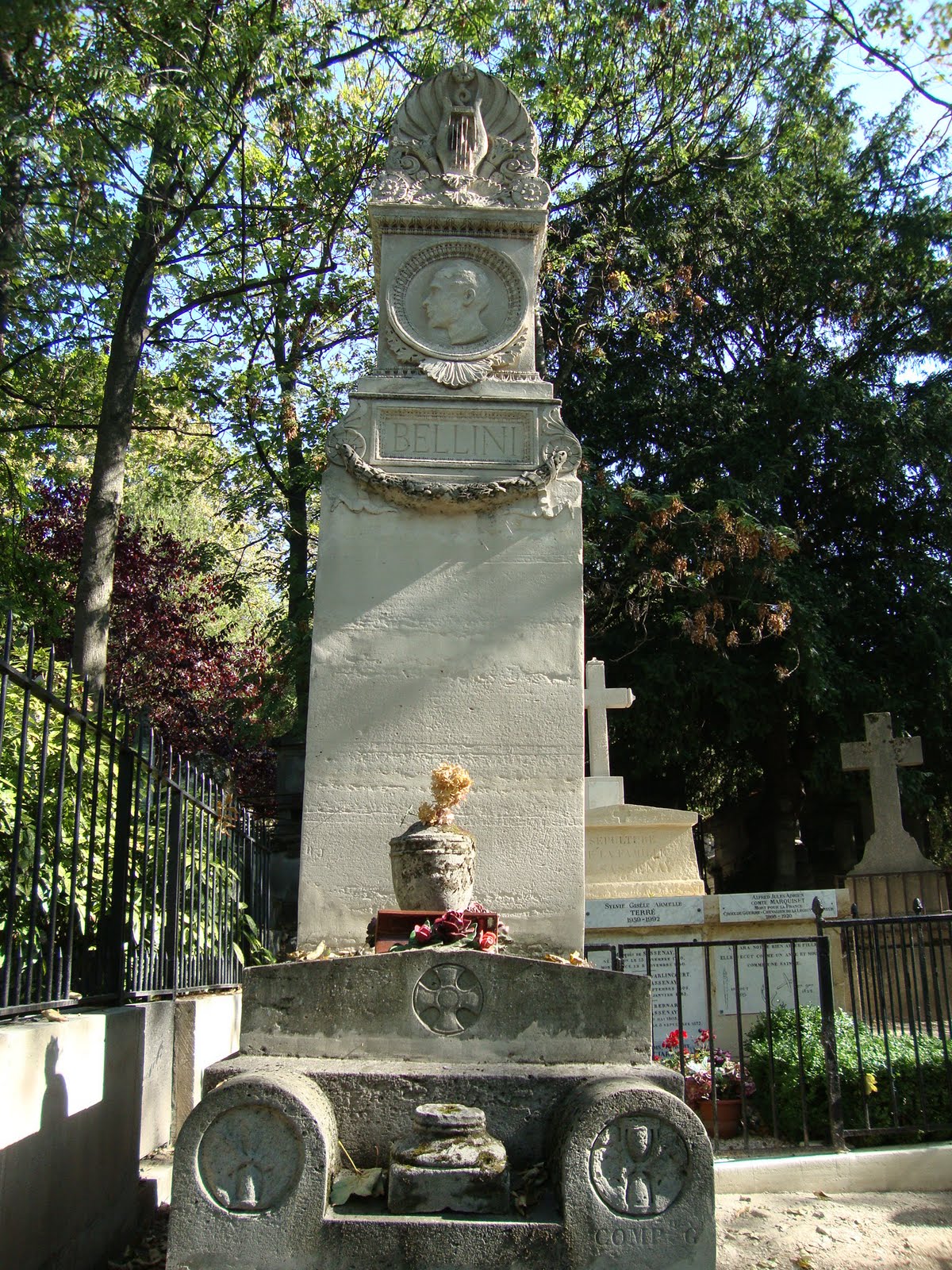
Then, he decided on his burial - the Mozart Requiem at the Church of the Madeleine, the body to be interred at the Parisian cemetery Pere Lachaise, next to Bellini and Cherubini, and the heart, submerged in brandy, carried under the skirts of his sister back to Poland, to be enshrined in a pillar in the Church of the Holy Cross on the Krakowskie Przedmiescie Street in Warsaw, not far from the place where he spent his youth.

Before burial, came Chopin's last days and moments, so fastidiously and admiringly described by Liszt:

"From week to week, and soon from day to day, the cold shadow of death gained upon him. His end was rapidly approaching; his sufferings became more and more intense; his crises grew more frequent, and at each accelerated occurrence, resembled more and more a mortal agony. He retained his presence of mind, his vivid will upon their intermission, until the last; neither losing the precision of his ideas, nor the clear perception of his intentions. The wishes which he expressed in his short moments of respite, evinced the calm solemnity with which he contemplated the approach of death.


As Liszt had it, everyone was blessed and raised to the heights of a spiritual realm by the very proximity of the dying "seraphic" artist: "—every knee bent—every head bowed—all eyes were heavy with tears—every heart was sad and oppressed—every soul elevated." After the final blessings, the agony began:

"A convulsive sleep lasted until the 17th of October, 1849. The final agony commenced about two o'clock; a cold sweat ran profusely from his brow; after a short drowsiness, he asked, in a voice scarcely audible: "Who is near me?" Being answered, he bent his head to kiss the hand of M. Gutman, who still supported it—while giving this last tender proof of love and gratitude, the soul of the artist left its fragile clay. He died as he had lived—in loving. When the doors of the parlor were opened, his friends threw themselves around the loved corpse, not able to suppress the gush of tears."

To remove the sanctified sheen of Liszt's verbosity let us read what Anne Woodworth wrote about this very moment in her poem published in the Chopin with Cherries anthology:

At the “Hour of Twilight”

– after reading Franz Liszt on Chopin’s death

Anne Harding Woodworth

Franz will write it all down:
that I swooned, that I asked for flowers
and music. Trouble is, I don’t know any Franz.

Tens of friends waited
in the anti-chamber. Trouble is,
I don’t have even four.

And a student held my hand,
because he wanted to return my affection
except that I’ve never had a student who loved me.

I do have a sister. I have two, but they wouldn’t think
of being prostrate at my bedside.
So who will hold my hand?

Where is a Franz who will unabashedly
describe my pillow? my sweat? my bitter suffering?
the unknown shores where next I go?

Of course, it’s true:
I don’t believe I’m going anywhere,
nowhere beyond nothing, that is.

Sing, Countess. Sing, my compatriot.
Trouble is, I’m not Polish. I don’t know any singers,
at least not one who can attain profound pathos.

And there’s no one to roll the piano I don’t own
to my bedroom door. Oh, Liszt, where are you?
I am coughing so. And the pain . . .

And the love . . .
Where is my Franz who will record
the cliché of a final agony?


I have not written about Chopin's death; for me his music is far too alive. But I have written about death and sorrow - too many poems, I think. The worst death, the death of hope, the death of the soul:

Black Iris

by Maja Trochimczyk

Black iris
Purple iris
Three tongues licking the air
The infinity of golden fuzz
Three in one

Trinity inside
Trinity outside
Circling, endless

Oh, to dissolve
Into that velvet smoothness
become one with the tricolor blossom
one with the tongues
Licking the air

Oh, to fade
Into the molecules
Dissemble within the iris
Flower into un-being
Into seed


The association of flowers with paying tribute to the dead, so typical of the West, was amplified in Chopin's death chamber: "His love for flowers being well known, they were brought in such quantities the next day, that the bed in which they had placed them, and indeed the whole room, almost disappeared, hidden by their varied and brilliant hues. He seemed to repose in a garden of roses. His face regained its early beauty, its purity of expression, its long unwonted serenity. Calmly—with his youthful loveliness, so long dimmed by bitter suffering, restored by death, he slept among the flowers he loved, the last long and dreamless sleep!"

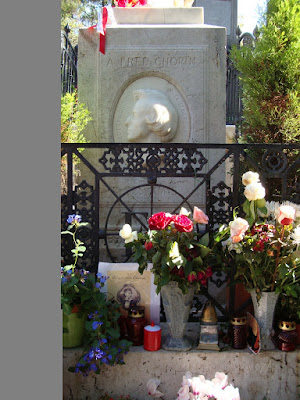
The flowers are still there, in abundance. I visited his grave at Pere Lachaise Cemetery on October 3, 2011, during a strangely hot Indian Summer day. The tomb was easy to find. That's where everyone was going. The cemetery office distributes maps with notable graves marked, from Heloise and Abelard, to Oscar Wilde, Edith Piaf, and Rossini. But there are no fresh flowers at almost any of them - except at Chopin's. The grave is taken care of by a local Polish Historical Society that decorates it with the national symbols (white eagle on a red flag), and vases for flowers. These are always fresh, brought to the grave by the stream of visitors. About fifty people passed by during the ten minutes we were there.

Afterward, I was asked for the location of Chopin's grave five more times on the way out - by an American, a French hobo (visibly drunk), an Italian couple, and a family with teenage kids. Some had flowers to leave at the people's shrine, I brought my poems and a cover of our anthology. I left it there for the grave-keepers to put in a makeshift historical museum, preserving notes, piano keys, and other memorabilia left for Chopin over 150 years after his death.

The intertwined themes of death, mortality and morbidity were associated with Chopin especially strongly at the end of the 19th century and through the early decades of the 20th century. Polish composer Zygmunt Noskowski (1846-1909) elaborated on the topic of the “typically Slavic” feeling of the unspecific, yet overwhelming, “sorrow” (“żal” or “żaÅ‚ość”) and nostalgia permeating Chopin’s music. This overriding expressive tone was associated with a general poetic quality in Noskowski’s 1899 article, “The Essence of Chopin’s Works:”

"Whatever we call the mood in Chopin’s works, be it “elegiac quality,” “longing,” or “sorrowfulness,” it is of primary importance to state that, above all, the purest poetry prevails in them and that the breath of this poetry captures the hearts in a way that cannot be described with words."

Strangely enough, Liszt attempted to do precisely that, "describe the ineffable in words" in his discussions of that most famous, and trivialized of Chopin's pieces, his Funeral March from the Piano Sonata No.

"All that the funeral train of an entire [Polish] nation weeping its own ruin and death can be imagined to feel of desolating woe, of majestic sorrow, wails in the musical ringing of this passing bell, mourns in the tolling of this solemn knell, as it accompanies the mighty escort on its way to the still city of the Dead. The intensity of mystic hope; the devout appeal to superhuman pity, to infinite mercy, to a dread justice, which numbers every cradle and watches every tomb; the exalted resignation which has wreathed so much grief with halos so luminous; the noble endurance of so many disasters with the inspired heroism of Christian martyrs who know not to despair;—resound in this melancholy chant, whose voice of supplication breaks the heart [...] The cry of a nation's anguish mounting to the very throne of God! The appeal of human grief from the lyre of seraphs!"

Seraphs or not seraphs, the music still moves us deeply, still resonates within us, still inspires. The YouTube comments of uneducated teens betray their helplessness under his sway:

  • "When this song is played while bright sun light shining through a big window. its simply amazing" (on Nocturne Op. 9, no. 2)

  • "Even when I'm sleeping its playing in my head!! Have to learn this!! Chopin rocks!" (on Prelude in D-flat major, Op. 28, no. 15, "The Raindrop")

  • "Full metal alchemist" (on Pollini playing the Etude Op. 10, no. 3)

  • "This is how music was meant to sound like, from the soul. Sounds that you can relate to and understand." (on Zimmerman playing the Ballade No. 4)

  • "Amazing how few notes can make you wonder in your thoughts.....ahhhhhh" (on Aszkenazy playing the Nocturne Op. 55, No. 1)

  • "Ok the first time I've heared this song, was because Jimmy Page did a cover of it and I must say this song is just like a sweet but really deep pain that is falling slowly and slowly as it's becoming more near to it's end...a very intense short piece of music indeed" (on Prelude Op. 28, No. 4)

    So here it is, for your enjoyment, Jimmy Page (I do not even know who that is, but apparently, he plays a guitar):

  • http://www.youtube.com/watch?v=QZXG0fNUUXs&feature=related

    ______________________________________


    Photos (c) 2011 by Maja Trochimczyk, including the tombs of Bellini and of Chopin at the Pere Lachaise Cemetery in Paris.

    Vintage postcards with scenes of Chopin's death, from the private collection of Maja Trochimczyk:

    Postcard with a caption in Polish: “Portrait of Chopin on his death bed, according to a watercolor by T. Kwiatkowski.” Published in Lwów: NakÅ‚. Spółki Wydawniczej “PostÄ™p,” n.d., ca. 1910.

    Postcard The Last Chords of Chopin, based on a painting by Fr. Klimes, Les derniers accords de Chopin. Published by BKWI (Bruder Kohn) in Vienna, Austria, c. 1900-1910.