Showing posts with label exile. Show all posts

Thursday, August 25, 2016

"The Rainy Bread: Poems from Exile" - Stories of Poles from Kresy - Deported to Siberia, Scattered Around the World

I'm going  to Poland in September - to welcome the youngest member of my family, the first grandson, and to attend the conference Kresy-Siberia "Generations Remember 2016" of families and survivors that lived in the Eastern borderlands of Poland, called Kresy (now Lithuania, Belarus and Ukraine), and were deported by Stalinist government to Siberia in 1940-43, survived with severe losses and trauma, and emigrated to the ends of the world. For my poetry reading at the conference, I put together a brand-new book. 


by Maja Trochimczyk. Moonrise Press, August 2016
ISBN 9781945938009, paperback, 64 pages, $10.00
ISBN 9781945938016eBook, $10.00

This volume includes 30 poems about forgotten stories of Poles living in the Eastern Borderlands of Kresy, who were killed, deported, imprisoned, or oppressed after the invasion of Poland by the Soviet Union on September 17, 1939.  Some of these brief portraits capture the trauma and resilience, ordeals and miraculous survival stories of the author’s immediate family. Her maternal family comes from Baranowicze and the surrounding area near Adam Mickiewicz’s Nowogródek and the mythical lake of Świteź in what is now Belarus. Their experiences of displacement, hunger, cold, and poverty during the war are typical of Polish civilian.

These fictionalized memories are coupled with depictions of survival of other Poles deported to Siberia, the Arctic Circle, or Kazakhstan; who left the Soviet Union with the Second Corps of the Polish Army under General Władysław Anders; were transported to refugee camps in India or Africa; and ended up in Argentina, Canada, Australia or the U.S. The book is a companion to “Slicing the Bread: Children’s Survival Manual in 25 Poems” (Finishing Line Press, 2014), with which it shares some poems, including vignettes from the author’s childhood in Warsaw, permeated by the strange rhetoric of the Polish People’s Republic, yet still overshadowed by the war. 

You can read the introduction on the Moonrise Press blog


≡ KOLYMA ≡

Who knows how many?
The pit was dark, still darker at the bottom,
deep as the gates of hell. Its demon’s mouth wide
open to devour row after row of bright young men.

Who knows their faces now?
The corn-blue eyes sparkling with tears and laughter.
The closely cropped soldier’s dark blond hair.

Down, down they went
to the bottomless pits of Kołyma
for Stalin’s diamonds, uranium for his bombs.

Down, down they went
to the boundless hell of Kołyma
for Stalin’s riches, his bombs, and his revenge.

They lost the fight for Poland’s sacred freedom
They knew how precious independence was, how rare.
They kept on fighting when enemies became allies.
Their lives sold on a global market of slaves.

Down, down they went
To the bottomless mines of Kołyma
For Stalin’s diamonds, uranium for his bombs.


≡  UNDER AFRICAN SKY ≡
                                       ≡   for Julian Stanczak  

    amber and coral
    ruby and carnelian

He looks at the brightness of the African sky.
The blazing sunset above the plains of Uganda
His eyes follow the pattern of light and shadow
on the savanna’s tall grass. Dark lines cut
into light on the flanks of a zebra —
he thinks of a donkey back home,
transformed by the extravagant, geometric
boldness of stripes, shining bright —

blinding his eyes, used to Siberian darkness
in dim interiors of musty prison huts —
he admires the play of gold and bronze inside
the tiger’s eye — a stone his teacher gave him
for protection and good luck. How it shifts
with each turn, different, yet the same —
lines upon lines of light.

The richness stays under his eyelids
as he twists and turns the tiger’s eye
in his one good hand, left — while the other,
a useless appendage, hangs limply
since the beating in a Soviet prison camp.
Shattered, like his dream of music,
the honey-rich tones of his cello.

He finds a different-flavored honey
in the richness of African sunsets,
the stripes of the tiger’s eye.  

He captures the undulating lines
and blazing hues on majestic canvas,
moving in the rhythm of wild planes
out of Africa, into fame.

amber and topaz
    gold, bronze, and light
    so much light  —


Hot Summer by Julian Stanczak (1956)


≡ LIST OF POEMS 

≡ PART I  DESTINATIONS ≡ 1

  1.           What to Carry ≡ 2
  2.              Starlight ≡ 3
  3.           Charlie, Who Did  Not Cross ≡ 4
  4.              Five Countries in Venice ≡ 6
  5.              Eyes on the Road ≡ 8
  6.              The Baton ≡ 9
  7.              Diamonds ≡ 10

 ≡ PART II  THERE AND NOWHERE ≡ 11


  1.              The Odds ≡ 12
  2.               Wołyń ≡ 13
  3.               Kołyma ≡ 15
  4.               Amu Darya ≡ 16
  5.               Shambhala ≡ 18
  6.               Reflection ≡ 20
  7.               A Piece of Good Advice to Stuff in the Hole  in the Wall ≡ 21
  8.               A Pilot in Pakistan ≡ 22
  9.               Under African Sky ≡ 23

≡ ≡ ≡ PART III  THE HUNGER DAYS ≡ 25


  1.             Kasha ≡ 26
  2.            The Trap Door ≡ 27
  3.             Slicing the Bread ≡ 29
  4.              Peeling the Potatoes ≡ 30

  ≡ ≡ ≡ PART IV  THERE AND BACK ≡ 33


  1.          Of Trains and Tea ≡ 34
  2.           Once Upon a Time in Baranowicze ≡ 35
  3.                     Ciocia Tonia ≡ 37
  4.           Asters ≡ 39
  5.           No Chicken ≡ 41
  6.           The Coat ≡ 43
  7.           Short Leg≡ 44
  8.                     Standing Guard ≡ 46
  9.           Losing Irena ≡ 47
  10.           Language ≡ 48


≡ ABOUT THIS BOOK 

Unwavering in its honesty, The Rainy Bread is a thought-provoking look at a brutal chapter in history: the Soviet occupation of Poland during World War II and the deportations and repressions that took place in the country's Easter Borderlands, known as Kresy. Trochimczyk gives a public face to this history but also reveals the private heart of a family that endures despite horrific loss.  With simple language and stark imagery, these poems create a powerful testimony and bear witness to the hate that destroys, to the truth that restores, and to the poetic vision that honors our common humanity.

 Linda Nemec Foster, author of Amber Necklace from Gdańsk (LSU Press), 
winner of the Creative Arts Award from the Polish American Historical Association

Maja Trochimczyk’s poems draw you into a bestial, almost inconceivable history.  Using objects—bread, potatoes, trapdoors, high heels—she guides you through an experience with the madness of World War II and its aftermath when a dictator is judged worse or better by how many fewer millions he has slaughtered. This book needed to be written.  This is a fascinating, tragic, and instructive time in history which should not me neglected. Trochimczyk doesn’t lecture; you are riveted by the power of her poems; their narratives flow from her hands as if a Babcia were still guiding them. And maybe she was. You will remember the taste of this book.


≡ Sharon Chmielarz, author of Love from the Yellowstone Trail


Maja Trochimczyk, Portrait by Susan Rogers, 2013

Saturday, June 2, 2012

The Old Towns in Warsaw, Krakow, Gdansk...

Returns, in thought or reality, to the landscapes of childhood, constitute an important poetic inspiration. I had a chance to re-visits the landscapes of my youth during the travel to Poland in May and June 2012. It was a sentimental travel back to my roots and more than a few of my "favorite things."

First, Warsaw: this is where it all began. The house I spent my childhood in is gone, demolished to make room for the widening of the street of Powstancow Slaskich. The fields on the other side of the street have been turned into a huge "osiedle" (subdivision) with thousands of inhabitants in ugly apartment blocks. There is a massive signboard in the exact spot where our house once stood and the cherry tree once grew. The little street, "alejka" is still there, lined with yellow iris of our neighbors.

My childhood is gone, of course, but it was a strange feeling to see its material traces erased. I asked a high-school friend to drive me through the narrow streets of Osiedle Przyjazn, where the faculty of the Warsaw Polytechnical University used to live after the workers who built the Palace of Culture had returned to the Soviet Union. Quite a few houses still stand, the streets are lined with maple trees, I remember walking on the curb, picking up the yellow leaves...

My favorite part of Warsaw, the Old Town is still there, though - "still" is a wrong word here, since it was completely destroyed after the Warsaw Uprising and rebuild after the war. The enormous effort of reconstruction of downtown Warsaw ended only with the reopening of the Royal Castle in the early 1980s. I was there before that. I remember the last ruined wall standing with just one window at the top, in the sea of ruins. I used to go to a music school right there and looked up to and through that window at the night sky, while waiting for a tram to take me home. The trams are there, too, painted red and white. It was hard, and still is, to get used to the red square building of the old/new Royal Palace. It still strikes me as something that does not quite belong where it stands, where it once stood. It was gone for just thirty years, but I lived with that gap, and now it is there again, an apparition from before my time.

Filled with tourists and school groups of kids who jump into the puddles the Old Town in Warsaw is very much alive. It is also very lively and completely swarming with schoolkids in Krakow, where I went to a conference on emigration at the Jagiellonian University. In contrast to Warsaw, this Old Town is completely "old" - all buildings, churches, and lecture halls of the university where we held our sessions are real and ancient, though many have recently been restored and repainted. The city is lovely at all hours of day and night, marked by the trumpet call from the tower of Kosciol Mariacki, to the four corners of the world. The "hejnal" is interrupted in the place where the original melody was cut short by an arrow from a Tartar invader, back in the 12th century. History runs deep there - and it suffuses the city and its inhabitants with the warm glow of benevolence. Somehow, it seems, there are more friendly folk, willing to go out of their way to help everyone, in Krakow than in any other city on the planet. Maybe walking through these streets mellows their spirit?

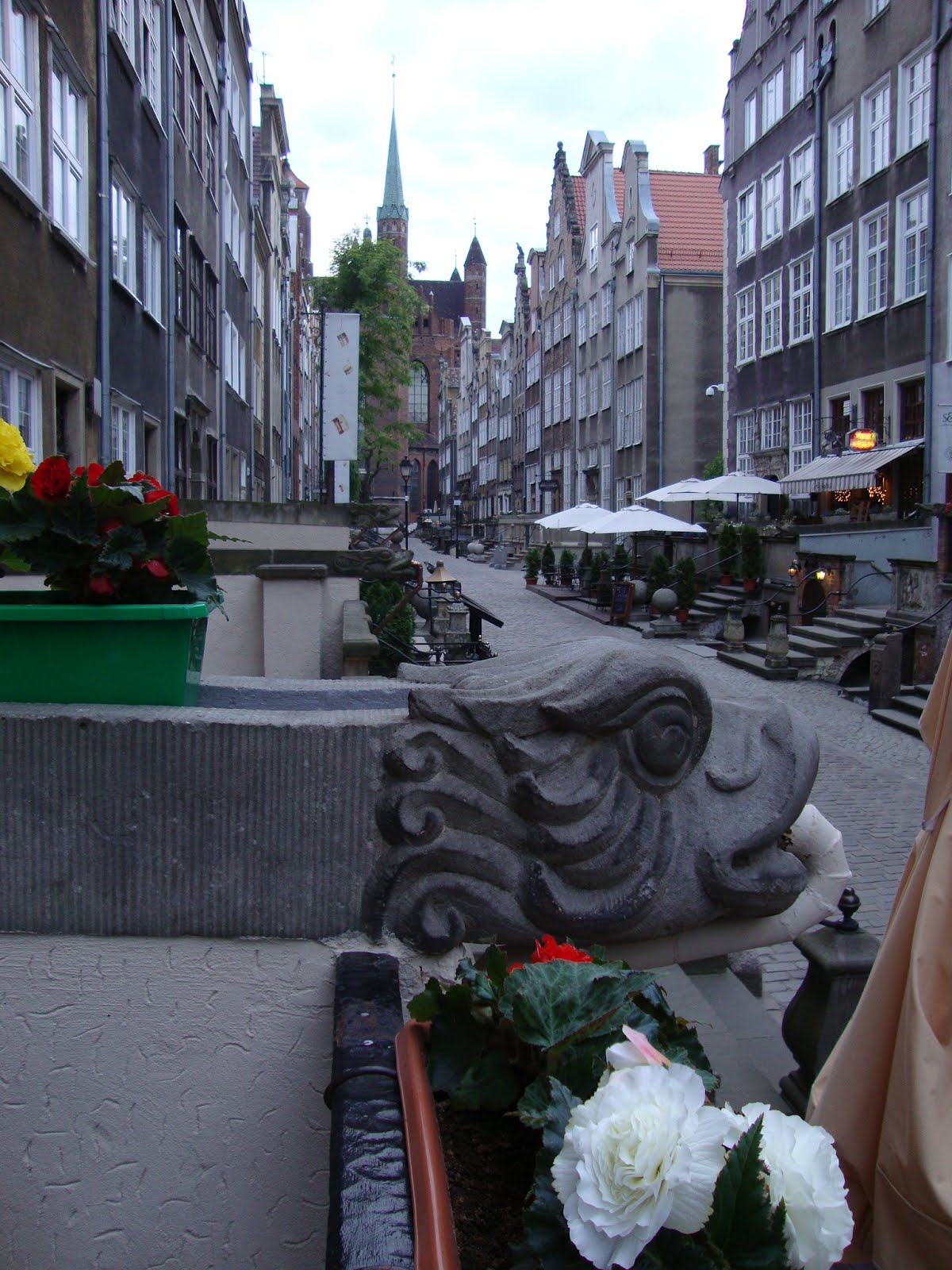
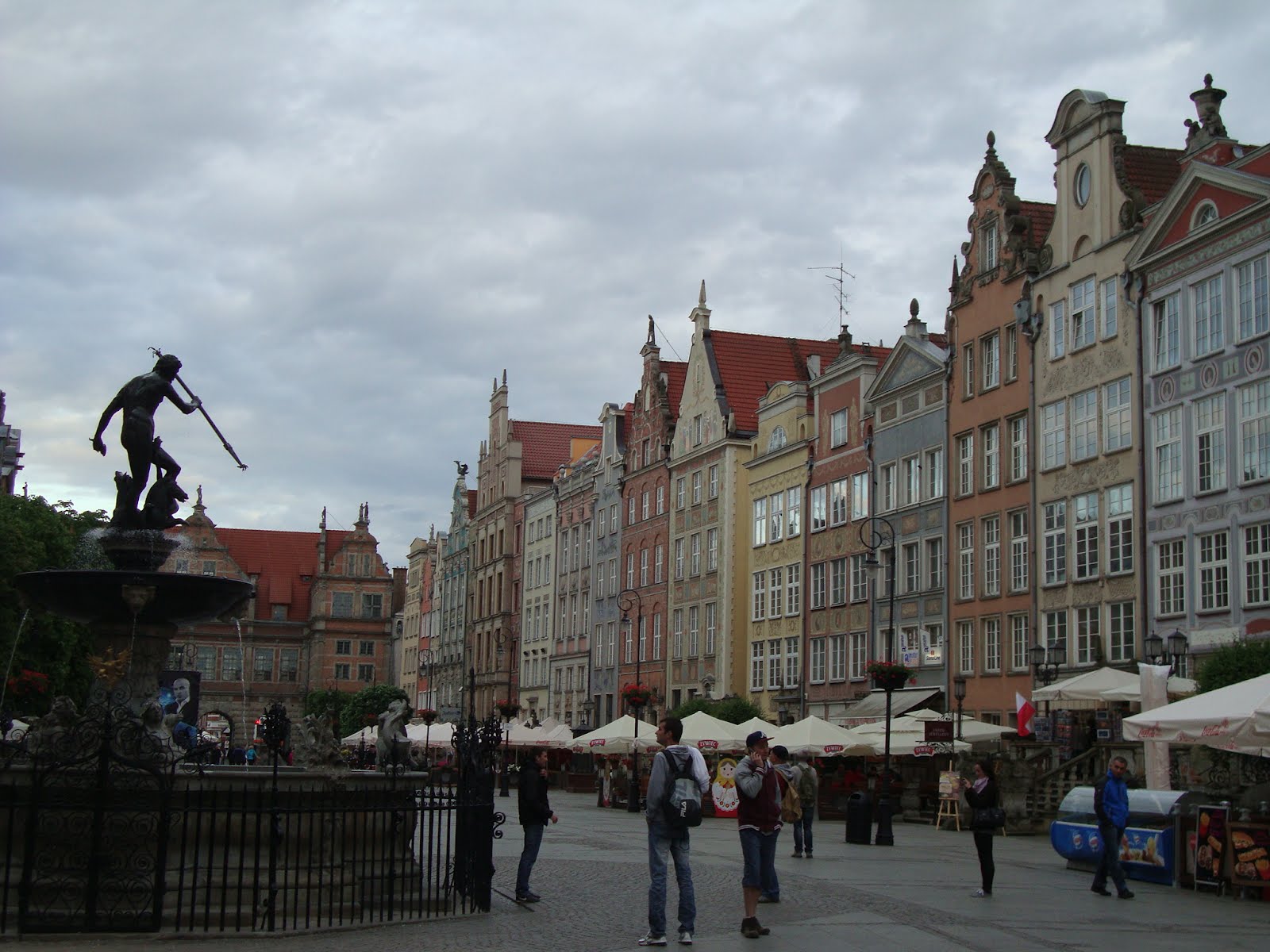
Finally, Gdansk. I travel there to a conference at the University of Gdansk, East and Central Europe in Exile: Patterns of Transatlantic Migration, organized by a large group of partners, headed by the indefatigable Dr. Anna Mazurkiewicz. I'm to speak about exiled composers, but before that happens, I revisit the sites of my own exile and those of my family. The residents are justifiably proud of the recently completed restoration efforts that transformed the Old Town of this Hanseatic sea-bound city, into a real gem filled with amber necklaces and artwork. After my poetry reading on "Aliens in California" (illustrated with photographs and artwork of my California friends) and before the conference begins, I walk through the narrow, streets lined with peaked houses all decorated and colorful. It is much more beautiful than I remember from my childhood at my aunt's home. At that time, in late 1960s and early 1970s, large swaths of the Old Town were still in ruins, only the main street and a couple of side streets were restored, while across the Moltawa river you could see the empty holes of the window, roofless brick walls. It was a scary place then, with so many areas barren, a real wound of the war. But it is completely different now...

My mother's aunt, Jadwiga Hordziejewska and her uncle, Dominik, lived there, after forced resettlement from their estate in what is now Belarus and used to be Soviet Union, near the lake of Switez, and Mickiewicz's hometown of Nowogrodek. They lost everything in that move, everything except for the one cow my uncle took with him to Oliwa. They used to walk through the parks and streets of the city for many years, an old gentleman in his top hat and the prize-winning Holstein black and white cow... He refused to speak to anyone, Ciocia Jadzia worked to support the family, while her husband grieved, frozen in the past, unable to accept the present.

The builders of these old towns, and those who restored them to their colorful and welcoming charm, tell us that we should cherish the past, though never forget what pain was wrought upon us.

Thus, we should always cherish the little flower of "niezapominajka" - forget-me-not. In an old children's verse it is "growing at a stream, looking at me with its blue eyes, and whispering modestly: "do not forget me."

We should not forget what made us who we are. I talked about remembering and being either petrified by grief, loss and guilt, or just remembering the past moments, as beads on an necklace. I even wrote about that lamp I photographed in Jelonki, Warsaw, with the snowflakes twirling in its yellow glow. This poem first published in Miriam's Iris is a suitable tribute to a travel back in time and into the future of being an emigre in California. On the occasion of this long, sentimental trip through my favorite landscapes, I decided to reproduce it for my readers.

Prelude - Water Charms

I.

The hummingbird builds its nest.
Its thin beak – the stem
of a multicolored jewel
sparkling in the sun
(a copy of its own similitude) –
holds the glistening body aflutter.

Rose bushes wear diamonds,
well-polished – their colors change
with the breeze
like the bird’s shiny feathers.

My Californian garden
tries to seduce me
with precious necklaces
and melliferous strains
from the mocking bird
hovering above
the scent of gardenias.

“All right” – I say –
“Don’t play games with me.
I’ve seen it all before.”

II.

Pearls scattered on the meadow
tremble on the blades of grass,
hide in the hearts of clover.

The sun shines straight through their ovals,
translucent, in a bright shade of green.
Stalks bend under their glassy weight.

Tempted by curiosity,
I destroy their perfect balance,
depriving the world
of its well-deserved splendor.

The droplets fall
to the ground and disappear.
How shall I ever be forgiven?
My wickedness – unthinkable.

III.

Dead leaves seek shelter
under thin panes of glass.
Ice covers pools of rainwater.

The stillness mocks past intimacy
when noisy reds, yellows, and browns
flew up from under my feet
in an autumn park
of maples and poplars.

I changed the future of the world
with one step of my boot:
the pane cracked,
the air bubbles shifted,
a the harmony was gone.

With glee I crushed the worlds
that did not need me.

I shudder when I look back –
a trail of footsteps
filled with muddy water,
dirt splattered on the geometry of ice.

IV.

The magic of white butterflies
twirling in the glow of street lamps
makes me dizzy. The black sky turns.
Bright spots move faster still.

I’m afraid. They chase me –
larger – whiter – denser
stars, monsters, snowflakes?
My scarlet fever began that night. V.

Winter morning reveals its treasures.
Leaves, cones, twigs, tree-trunks,
even pebbles on my path
wear bristling coats of crystal ice.

The pearl-grey sky is a bride’s dress,
waiting to burst open with new life.

The clouds settle on their beds.
Houses, bushes, roofs, fences,
dress in white muffs,
scarves and blankets.

The fence boards,
stiff like British soldiers,
present puffy hats to the Queen.

I admit it. I cut their heads off
with my red-gloved hand,
leaving behind a line
of headless corpses –
oh, silent horror!

VI.

The damage that cannot be undone –
melting the universe of beauty
with one breath
that changed a snowflake
into a dirty spot on my glove.

Slowly walking into
the immaculate field of whiteness,
I scarred the snow’s pristine expanse
with clumsy footmarks.

VII.

Again: plunging into
the smooth expanse of a lake,
I broke its sleepy obsession
with mirroring the evening sky.

I paid for my guilt with exile –
a foreign country, a borrowed name.

Crystals do not charm me in the desert
where Joshua trees parody my gestures
of praying for snowflakes
by stretching their twisted limbs
into the purple sky.

No hope for maki, chabry, and rumianki.
My childhood flowers
won’t be found on the meadow
painted yellow by the spring
across the barren slope
I see from my kitchen window.

VIII.

I’ve dreamed of being happy
in the sweet impossible,
with Italian cypresses, ice plants,
and a white fence around my house.

But my memories trap me.
Only the hummingbird
floats around, twitching its tail
like a miniature goldfish.

Maki – wild, red poppies (Papaver rhoeas); chabry – blue Centaurea cyanus, and rumianki – white chamomile daisies, grow in the meadows and fields of Poland and throughout central Europe.

________________________

And here's my bouquet of "niezapominajki" from the Royal Baths Palace at Lazienki Krolewskie. Do not forget me, or so they say...