Showing posts with label Holocaust memorial day. Show all posts

Wednesday, April 15, 2015

Holocaust Memorials and Reviews of "Slicing the Bread" Poetry Chapbook


The "Slicing the Bread" poetry book is starting to make waves. I did some readings, and sent some review copies, and the results are starting to appear in print and online.

The poems also have a life on their own, in their proper context.  One of my poems dedicated to the victims of Holocaust, heard not seen ("Bees and the Breeze") was just reprinted in the 17th Annual Yom HaShoah (Holocaust Remembrance Day) issue of the Poetry Super Highway, managed by poet Rick Lupert. It is my second time in this commemorative issue, another poem was published two years ago. There are just a few poems about the Holocaust and its witnesses in the "Slicing the Bread" book. I'm honored to be among the distinguished group of 40 poets, each with a different story to tell, a bitter family history, or a reflection on the unimaginable. It is now children of survivors, children and grandchildren of victims who take upon themselves the task to remember.


http://poetrysuperhighway.com/psh/2015/04/annual-yom-ha-shoah-issue-2015/

Rick picked a photo from the death camp of Majdanek, where many people from Lublin and Warsaw died; these areas are my ancestral lands, so it is good to share this, lest we forget who died, how and why...

_________________________________

The best response to so much suffering is silence, prayer and a resolve to not allow anything like that to happen again.

Like that - wars for financial gain, wars for territorial expansion, genocide for financial gain, genocide for "Lebensraum." We do have such wars today... And what are we doing about them?

             An Intermission

              She stopped waving the flag at the passing troops
              to sigh and say: "It is not my fault. I did not kill the children."
              "I did not want this to happen. I did not know..."
           
              He stopped singing the anthem with a hand on his chest
              to sigh and say: "It is not my fault. I did not carry the gun.
              I did not vote for the war. I did not vote at all."

              Why are they saying these things then, if they are not guilty?
              These innocent bystanders, the witnesses that did nothing,
              The silent, self-righteous ones... Their silence devours their souls.
           
              Their silence screams in the town squares. Their silence
              stifles the breath in their lungs.  This silence spreads quickly 
              like the plague of indifference. It is the death of all of us. 

                                                                                 Maja Trochimczyk, April 2015.
           
_____________________________

I have been so pleased that the two reviews published so far of the book have been so positive. I enjoyed the endorsements of my poet friends:

According to Pulitzer-Prize nominated poet John Guzlowski, These “poems about what the Poles suffered both during World War II and The Cold War afterwards are written with the clarity of truth and the fullness of poetry… Here are the stories of how the people she loved experienced hunger and suffering and terror so strong that it defined them and taught her, and teach us, the meaning of family.”

The Tieferet Prize winner and Poets-Café host Lois P. Jones points out that “Maja brings the Warsaw of her youth and that of her ancestors into vivid and heartbreaking detail. These are words that will move you to appreciate the simple privileges and necessities of life. Slicing the Bread is a feast in our universal and ever present famine.” As Jones wisely observes “It is the duty of the poet to convey story, but it is the art of the poet who can transform our often cruel and brutal history and affect forever, the way we look and listen to the world.”

According to Zofia Reklewska-Braun’s review of this volume (Goniec, March 2015), “One wants to read these poems. They attract the attention of the reader, from the first to the last… They are poignant, engaging. The readers’ own memories may become superimposed on these poems, if the reader is a Pole or a Polish Jew. The poems force one to reflect about the painful events from the modern history of Poland.”

Quite fittingly, Zofia Reklewska-Braun's review was printed in a Polish American periodical "Goniec."  This book, though about the War and its aftermath in Poland, is written for Polish Americans and for Americans, for those who do not know. All the families that I knew and was a part of had their stories similar to mine, some with more heroism, others with more suffering. None - not affected.

 http://www.goniec.net/goniec/inne-dzialy/goniec-poleca/poetycki-podr%C4%99cznik-przetrwania-maja-trochimczyk-%E2%80%93-slicing-the-bread.html

__________________________________

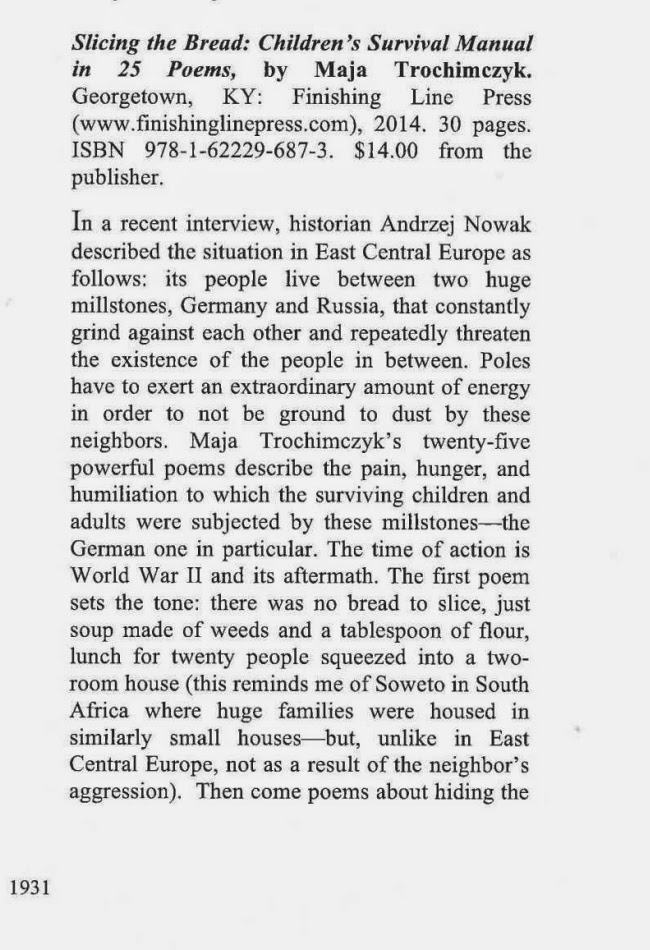
The second review, this time in English, appeared in the venerable Sarmatian Review published by the Polish Institute in Houston, Texas (April 2015).  The review by Sally Boss, one of the founders of the Sarmatian Review, praises the insightful yet hopeful poems that "describe the pain, hunger and humiliation" of the victims of the two huge millstones, Germany and Soviet Union, that "constantly grind against each other and repeatedly threaten the existence of the people in between" (a metaphor borrowed from historian Andrzej Nowak). 

"Then death, death, and more death - but not the anonymous death of millions, rather the loss of fathers, mothers, uncles, and aunts - sometimes in twenty-four hours, as when the incoming Soviets shot the narrator's uncle int he street and shipped his wife and two sons to Siberia, all in twenty-four hours."  The ray of hope found in this book is credited to the "delicacy and gentleness" in approaching the suffering, without condemnation of unnamed murderers, just as a  tribute to those they killed. 


Monday, January 27, 2014

Day of Remembrance at the United Nations and in Family History


On January 27, 1945, Soviet troops came into the largely empty death and concentration camps at Auschwitz-Birkenau. Its prisoners were sent on the death march towards Germany. Only few were left behind. The United Nations selected this day to establish the International Day of Commemoration in Memory of the Victims of the Holocaust. The more time passes since the war, the more people want to forget or deny that it happened. It is important to remember. All the more so, that people who have seen and heard what happened when it happened are dying out. It is important to record their memories, even if these memories are not exact and fit for official historical record. Even if they are garbled in family stories, passed on from grandmother, to mother, to daughter, transmitted from grandfather, to father, to son.

 Born in Warsaw, Poland, with ancestral roots in Podlasie and Kresy - eastern borderlands of Poland, Lithuania, and Belarus, now divided between these three countries - I used to travel to visit the tombs of my grandparents every October, for All Souls Day, Zaduszki. On the way we passed through a small town with a cemetery right by the road. What happened is in my poem.

Zaduszki

The arch of candlelight in the night sky
above the town of Kałuszyn greets them on the way
to the grandparents’ village. Zaduszki.
All Souls’ Day – the annual visit to the cemetery.

They drive towards the yellow halo
above charcoal horizon. Aunt Basia reminds her:
You have to remember. This town was Jewish
and they were all killed. There’s nobody left
to light a candle for them. They don’t even have tombs.
They were all taken, all murdered.
Other people moved into their houses.
Beyond the moss-covered stone wall
of the village cemetery in freshly plowed fields
her grandparents twin tombstones
rest in the reassuring golden shade
of ancient chesnut and oak.

Candles, chrysanthemum, flower wreaths.
They walk in the rustling leaves,
pray, think of the past.
She tries to imagine the empty town,
the unnamed strangers.

Thirty years later, in Montreal, she sees her first Jew,
in a long satin robe, yarmulke, with curly locks of hair.
She smiles, finally relieved of her duty.
They remember.

(C) 2014 by Maja Trochimczyk

This poem is a part of a new book I suddenly started writing, What Children Learn from War with bits and pieces remembered by my parents, my grandparents, my friend's mother. With bits and pieces heard and seen. With lessons what to do and how to behave to survive. I started thinking about it because I had to. Invited to a conference on "The Musical World of Polish Jews, 1920-1960" at the Arizona State University in Tempe, I decided to educate myself on the historical context of the musical lives I was writing about. My study of "Jewish Composers of Polish Music in 1943" evolved into a different paper, seeking to show the extensive presence of Jewish musicians in Polish musical life in the interwar period, and their displacement or destruction afterwards. For the context, I read some books, then decided to see what happened and, thanks to YouTube, was able to watch documentaries. The most striking one was about the trials of German guards caught by Soviets at the extermination camp in Majdanek near Lublin. Their complete lack of remorse, their inability to understand that what they did - kill Jews - was wrong. They turned to their accusers, not comprehending: "But we did not kill you, guys. We had to do what we did. We just killed Jews."

For these men, quickly relieved of their lack of comprehension by the "guilty" verdict and a public execution, the Jews were not human beings. Over 100 death camps guards were convicted and executed in Poland, under Soviet rule, only about 10 in Germany, liberated by American and Allied troops. The purpose of remembering the Jewish victims is obvious: this was an unprecedented crime against humanity, crime against all of us.

I went to the U.S. Holocaust Memorial Museum for the first time this year. I was very impressed with the scope and tone of the exhibits. As a Pole, I was also grateful for an extensive and fair portrayal of the suffering of all Polish people: the Slavs, in accordance with their name, given to them back in the times of the Roman Empire - sclave/slave - were to be slave laborers. Their leaders - teachers, priests, university professors, officers - murdered, their schools and colleges closed. Poland was the first country invaded by Hitler that fought the invasion. The first country that never formed a government supportive of the Nazi rule. The country with over 400,000 people involved in the  underground Home Army - armed resistance. The country with the largest number of the Righteous among the Nations in the world.

Some people want to use the term "Holocaust" for other victims. It is and should be limited to the Jews and Gypsies, who were both scheduled for complete annihilation. It is hard to visualize a crime of such monumental proportions, executed in a frenzy, accelerating towards the end of the war: when all was lost and the ring was tightening around Germany, they still have time to kill the Jews. Calling it crazy does not do it. But visiting the Museum is a step towards understanding.

One exhibit struck me - the photographic record of the entire shtetl of Ejszyszki, from 1890 to 1942. All its Jewish inhabitants were killed but the photographs somehow survived and now form the inside of a circular tower that spans several floors. You can look up from the ground floor and see the small photographs way up high, with details disappearing. You can look down from the second floor and see the generations receding into shadows. The exhibit is masterly, as it brings the ordinary lives of ordinary people to our attention. Just like you and me. They went to school, worked, married, had fun, posed for family portraits... This exhibit filled in the blank that I had in my mind about that empty ghost town of Kaluszyn that we drove by each year and I had to remember. I did not know what to remember, just that it was empty after the war. So this is how these people looked like. Us. I went into the Hall of Remembrance, lighted a candle - just one candle - for all the people from Kaluszyn whom I never knew. Never had a chance to know. Germans made sure of that. I also lit a candle for the victims from my mother's family.

Thanks to the efforts of family historians Waldemar Wajszczuk and Barbara Miszta, we know how many people in the extended Polish family Wajszczuk from Podlasie have been incarcerated in Auschwitz, who died there. Who was a prisoner in Sachsenhausen, Dachau, Majdanek. Who died there.  www.wajszczuk.v.pl

My family is not Jewish, yet claims quite a few victims. And freedom fighters. Father Karol Wajszczuk (b. 1887 – d. 1942) was a prisoner of the Lublin Castle since April 1940, he was then moved to Sachsenhausen and then to Dachau on December 14, 1940. He died on 28 May 1942 in the Castle Hartheim in a gas chamber built to exterminate the disabled for the Euthanasia program. His father, Piotr, was the brother of Franciszek, the patriarch of the Wajszczuk-Trochimczyk branch. He was a chaplain for a small cell of Polish freedom fighters, an underground group called "Our Eagles" and including the following men: Stefan Kowalczuk, Bazyli Łaźko, Adolf Młynarczuk, Feliks Szafrański, Józef Krawiecki, Tomasz Stańczuk, Jan Dąbrowski and Bolesław Hawryluk killed in Auschwitz; Stanisław Daniluk arrested and murdered by the Gestapo in Radzyń Podlaski; Jan Ciechowski and Jan Saczuk, also murdered by Germans. "Only Jan Kozłowiec, imprisoned in the Lublin castle, was rescued by members of the Warsaw diversion section of AK" - states the memorial site for Father Wajszczuk in his home parish of Drelow.

His cousin, Father Feliks Wajszczuk (b. 1902 – d. 1973) was in Sachenhausen, then in Dachau since 14 December 1940 and was liberated by Americans on 25 May 1945. He spent the rest of his life in a monastery in France, since his damaged health did not allow him to work. All together, seven members of the extended Wajszczuk family were imprisoned by the Nazis at the infamous Lublin Castle. Two died there and one, Józef Wajszczuk, died in Auschwitz where he was sent in April 1942 and died on 20 December 1942. “Known” as “Mały” he was a member of the Polish Underground (Home Army). Three other members of the extended family were killed fighting in the Warsaw Uprising in 1944: Barbara, Wojciech, and Antoni Wajszczuk. They followed in death their father Edmund (Karol’s brother) who was also involved with the Polish underground.

I wrote about them in two poems. Their memories should be carried forward to the younger generations. I did not want to know, did not want to remember. I was "allergic" to all these monuments to the victims, commemorations, the entire month of April spent on national "martyrology"... Too much for a teenager wanting to study music, read books, go to art exibits. Too much for a young "social butterfly" flitting from an art opening to a new music premiere.


Standing Guard

Enough with the cemeteries, martyrs.
Who cares? Not she, forced to stand
at a tombstone for some fifty strangers
in the freezing rain of April.
She shivers in a white shirt, pleated navy skirt,
a school sweater. The longest hour
of her ten young years.

Someone gave her an ugly beret
she would have never picked. A red tie?
Not allowed to move, sit, turn, frown,
or scratch her nose. Not allowed to talk
to the other girl. No smiling either. Eyes fixed
straight ahead, looking at a distant point.
The longest hour. This is how the dead
consume the living. Reverse cannibalism.

Would she have been more willing
had her parents told her?

Two great uncles, priests held at Dachau:
one relieved of his ills in a gas chamber,
one liberated, with his body, spirit broken.
A fighter of the Polish underground killed in Auschwitz.
Two others hanged in the Lublin Castle.
A denounced Home Army soldier
who came back alive from Majdanek and Gross Rosen.
Three siblings went to fight in the Warsaw Uprising,
were buried in ruins in September 1944.
Those who perished in the Soviet Gulag.
That officer shot in Katyń.

The list goes on and on.
Is that what a ten-year-old should learn?

The list of my family's victims includes freedom fighters, members of underground resistance. Not ordinary children, babies, mothers, grandmothers, wheel-chair bound invalids. It is the killing of ALL that is unique to the Holocaust. It is the killing in the name of making a new, better world. This, too, we have to remember.