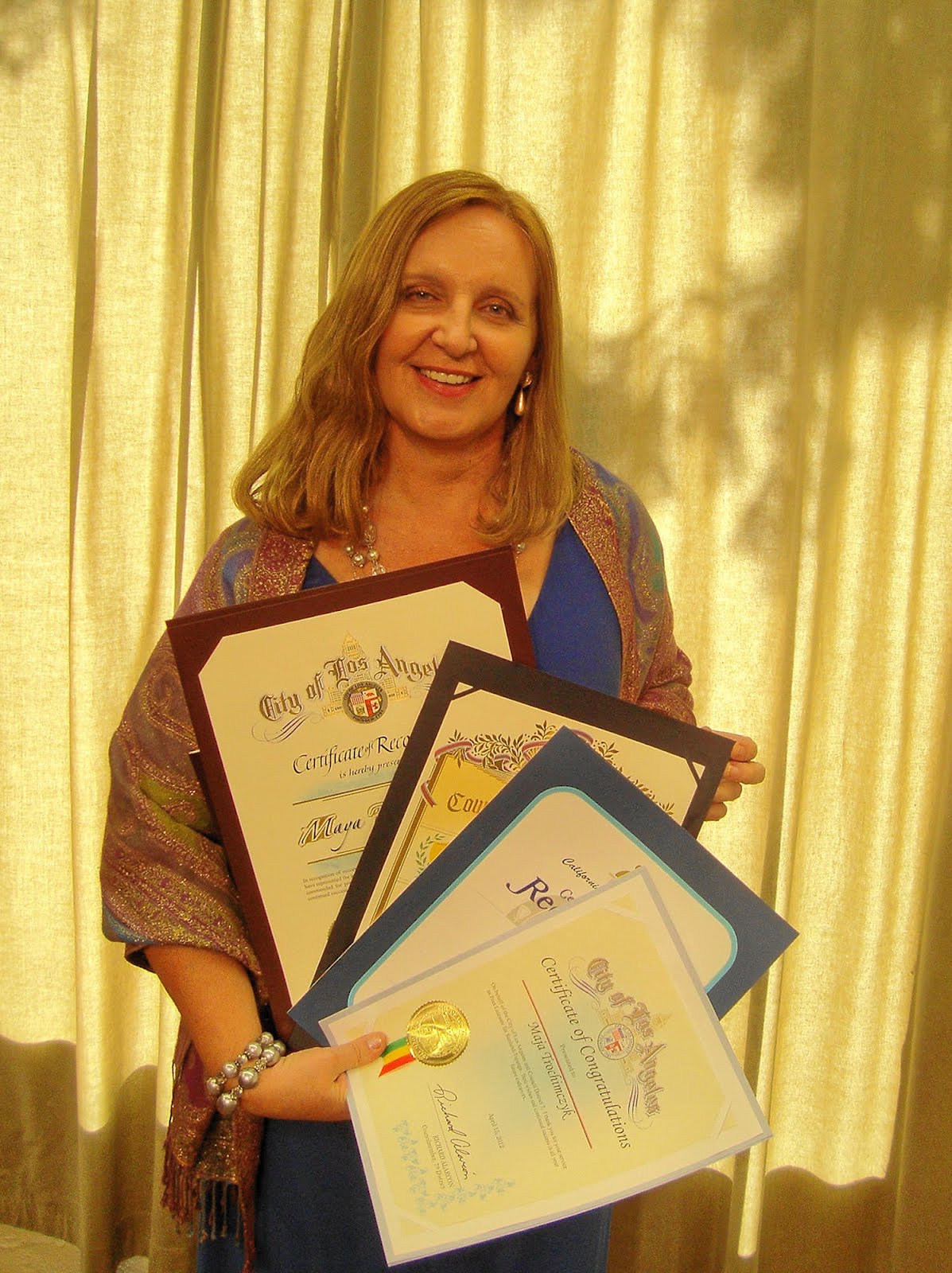
 On Sunday, April 15, 2012 my adventure as the Sixth Poet Laureate of Sunland-Tujunga ended where it began: at the McGroarty Arts Center in Tujunga. I invited friends - poets and musicians - to share the spotlight with me and I took off the laurel wreath and placed it on the head of my successor, Dorothy Skiles.
 The ceremony, MC-ed by Joe DeCenzo, and introduced by the Director of the McGroarty Arts Center, Claire Knowles, included awards presentations, poetry, songs by William Lenaburg, and speeches. My own speech is copied below in italics.
Ladies and Gentlemen,
My “elevated” position in the community as the Sixth Poet Laureate of Sunland-Tujunga is ending. I did not know what to expect and where this adventure would take me when I declared that I would like to make my motto “poetry in pursuit of happiness...” There is only one country in the world that has the Pursuit of Happiness as a constitutional right. … My pursuit took me far and wide.
 During the past two years, I worked with some of the most amazing poets and musicians, including Kathabela and Rick Wilson of Pasadena and Just Kibbe of Sunland. Kathabela and Rick are founders of the Pasadena group Poets on Site that I have belonged to since its creation over four years ago. I often participate in their readings and Rick accompanies me on some of his flutes, as he will do later today. His day job is as professor of mathematics at Caltech… Kathabela and Rick are dear friends of mine and I greatly appreciate that they agreed to come and perform for us today. I wrote about a hundred poems for their projects. Instead of me talking about them, let me then introduce them to you and let them take over...
[Kathabela and Rick read three of her poems, including a brand-new one dedicated to Sunland-Tujunga, and one with Just Kibbe: “Everything I Ever Wanted,” “Something Green” & “Time Begin Again”]
The next guest lives closer to us, Just Kibbe, originally from a farm near Fresno, is now a proud resident of a home near Sunland Boulevard. He is an endlessly inventive poet who was able to create poems from text message abbreviations, create a Three-Ring Poetry Circus, and establish a publishing house and a journal, The Pirate Pig Press and its associated productions. Just has written poetry on just about everything, including a very long rattlesnake skin, burned wood, and walls of public urinals. I mean he did not write ABOUT, but literally ON these things. He has something quite different for you today - a set of love poems. I think it is a bow to my original presentation two years ago, where a portion of my reading was of love poems.
 [After sharing the mike with Kathabela in her "Time Begin Again" Just Kibbe read three poems: “After Eleven,” “Love Seat Love” & “Butterfly Love." He was accompanied by Rick Wilson in some of them.]
These were my Poets on Site. The next group that I volunteer for is much closer to home. Village Poets of Sunland-Tujunga is a local collective – we organize monthly readings of Sunland-Tujunga and consist of current or future Poets Laureate of our wonderfully twin towns. The next poem you are going to hear was written by Joe DeCenzo the Third Poet Laureate and will be read by the group including also the First Marlene Hitt and the Sixth, myself.
[The group reading of "Entitlement" followed - with Marlene Hitt, myself, Lloyd Hitt, Dorothy Skiles and Joe in charge. He had earlier read another poem of his - in the introductory part of his remarks.
 Following the guest readings, Joe DeCenzo presented a variety of awards from local state, county, and city officials as well as community organizations - commendations and expressions of appreciation for my work and congratulations for Dorothy. My list of honors included additional scrolls from: State Assemblymember Cameron Smyth; Supervisor Michael Antonovich; Councilman Paul Krekorian of District 2 (current district for our area), Councilman Richard Alarcon of District 7 (future district of S-T), the Rotary Club of Sunland Tujunga, and the McGroarty Arts Center Board Member, Ed Novy. Dorothy had the same set, minus a scroll from Sup. Antonovich that she had to earn, but plus a certificate from State Senator Sharon Runner.
 We had the distinct pleasure of welcoming representatives from these governmental offices, including Councilmember Paul Krekorian both in person - with a lovely speech - and represented by a senior staff member from his office. Jaimie Rodriguez from the office of Councilmember Richard Alarcon turned out to be a spoken word artist and he proved his chops by reciting a poem about his father. Then, it was time for me.]
Looking back at the past two years, I see a pattern in being inspired mostly by beautiful artwork and landscape that “speak” to me when I look at it. I write it down for myself and others so they can see the world through my eyes. I also write reflections on nature and spirituality.
During my tenure as Poet Laureate, I started two poetry blogs, one called “Chopin with Cherries” after the book I published in 2010 and dedicated to poetry about Chopin, a composer I love. The other one is called “Poetry Laurels” and includes reflections on poetry and poems. Together, they reached over 25,000 people in the U.S., India, England, Canada, and other countries. I also maintain the blog for Village Poets!
 Locally, I rode twice in the Fourth of July Parade, in a specially decorated convertible, giving away poems. I read poetry to children at Watermelon Festivals and brought a lot of featured poets to Bolton Hall Museum readings of Village Poets. I think I booked 90% of readers there. I published a whole lot of poems and a new column in our wonderful community paper, The Voice of the Village. I edited a whole book, “Meditations on Divine Names” – this book will be the most lasting fruit of my tenure as the Sixth Poet-Laureate in Sunland-Tujunga.
 All creative individuals reveal their own deepest sense of self - emotional, intellectual and spiritual in their works. They do so by directly expressing themselves and by avoiding themes of no relevance to them. But is this “self-revelation” the main value of art? What about the audience?
 I hope that my listeners find something of themselves in my reflections, impressions and memories transformed into poems. My quest for being remembered may be summarized in the Latin motto “non omnis moriar” (not everything dies). Survival - cheating Death out of her triumph - is the most powerful motivation for "the pursuit of happiness" through poetry and art. I entitled my set of poems, my Swan Song. . .
[I read “The Veil, the Weave” – with Village Poets; “Easter Apocalypsis” – with William Lenaburg, guitar; “My Sky” – with William Lenaburg, guitar; “Awakenings” – with Rick Wilson, flute; “A Box of Peaches” – with Rick Wilson, flute. Since these are some of my favorite poems, I have already posted them on this blog. . .]
 I first met Dorothy when I was being inducted as the Sixth Poet Laureate of Sunland-Tujunga. She brought a whole bunch of congratulatory certificates for me – that left me speechless! Since then, I have come to know her personal generosity much, much better. She has served as the President of Village Poets and has put together the calendar, booked dates, and promoted our events. She has been reliable and supportive, generous and even-minded. I cannot think of a person who is doing more for the poetry community in Sunland-Tujunga. She herself will tell you what her plans are, and her tenure will be different from mine, but not less fruitful. I will just tell you a little bit about her.
 The first poem she wrote was about her grandmother who died when Dorothy was fourteen years old. While married, raising twin boys, and managing a career, working for the Los Angeles County as a social worker, Dorothy published several chapbooks, including Spine Flower Blues (1999) with fellow members of the Chuparosa Writers, and Riddle in the Rain (2003) - a joint venture with Marlene Hitt. She has been involved on the local poetry scene reading and organizing community events. She will be an excellent leader of poets in our neighborhood.
 Alas, now comes the part that I have dreaded for quite a while now. Time to part with my crown! I have to take off the wreath I made from olive branches and place it on Dorothy's head. I went to an olive tree on Marlene's street with large scissors and had to explain to the owner the purpose of my attack on his tree.
 Olive branches are quite symbolic in their own right - the branch of peace, the oil poured during crowning ceremonies, the symbol of the spirit.... Olive – the tree that symbolizes peace and wisdom. . .
The truth is we could not find a laurel bush in our neighborhood, and decided that olive would look better. So now, ladies and gentlemen, here is the reason we have gathered here today. First, comes the crown.
 Second – the heart. I got a little plastic heart two years ago with some dried leaves from my predecessors' wreaths, as a symbol of continuity. I promptly lost it, or thought I did, so I bought another gold heart locket to replace it, just in case I had to show that, indeed, I still had a heart. Then I put it in a music box until two days ago, when, again I lost it, with the box, and all. But it turned out last minute when I was leaving for the ceremony, in time to pass it on. Now Dorothy has not one but two hearts, one from the founders But I found it. The leaves in the heart are from the same olive tree that the crown is made of.
 Third, we have to unveil the plaque that records all the poet laureate names for posterity and is kept at the McGroarty Arts Center. And here it is...
Ladies and Gentlemen, I present to you Dorothy Skiles, The Seventh Poet Laureate of Sunland-Tujunga. Congratulations, Dorothy!

L to R (front): Marlene Hitt, Joe DeCenzo, Kathabela Wilson, Just Kibbe, Rick Wilson. Back: Maja Trochimczyk, Dorothy Skiles, William Lenaburg, Lloyd Hitt, Mira Mataric.
A report in the Crescenta Valley Weekly by Robin Goldsworthy, April 19, 2012: "Skiles Honored as a New Poet Laureate of Sunland Tujunga."

With the Laureates' "laurel heart" and a music box. Quotation from "Tiger Nights" published in The Epiphany Magazine and Rose Always. Portrait (C) 2010 by Ronna Leon, Used by Permission. August 2010, McGroarty Art Center
The
motto for my two years as Poet Laureate was
"Poetry ... in pursuit of
happiness"
My activities have included public readings, appearances at
civic ceremonies, participation in art festivals and community events. I have
also decided to publish an anthology with work by local poets. The anthology
evolved into a somewhat different project, an anthology of spiritual poetry,
Meditations on Divine Names which appeared in March 2012. You may see the list
of events below.

With Marlene Hitt, first Poet
Laureate of Sunland-Tujunga. April 25, 2010, McGroarty
Art Center, .
On April 25, 2010, the Passing of the Laurels Ceremony was held
at the McGroarty Art Center, Tujunga, with Joe DeCenzo doing the honors on
behalf of the Sunland-Tujunga Poetry and Literature Committee. The event
included presentations by Claire Knowles, Director of McGroarty Art Center,
Dorothy Skiles, President of Village Poets, Mary Benson from Paul Krekorian's
office, music performances and poetry readings by Joe DeCenzo, Elsa Frausto and
myself. I received Certificates of Congratulations from State Senators Bob Huff
and George Runner, and Los Angeles Councilman Paul Krekorian. My reading
included a poem I wrote especially for this occasion, What I love in Sunland.
You may download the poem in Word format here. My Poets' Cafe Radio interview
with host Lois P. Jones was broadcast on March 30, 2011 and is archived on Tim
Green's Site.

With Dr. Blues, guitar, at "Imagine Poetry" Reading at the Sunland Tujunga Neighborhood Council meeting, March 8, 2011.
I participate as co-organizer in the monthly Village Poets Open
Readings at Bolton Hall Museum, where my role is to find and invite featured
poets, musicians and other artists. I write a monthly poetry column in The
Voice of the Village and maintain two poetry blogs, Chopin with Cherries and
Poetry Laurels. For more information, see events and readings, and photos from
recent events,

Chopin with Cherries reading at the Loyola College Chicago, November 2012.
PUBLICATIONS
My
tenure as a poet-laureate is documented in three poetry blogs and a column in
The Voice of the Village:
- ·
poetrylaurels.blogspot.com
- ·
chopinwithcherries.blogspot.com
- ·
villagepoets.blogspot.com
- ·
The
Voice of the Village (monthly)
·
On
the site for Moonrise Press, you may read about my four books:
- ·
Rose
Always,
- ·
Miriam's
Iris,
- ·
Meditations
on Divine Names, and
- ·
Chopin
with Cherries.
Some of poems from the Chopin with Cherries anthology were selected for the Cosmopolitan Review. Other poems may be found in chapbooks (Glorias & Assorted Praises, Poems for My Friend, and Poems and Stories), and other poems published on various sites, including My Sky, Photo Poem, a photo-album My Hat Collection, "Look at me..." in Loch Raven Review, A Monument of Time and Memento Vitae in Clockwise Cat (2009), and a recent publication of "Easter Apocalypsis" in The Scream Online Magazine of Art, Poetry and Photography, vol. 7 no. 4 December 2011. "Heaven and Hell" issue edited by John Z. Guzlowski.

AUDIO AND VIDEO
If
you want to hear my voice, listen to the interview with host Lois P. Jones at
the Poets' Cafe, on KPFK Pacifica Radio (Broadcast March 30, 2011), or to
"Illuminata" ("I want that crown...") on the Pacific Asia
Museum's website at the 2009 Audio Tour link, Himalayan Art Yab Yum and Crown).
A
set of poems inspired by Asian art is on Pacific Asia Museum's Audio Tour 2011,
maintained on Old Flutes Site by Kathabela Wilson. In September 2011, I
recorded these poems for the 40th Anniversary Audio Tour of the Museum. Each
poem is accompanied by Rick Wilson on an appropriate Asian flute. To listen you
may go to the Audio Tour 2011 on Old Flutes Site, or call the Museum: "A
Box of Peaches" written on the Gau Prayer Box, 626-628-9690, 455#;
"An Embroidery Lesson" 626-628-9690, 464; and "Smiling Buddha"
- 445.
A
recently created YouTube video channel for Moonrise Press features video
excerpts from various poetry readings, including the "Passing of the
Laurels" ceremony and other events. You may see my readings of the
following poems:
·
The
Arms of Mercy, Poetry Audio Tour , Pacific Asia Museum, August 22, 2009. http://www.youtu.be/52p-lWq2zxU
·
Ascension
(A Memorial Poem) dedicated to Barbara Koziel-Gawronski (1946-2009), read at
the Passing of the Laurels Ceremony, McGroarty Arts Center, Tujunga,
California, April 25, 2010: http://youtu.be/9gB9Yj9acaM
·
Claremont
Concert, read at the Passing of the Laurels Ceremony, McGroarty Arts Center,
Tujunga, California, April 25, 2010, published in poeticdiversity.org vol. 8
no. 2 (August 2008): http://youtu.be/ceX1_IWZW4Q
·
Green
Sea at Albian, (Cathedral), inspired by a painting by Milford Zornes of the
same title, read at "Three Generations" Exhibition, APC Gallery
Torrance, California, July 26, 2008: http://www.youtu.be/sCO7aSYXfgc
·
Illuminata,
Pacific Asia Museum Audio Tour, with Rick Wilson, flute, recorded at Pacific
Asia Museum, Pasadena, August 22, 2009, also posted on the museum's website and
published in the "Poetry Audio Tour" chapbook, Poets on Site,
Pasadena, 2009: http://youtu.be/mbiIMszaLwY
·
Illuminata,
written for Pacific Asia Museum Audio Tour, version read at the Passing of the
Laurels Ceremony, McGroarty Arts Center, Tujunga, California, April 25, 2010: http://youtu.be/Bst2kYh8ciM
·
'Look
at me...' , inspired by Ella Fitzgerald's "Misty" and a Sunday drive
to a Buddhist orchard. The first reading as Poet Laureate of Sunland-Tujunga,
at Bolton Hall Museum, Tujunga, California, May 23, 2010: http://youtu.be/TJzzOId3KCY
·
A
Magnolia Courtryard for Pacific Asia Museum Audio Tour, with Rick Wilson,
flute, recorded at Pacific Asia Museum, Pasadena, August 22, 2009, also posted
on the museum's website and published in the Poetry Audio Tour chapbook, Poets
on Site, Pasadena, 2009: http://youtu.be/1kOTn11xa1I
·
Mountain
Watch, at the first reading as Poet Laureate of Sunland-Tujunga, introduced by
Joe DeCenzo, at Bolton Hall Museum, Tujunga, California, May 23, 2010: http://www.youtu.be/MxlahG639pY

At the Art Exhibit at McGroarty Arts Center, 2012
·
An
Ode of the Lost, dedicated to Adam Mickiewicz and all Polish exiles. The first
reading as Poet Laureate of Sunland-Tujunga, at Bolton Hall Museum, Tujunga,
California, May 23, 2010: http://youtu.be/LWSOufEAk30
·
Of
the Mountains, inspired by a painting by Bill Anderson, "Foothill Rancho
Cucamonga, Cliff Road" and read at "Three Generations"
Exhibition, APC Gallery Torrance, California, July 26, 2008: http://youtu.be/TL3oXxJC-Bg
·
Passing
of the Laurels Ceremony for the Sixth Poet Laureate of Sunland Tujunga, with
Joe DeCenzo, McGroarty Arts Center, Tujunga, California, April 25, 2010.
·
A
Portrait in Brackets (Eidetic Reduction) at the first reading as Poet Laureate
of Sunland-Tujunga, at Bolton Hall Museum, Tujunga, California, May 23, 2010: http://youtu.be/eFhVhOAxbxM
·
Point
San Vincente, inspired by Milford Zornes's painting of the same title.
"Three Generations" Exhibition, APC Gallery, Torrance, California,
July 26, 2008: http://www.youtu.be/jLai-H7wf5A
·
Selected
love poems from Rose Always - A Court Love Story, poems no. 12, 13, 20, 52. The
first reading as Poet Laureate of Sunland-Tujunga, at Bolton Hall Museum,
Tujunga, California, May 23, 2010: http://youtu.be/k5W-X6mEygM
·
A
Study with Cherries, from the "Chopin with Cherries" anthology
(Moonrise Press, 2010), read at Kathabela and Rick Wilson’s salon, Pasadena,
August 8, 2009: http://www.youtu.be/ljaCVn9NZqI
·
Stravinsky's
Venice, inspired by Bill Anderson"s painting Venice, Italy. "Three
Generations" Exhibition, APC Gallery, Torrance, California, July 26, 2008:
http://youtu.be/hh6SWgsX09c
·
What
I love in Sunland, the first reading as Poet Laureate of Sunland-Tujunga, at
Bolton Hall Museum, Tujunga, California, May 23, 2010: http://youtu.be/I1DFKCDZ83s


