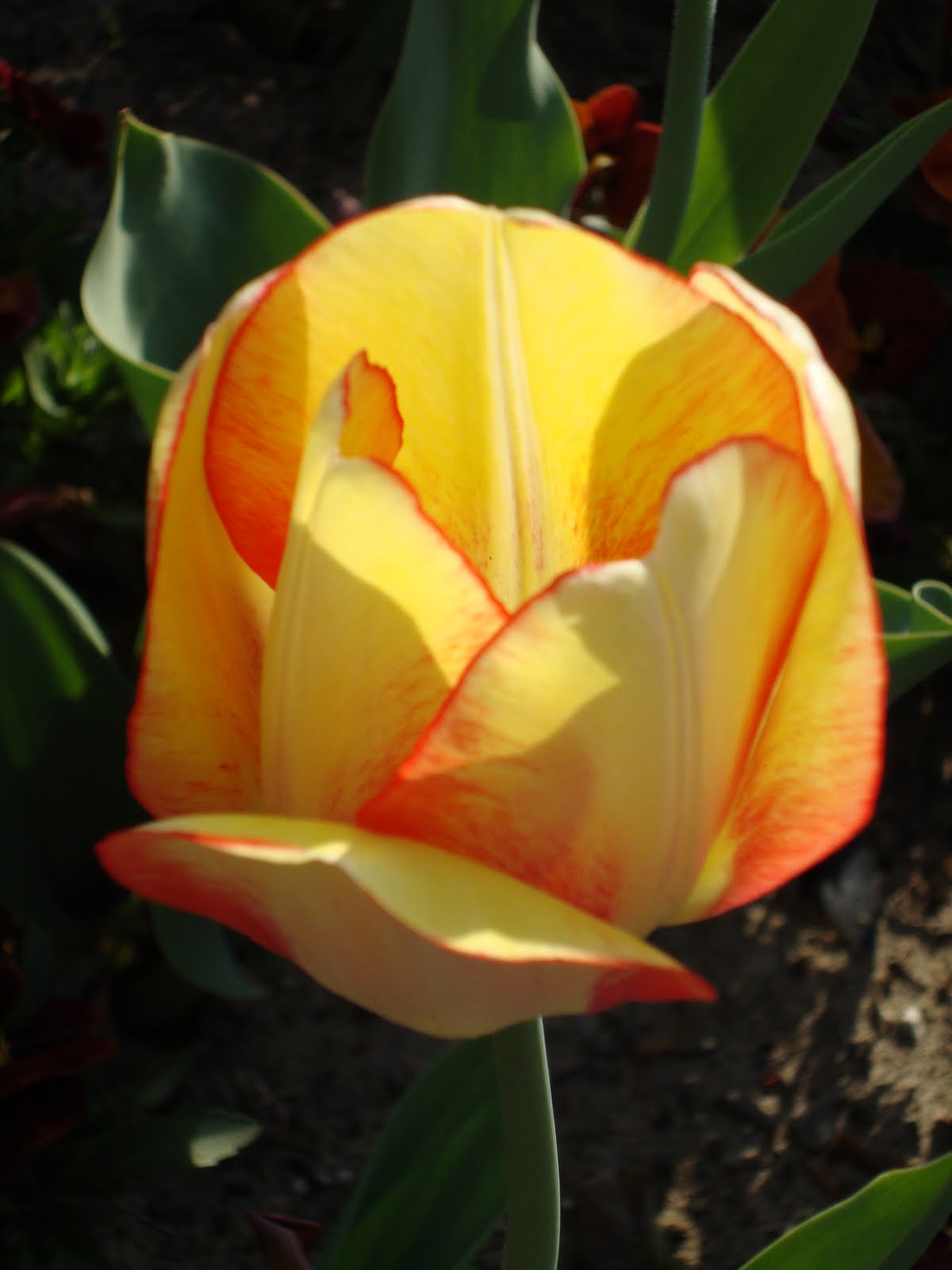
Sunday, June 26, 2011

Summer Blues in Indigo and Gold

You should never believe a poet. They make stuff up. They create worlds of words and twine. They always lie. Do they? Is a poem made of personal experience distilled into its essence that transcends the individual origins and speaks to millions? Is a poem a lesson in verbal pyrotechnics, exploding with fireworks of erudition, allusion and sophistication? Is a poem just a page from an intimate journal left to be read and pondered long after the thinker and the pen are gone?

The pen could outlive the thinker - we see the golden pens in museums. Would the computer do it, too? If the technology shifts as fast as it does, what could we put in our museums along with the clothes and plates and pillows of dead poets? Maybe their Kindles, laptops and smart phones that they use to read their work, scrolling down the screen with miraculously agile thumbs while holding the tiny device up in the air and squinting, because the font is too small in the feeble light on the stage...

Maybe nothing. Maybe there will not be any museums built for poets living today. Too many poets lived and died and clamored for fame already. There's no more space for museums, no space for new words to be added to the universe of language that surrounds us, that makes us who we are, fully human. Does it? Is language, fit for naming things and limiting them with a label, the answer? The only answer? Too many questions just give you a headache.

Mister Cogito wrote Zbigniew Herbert, taking his cue from the famous saying Cogito ergo sum... In her intensely intelligent essay, Oriana Ivy wrote an ode to non-thinking as a key to bliss. I followed another lead - into doubt (Dubito ergo sum , instead of Dubito, ergo cogito, ergo sum as Rene Descartes's dictum is sometimes rendered), but I will save it for another day. Could the poets say: Scribo, ergo sum? - "I write, therefore I am?" Sounds unusually boring. How about: Lego, ergo sum... or Recito, ergo sum... (I read, recite...) This does not work either. Amo, ergo sum - now, that's something altogether lovely, but we cannot be mono-thematic, can we.


I started public readings at Poets on Site various events around Pasadena and decided to start the summer with a reprint of one poem first heard in Torrance in the summer of 2008, the first reading that surprised me by the hushed attention of the audience. Everyone was silent, listening to my voice. An eerie feeling, even for a former college professor, used to inspiring silence in the classroom. The difference was that the poets were listening to my own words, not regurgitated thoughts of others. I start from this poem to welcome back our founder and leader, Kathabela Wilson and her wonderful musician-mathematician husband. They just returned from a long tour of China. The picture, by Milford Zornes is depicted in the lower left corner of the photograph. Susan Rogers, who later took my portrait above and called it "Maja Starlet" is standing and reading behind me.

Point San Vincente

~ inspired by a painting by Milford Zornes

Wincenty, my Orthodox great grandpa,
was a cipher I'll never unravel
except that the name bore a whiff
of old-fashioned stiffness.
Prim and proper, St. Vincent
was the patron of lovers in Poland
before the wave of Valentine's red hearts
swept aside such quaint traditions.
In France, old beggars crowded
to St. Vincent de Paul, the giver of bread
to the hungry, love to the afflicted.
In California, one young Vince was proud
of his middle name, shared with the saint.

A lone lantern shines in Vincent's name
onto deep ocean waters from the cliff
of last hope for those who lost
their most cherished treasure –
their life, drowned in the foam
of temptations, slowly strangled
by the fecund seaweed of desire.
Dangers lurk beneath the surface,
tentacled monsters wait
to pull weary swimmers under the waves.

Lasciate omni speranza say the gates
to Dante's Inferno. In the ocean,
Symbolophorus barnardi, the lanternfish
lures its victims with a false light
shining in the murky depths. The golden
sands announce the safety of shore. There is hope.
The light keeps calling: "Come to me,
come to Point San Vincente, come home."

______________________________________

This occasional poem brings together various Vincents from my life in a free play of associations, centered on the image of the light shining over the ocean. Since the inspiration was the painting of Point San Vincente, I skipped the obvious reference to paintings by Vincent van Gogh.

Three years later, on the way to work, I saw horses wondering around their enclosure and the image wrote itself into a poem of sorts. Still fresh and unfinished (too wordy), it brings together disparate thoughts and images in another play of associations.


Summer Blues


The bay colt learns
how to shake his tail
properly from left to right
looking at his mom’s smooth bronze coat,
swift movements. Three-times his size,
she does not mind the attention.
They trot around the enclosure
in locked step, their manes waving.

“You look like a tomato” –
my son notices my skin
burned by the first rays of summer.
“Sunscreen, Mom, it’s called sunscreen”
– scolds the girl, as cautious
as ever.

I wish I lived in Spain
danced the flamenco every night,
an outpouring of passion
distilled into gestures.
I wish I had a horse ranch
in Nevada – a big Stetson hat
and cowboy boots to shield me
from rattlesnakes, made of their skin.

I was a ballerina,
played in an orchestra,
baked Canadian muffins
I hated, with bran and molasses.
Choral singing, knitting
and embroidery - two perfect napkins
still await the half-finished
tablecloth with Art Nouveau flowers
entwined along the edges
in purple and gold.

Shape-shifting, I move
from place to place, life to life,
like a petal carried by the gale
above the ocean.

The colt will grow into a horse.
The children will find their paths
to make and follow. I’ll keep dancing
my solitary flamenco – black, twirling skirts,
fluid gestures cutting the air
that shimmers with the strumming of guitars.
Throaty voices tear the hearts
with nostalgia
for life that could not be.


_________________________________

The heartbreaking beauty of flamenco used to be spontaneous, but is so strictly choreographed these days, there's no room for invention. The flamenco "I" would have danced - in my poem - does not, could not, exist.

In contrast, it is very pleasant to write about things that are.
Solid, physical, gold-plated, able to withstand the assault of time.
Things outlive us. The pianist's suit laughs in its glass case,
in a museum room filled with things that make the absence, the loss of the owner even more vivid. His body already turned into dust.

The solidity of a Japanese screen calls for a celebration in a "mock-haiku" sequence. The golden glow is made to last, it is created to fix a moment into perpetuity, transform the afternoon minute into timelessness.

Six Variations on a Screen

Rich golden sunset
blooms with intensity
ignored by the birds

Camellia blossoms
with innocence unnoticed
In the dazzle of sunlight

Pine branches shine
stars in the gold sky
happily oblivious

The rocks sigh, resting
aged by mineral stardom
tired into existence

The mossy slope spreads
between glistening stones
sleepy with contentment

Green grass awakens
the veil lifts before you enter
serene gold kingdom

This poem also came from an inspiration by Kathabela, who organized a Japanese-themed Poets on Site reading at the Pacific Asia Museum in 2010. The golden beauty of the screen fills the room with tranquility. No wonder, billionaires spend such fortunes on collecting artwork! Could someone spare a fortune for collecting words?

____________________________________________

Credits:

Portrait by Susan Rogers (2009, Pasadena)
Photo from Poets on Site reading at APC Gallery in Torrance by Kathabela Wilson(2008)
Photo of a matilla poppy by Maja Trochimczyk (2011)
Photo from Poets on Site reading at Pacific Asia Museum, Pasadena by Kathabela Wilson (2010)
"Point San Vincente" was first published in a chapbook edited by Kathabela Wilson for Poets on Site (2008) - Three Generations: Milford Zornes, Bill Anderson and Ron Liebbrecht
"Six Variations on a Screen" was first published in a chapbook edited by Kathabela Wilson for Poets on Site (2010) - Gifts to the Japanese Collection at the Pacific Asia Museum

________________________________________________
________________________________________________

COMMENTS FROM FACEBOOK
________________________________________________
________________________________________________

Kathabela Wilson wrote:

"So, so sweet and beautiful Maja, you know how I love your poetry and love our collaborations. That is the most beautiful welcome I can imagine. And this is such amazing timing as we begin a NEW adventure together as Poets on Site for the Pacific Asia Museum's 40th anniversary exhibition, 2011! I love your tapestry of words here, and hear them ring. As some of the countries of Pacific Asia still resonate with immediacy in my mind I am up late weaving words too. You would have loved to see me writing in the dark on the way to Yellow Mountain, the words tumble over one another for 20 pages...in my journal for the trip... I know I can decipher them but there is something so amazing about the wildness of that first writing... maybe tomorrow I will untangle them and let them sing... our words will turn to gold... words on white like sunset coloring clouds, and seeping into the dark pen of night..."

Toti O’Brian wrote:

"Marvelous good morning I got, with these thoughts, poems and images of beauty. Thank you Maja! The words of poets are just like dreams, as you well demonstrate all the time: not only true, but quintessentially true. Yes, the story has been told already an uncountable number of times, but, as papa stork says to mama stork (they're are two amazing philosophers, after all) in Hans Christian's tale... . we will say it again, and again, and again. Trust the stork."

Lois P. Jones wrote:

"Awash and awakened in this golden outpouring Maja, weaving the thread of wonder between memory and imagination. Your rich history, mingled with the ecstatic bounty of nature makes for such a pleasure ride. How fortunate for those who know you that the scholar turned to poetry. When poetry calls to us...it is like the siren we cannot resist, no matter how we might try :)"

Rina Rose wrote:

"Maja, every word of prose and poetry is beautiful and magical. If I haven't thought so before, I think so now that you are one of my favorite poets. You are still a teacher, at whose feet so many (or at least this one) poet(s) would love to sit and learn. And I do learn from your words here."

Scott Kaestner wrote:

Wonderfully elegant per usual Maja, may you continue to dance with your muse and make music with language and I shall sing along to praise your poesy...


Oriana Ivy wrote:

"A lovely post. Marvelous opening photo. I am also taken with “nostalgia for what never was, could not be” – one of the main themes of my poems.

Yes, it takes a intelligence to argue against thinking – or introverted overthinking, to be exact. Interesting that the “think less” portion of this post is getting the most attention. I am certainly aware that some situations require us to think more. But productive thinking is “task-oriented thinking.” By “think less” I meant introverted overthinking that in my case invariably led to the conclusion: “I am a failure.” Maybe the word “thinking” should not be even applied to this phenomenon. It’s an automatic delusional train of thought that is not to be confused with functional thinking or the creative process.

I am also thinking of Dante’s warning against the misuse of the intellect. To Dante, misuse of reason was the source of all sin. But what truly haunts me is Jack Gilbert’s dementia. He used to be brilliant, and his best poems are indeed very good. His earlier photos showed a craggy, gloomy face, all sharp features and no smile. His recent ones show him with a roundish, cherubic face, and a happy smile at last. I am tempted to say he (involuntarily, to be sure) traded intelligence for bliss (in some cases, dementia disables mostly the left hemisphere, leaving the victim cheerful and sweet and childlike, delighted by the smallest things). Would I ever trade my intelligence for this kind of bliss? Never.

For all this brave talk about bliss, I put intelligence first. Nothing comes ahead of intelligence. If I had a choice between more intelligence or more bliss, I’d take more intelligence, in spite of the biblical warning that “in much wisdom is much grief, and he that increaseth knowledge increaseth sorrow” (Eccl 1:18). Intelligence can be either a source of deep pleasure – when I read a challenging book, for instance, one that makes me think – or a tool of torture when it turns against me, trying to find answer to questions such as “What is the greatest mistake I made in my life?”

It’s thanks to my intelligence that I know there can be no reliable answer. I also know that it doesn’t matter what the mistake was, since the process of healing remains the same: I have to forgive myself, acknowledge the huge role of circumstances I couldn't control, and move on (what Milosz called “escaping forward into work”). It’s thanks to my intelligence that I decided not to be depressed, and defined my “no-think zones” – my former portals to depression, which I could enter at will as a refuge against the hardship of engaging with the world. It’s thanks to my intelligence that I can read, re-read, and analyze – and write. I’d still choose to be intelligent rather than happy, assuming such a choice existed. But since the proper use of intelligence – going into a subject in depth, for instance, or “gazing at the world” – gives me great pleasure, it’s not an either/or. My new ideal is “intelligent AND happy.”

There is the kind of bliss which gives the brain a rest from thinking, or else the thinking is effortless: the surprising discovery and insight, the right ending for a poem. For me, these are watery phenomena that occur while I am in the shower. But there is also intellectual bliss, the bliss of making a huge, dedicated effort – the bliss of studying and learning, the bliss of writing a complex piece of prose (I typed “peace,” since writing prose is so beautifully peaceful in contrast to writing poetry, which easily slides into the hell of obsession). Of course I enjoy and welcome the watery bliss of non-thinking. But I am not giving up the bliss of complex thinking, of using my conscious mind to the utmost."

John Guzlowski wrote:

“In a world increasingly given to stark images of chaos and collapse, forgotten mothers and orphaned houses, it's important to celebrate the occasional moments of transient beauty that still somehow occur."

Oriana Ivy answered:

"I agree about the need to celebrate moments of beauty, but I wonder if the chaos and collapse are anything new. Possibly the Victorians' flight into the kind of sentimental beauty that we now reject was their reaction to the "dark satanic mills." Or think about the horrors of the Middle Ages -- yet some of medieval art is the most transcendent ever produced by humanity."

John Guzlowski responded:

"I'm sure people have always felt something of the chaos and collapse, but really when I think about how much violence there is now and how much violence there was in the last century, I feel that maybe there is more chaos and collapse."

Oriana Ivy ended the discussion:

"No question that the 20th century will be known as the age of mass annihilation, but what makes me slightly optimistic is the spread of education, the rising life expectancy, the economic surge in countries such as India and China, more communication, and much else. The progress is painfully slow, with backslides, but we are progressing. That's not to say we'll ever run out of pain, or that the beauty of nature can cease to inspire us to praise. Gee, maybe my optimism has something to do with my knee shots? And knowing that in the worst-case scenario, I won't be subject to the kind of crude knee replacement that was the only option 20 years ago? It is one of the ironies of my life that I, a poet, take comfort not in art (well, occasionally), but I am thrilled by leaps in science, technology and medicine. The genius of humanity, the collective psyche, does not fail to awe me -- in spite of religious wars and other monstrosities."

"To return to the gift of Maja's post, what comes to my mind is this statement by Joseph Campbell: "We cannot cure the world of sorrows, but we can choose to live in joy." My last blog post tries to say the same thing, and discusses various unexpected means achieving to more joy, e.g. limit choice (who knew?). "We must risk delight" -- Jack Gilbert"

Susan Dobay wrote:

"To my understanding those poets who lead us toward to higher awareness through imagination are giving us more TRUTH than those who giving facts and materialistic reality. Maja's poetry gives me beauty and food for my soul. The make up stuff could be closer to truth than the fact based lies."

Tuesday, June 14, 2011

Father's Day on the Beach

Did you notice how children want you to admire them when they are doing something special? I used to sit in my garden and watch my son jumping on the trampoline. As it turned out, I had to watch him, I could not read my paper instead, because the moment I lowered my eyes he’s cry out from the air, “Mommy, Mommy, look at me, look how I jump. Did you see what I did? Oh, you are not looking…”

Their childhood passes so quickly: they grow up, graduate from high school, from college. Then, they move away. We are left alone, wishing that we looked at them when they asked. (I’m glad I did). In June we celebrate graduations and the Father’s Day. Here’s a poem I wrote about a father and his little daughter playing on the beach. That daughter might have been me, on the distant, cold shore of the Baltic Sea. My father did not like water, but I spent hours swimming. I even knew how to swim backwards…

On the Beach

Daddy, Daddy! Look at me!
Look how I jump! Higher than the waves!

Daddy, look! I caught a fish!
Oh, it got away…
Don’t worry, Daddy, it’s okay,
I can be a fish.

Look, I’m swimming.
I’m a fish now and you are a shark.
Try to catch and eat me!
Let’s play fish!

Na-na-na-na-na
You can’t get me

You can’t get me
Na-na-na-na-na


Wow! That was a big wave!
Salty! I swim backwards now.
Did you know I can swim
backwards like a crab?

Watch out! I got you!
The crab caught the shark
and ate him! I win! I win! I win!

Let’s walk along now,
Maybe we’ll find
pretty seashells for my room.
Maybe we’ll find a pearl.
Will you make me a crown with my pearl?
I’ll be a real pearl princess.

I love you, Daddy, I love you so much!
I’ll always be your princess!

Daddy, Daddy! Look!
I found a pearl!

© 2008 by Maja Trochimczyk


For a companion piece to this childish monologue of a five-year-old, I picked a “geometric” poem, structured in two parts with a “horizon” line in between, just like the paining it was inspired by. (“Linea in aurea” means “line in gold” – almost, it is not correct Latin, but sounds good. “On the Beach” also has this pivotal central point in the little girl’s song, so there’s a structural similarity in two vastly different poems.)

For some reason, a beautiful, geometric painting by my favorite Hungarian painter, Susan Dobay, called “Sunset,” reminded me of pearls. Maybe it was the memory of the shining surface of water at dusk, an expanse of brilliance against the quickly graying sky. But the geometric transformation made this image a beach from an alien planet. Pearls are, according to one legend, made of a mother’s tears that fell into the water and became jewels, shining with sadness. There is something melancholy in their glossy sheen. They also lose their luster when not worn, for they have to be touched by warm human skin to stay shining and brilliant.

The subdued colors of Susan’s “Sunset” are quite melancholy, just like the pearls. I created a subdued mood by repeating the “sibilants” – shell, sunset, shelter, sun, sadness, sand, shore, silver… The word “shell” has another meaning in the last line: “shell-shocked” means “deeply traumatized.” One consequence of trauma is a tendency to escape from reality, another is compulsive control over one’s surroundings, continually organized in perfect order, just like the waves in Susan’s painting. That’s what makes this image so sorrowful and full of meaning for me, ten years after the death of my father from gunshot wounds. A home invasion robbery I wish I could forget. Or, maybe today I’ll wear another string of pearls…


Shelled Sunset

~ after a painting by Susan Dobay

In a parallel universe
umbrellas are made of seashells
and shelter suns from the glare
of the waves – daintily, stealthily
threading lines through more lines
ad infinitum. The air breathes
with golden contours of silence
after sadness danced away
on the sand, at the shore,
above silver waves – twirling,
circling towards the horizon.

Linea in aurea in linea
Line after line after line

You have to tread carefully here,
not to be snared by metallic vines
that multiply, moving into calm.
You have to be cautious – so close
to the heart of sorrow in this cosmos
of resignation, dignity and absence,
where waves petrify into shells,
the rhythm of their frozen crests
echoing the pearl-gray patterns
that blossom in the foreign,
distant, shell-shocked sky.

© 2009 by Maja Trochimczyk

_________________________________________________________

Photos and poetry (c) 2008-2011 by Maja Trochimczyk
"Sunset" by Susan Dobay, used by permission

Wednesday, June 1, 2011

The Golden Rule of Compassion

Compassion - co-suffering, shared feeling. This concept of Latin roots in two words, meaning "with" and "suffer" is the key to major religious traditions of the modern world. It may be found in Christianity, Judaism, Islam, Hinduism and Buddhism.

The Buddha said: "Compassion is that which makes the heart of the good move at the pain of others. It crushes and destroys the pain of others; thus, it is called compassion. It is called compassion because it shelters and embraces the distressed." Dalai Lama explained: "If you want others to be happy, practice compassion. If you want to be happy, practice compassion."

Compassion is more active and engaged than mere empathy; it implies action based on altruistic, charitable motives. It means living connected to others: to their emotions, their distress, their pain. There is no human society that is truly and fully human without compassion.

In the Western ethical tradition, the beginnings of compassion are summarized in the Golden Rule: "Do unto others as you would have them do unto you..." Ancient Chinese knew it as: ""Never impose on others what you would not choose for yourself." (Confucius). Buddhist teachings phrase it as: "Hurt not others in ways that you yourself would find hurtful." (Udanavarga 5:18). In 1993, the Parliament of the World's Religions, representing 143 faith organizations, passed a "Declaration Toward the Global Ethics" including the Golden Rule as the shared principle of all religions: ""We must treat others as we wish others to treat us."

How do we express it in contemporary world? How do we hear its voice in the incessant noise of the overwhelming barrage of information, mostly useless, and mostly ignored through the phenomenon of "partial attention." In order to feel connected and share the suffering of others, we need to focus on them, pay attention to other people in an intimate, personal way. Great spiritual traditions used "focal points" of stories or deities to make sure that the faithful paid attention.

A Buddhist monk lived a life "moved by mercy and, living compassionately, is kind to all creatures that have life." During the recent lecture of the Dalai Lama to students at USC, he talked about the difficulty he had with taking the life of a mosquito, he would not kill the first one that bit him, nor the second, third or fourth. Instead he would gently blow at them, trying to make them fly away. But by the fifth bite, his patience would being to run thin... Apparently, mosquitoes are the Dalai Lama's pet peeve and compassion for these pesky insects is extremely hard to practice.

Let us leave mosquitoes to their vices, then, and turn to noble swans. The range of "swan" stories is quite fascinating. In the West, we are all familiar with the "Ugly duckling" story of a swan raised not to know his true, regal nature, expected to be a mere duck and live among the common fowl. The magnificent self-discovery is the tale's timeless attraction: don't we all want to be enchanting swans, rather than quacking and waddling ducks? Another "swan" story is that of the Swan Lake and the myths surrounding this dark story with evil sorcerers and tragic loss, all the way up to the cinematographic and haunting in its spiritual darkness, the Black Swan.

But who has heard of Buddha's swans? The story is as follows: When the Swan King was caught in a hunter's trap and his leg started bleeding, all the other swans flew away. All, but one, his closest friend who refused to abandoned the injured King. When the hunter came back for his prey, the faithful swan begged him to free the Swan King so they could both fly away. Moved by the altruistic behavior of the second bird, risking his own life for that of his friend, the hunter let both birds free. The King of Swans was Buddha himself, teaching a lesson of self-sacrifice and friendship. The core virtue of this story is compassion.

In my poem, describing a sculpture found in the permanent collection of the Pacific Asia Museum, "Usha" is a Vedic/Hindu goddess of dawn and "Ushnisha" means a three dimensional topknot or crown on Buddha's head - a sign of enlightenment. Both words are used more for the sound effect than meaning, though ascent and illumination at dawn is an old spiritual theme. "Numinous" refers to the power or presence of divinity - I look at the Buddha through my Christian eyes, seeking divine signs and lessons everywhere.

Buddha with Swans

Swans embrace
on Buddha’s breastplate,
below his heavy-lidded
eyes and a half-smile
overshadowed
by the massive crown.

Usha towers above
Ushnisha. Dawn rises
over spiky bronze prongs,
wings on the shoulders.

He is covered in glory,
his mind ascends already
into the lucid distance of yes.

The left hand gathers love
from the world as a gift
to the other universe,
where all is always well.
The right hand sternly points
down to the earth.

Straight fingers, simple laws –
stand upright, patiently wait
for the rain of blessings
to fall upon you with the weight
of Buddha's crown.

On his chest, the swans
embrace, faintly shining
in the numinous wreath
of the present.


In the second poem, called "Illuminata" (the enlightened one), I refer to another core Buddhist principle: the renunciation of all desire, as the foundation for wisdom and compassion. Except, in my Western zeal for self-betterment, I really, really, really "want that crown" - thus, paradoxically, giving in to the desire that makes it impossible to attain enlightenment. "Avalokiteshvara" - a strange, eight-armed figure that is portrayed either seated or dancing, is an embodiment of infinite compassion. This Buddhist saint (Bodhisattva) was an enlightened one who refused to enter the blissful state of Nirvana in order to stay among people and help them ascend spiritually.

Illuminata

I want that crown.

That one. In the middle,
right above the eight-armedjavascript:void(0)
Avalokiteshvara of gilded
bronze with blue paint.

I want that crown.

I want the divine light
to paint my thoughts
with the blue of wisdom,
with the gold of compassion.

I want my eyes to sparkle
with the jewel hues
of enlightenment.

I want to soar in the song
of the mountain peaks,
breathe their rarefied air.

I want that crown.


(C) 2009 by Maja Trochimczyk

________________________________________

NOTES:

Written in 2009 for the tour of the permanent collection of the Pacific Asia Museum, the first poem is a description of a Seated Buddha sculpture from Myanmar (Burma), wearing a high crown and body armor. The second poem refers to a crown worn in Buddhist processions in Nepal.

Both poems were first published in a chapbook edited by Kathabela Wilson for Poets on Site, Pasadena, 2009.

"Usha" is a Vedic/Hindu goddess of dawn and "Ushnisha" means a three dimensional topknot or crown on Buddha's head - a sign of enlightenment. Both words are used more for the sound effect than meaning, though ascent and illumination at dawn is an old spiritual trope.

The digital collages (c) 2009 by Maja Trochimczyk use the images of the crown and of the sculpture accompanied by an enlarged detail from the armor with the two swans embracing.

"All is always well" - paraphrased quote from T.S. Eliot's Four Quartets.

Wednesday, May 18, 2011

Roses and Roses Without End

An insightful poet and photographer, George Jisho Robertson, who lives in London, England, posted a sweet set of rose photographs on Facebook, with many of the flowers captured chiaroscuro, their pastel colors contrasting with rich, verdant leaves of the rosebushes. George likes to blur parts of pictures and some of the artistically transformed photos are striking, appearing more transient and poetic than the real blossoms. (Other photos, changed into black and white, remind me of the portraits of the deceased on their tombstones, found in old cemeteries in Europe - no, I do not like those monuments of the dead).

The photo included here, of a "Chicago Peace" rose covered with raindrops (or, rather, as the case may be, drops of water from the sprinklers), looks like candied confection, a marzipan. It is delicate and pale, but it is not from misty England. I took it in my garden in Southern California, and posted in an album of 48 rose photos, called Rose and Roses, on my website.

A red "Mr. Lincoln" rose, with round water droplets spaced regularly along the edge of petals, reminded me of notes of music and I used that photo as a label for my "Chopin with Cherries" blogs. Other roses I saw through the lenses of my camera were completely covered in droplets of rain, shining like polished crystals or diamonds. My rain roses of the spring.

None of these roses, neither those in George's photographs, nor even those that are fading in the mellow fog of English countryside, have the tell-tale signs of Southern California heat: petals scorched by sunlight, shrivelling as they open. In the summer, all luscious, opulent blooms bear those heat marks. Their demise starts from the edges.

Seeing their struggles, one becomes mindful of transience and of the manifold and futile efforts we make to protect ourselves from our untimely demise - anti-wrinkle creams and lotions, injections, peels and masks... If all else fails, a lot of make-up. True, our lifespans exceed those of roses, but the efforts to transcend time are futile, all in vain. Inevitably, we'll fade away, just like these sun-singed roses!


You can see more scorched roses in my Rose and Roses album. The photo reproduced here was taken during the Station Fire, when all the mountains around were burning and the powdery white and gray ash kept falling down on my garden for weeks. There is an intense beauty in those last moments of a dying flower, don't you think? Like fireflies we dazzle in the summer, at dusk.


Rose Garland

I thought roses.
I thought rich, velvet blossoms.
I thought a red rainbow
from deep crimson to delicately pinkish.

The secret was underground
where the roots sustain
the multi-hued orgy of sensuous allure –
flowers opening to dazzle and fade.

The strength of the rose
is invisible – you see the blush
of seduction in each leaf and petal,

You admire their charms.
Yet, you care for what’s out of sight,
not for the obvious.

I thought your love.
I thought how you adore me.
I went deeper down to the source.

The rose, Sappho’s lightning
of beauty, breathes love,
laughs at the wind and wonders.

The mystic rosebush dances,
crowned with the royal
garland of fire.


Some of the "rose" and "love" poems were included in this blog to celebrate Valentine's Day with a reflection on the nature of love, spanning a rainbow, from eros to charity. I tried to capture the essence of loving defined both as a feeling and an act. Thousands of poets and writers did that before me. Lyricists of country songs still do that, but "real" artists and creators of "high art" look upon the subject of love with disdain, as if new expressions of ancient and timeless romantic ideas were somehow found unworthy of a serious literary effort. Lucky me, than, that I am not serious. (Only by being entirely non-serious about myself, can I stay alive). For this abandonment of love and roses, you may blame post-modern irony and ironists if you want, or Adorno with his declaration that poetry after the ravages of the Holocaust is dead...

We can be dead with the dead, or alive with the roses, the choice is ours.

______________________________________

RELATED POSTS: "What is Love? The Valentine's Day Reflections"

Love After Love: Poems For Valentine's Day

The Rose and Roses Album was posted in October 2010.

All photos and poetry (c) 2008-2011 by Maja Trochimczyk.

Sunday, May 8, 2011

Happy Mother's Day, Everyone!

Yes, you can find love in the streets of Los Angeles. I did - here it is! In time for the controversial exhibition at MOCA, making graffiti into art. I must say I will not attend this exhibition, yet another at MOCA I found a reason to miss. To put it simply: I do not like graffiti Tagging, to me, is what it is: the equivalent of dogs urinating to mark their territory, stinking ugly. Still... that heart on the utility box was painted over in a boring grey shade and I really missed it while driving to work. The heart reappeared recently, but without any text, nor tags, just in red.

Making "art in the streets" inspired painter Susan Dobay to create a beautiful collage from a photograph she took in Budapest. A young violinist, in a drab navy sweater and skirt, plays music in the street, while her baby looks on from his baby carriage. The open violin case waits for donations, which are not coming in the drizzle. I found something magical in this moment, looking at the scene transformed by Susan's art. I wrote a poem, one of a series inspired by her art. It was published in our community paper last May. Another poem on a painting by Susan Dobay, the Awakenings appeared here not long ago. I have to re-post the melancholy Shelled Sunset. Here's a tribute to Susan Dobay's "Violinist in the Street."


Mama’s Music

(After a collage by Susan Dobay)

The milk bottle is in the bag
but little Leo is smiling.
He likes watching the street.
He likes the music Mama makes
with those strange things she holds.
He gurgles happily at the sound
of the coins dropped into the box.

He stretches his arms to catch a sun ray
shining on them from an overcast sky
above the cobblestones and a magic tree
that grew from the sweet melodies
flowering with star dust. Maybe it will drop
bright blossoms on her dark skirt,
make her pretty like the ladies that listen?
They will go home when it starts to rain.
She is happy just to have the music
flowing from under her bow –
andante, tranquillo, legato.

________________________________________________

Another artistic friendship and a shared artwork connect me to another Susan, a wonderful poet and all-together-inspirational-and-inspired person made of light, Susan Rogers. We wrote poems based on the same painting. Mine was called "Always" and found the sweetness of old country music in that sugary landscape. Susan thought about her Mom. She posted her poem on this blog once already, as a comment to my poem about Patsy Cline and her landscape of love. Here it is again, in celebration of Mother's Day.

With You Always

~ for Jane


(by Susan Rogers)

It was supposed to be
just this way-
a watercolor world
lit by the clear, clear light
that happens only after rain.
You are lit here too
and so am I.
You who gave me
all the words I know
to describe the world
have become that world—
the colors bursting into
names: “Look, the sky
is peacock blue,
the grass is apple green.
See the peaches
in the clouds, persimmon
in the nearby hill, olive
where the branches lean.”
I couldn’t yet walk,
but you wheeled me
everywhere.
The stroller was my chariot
and you— my charioteer
pointing out the poetry
in every object,
every phrase
until my world filled
with the sound of your voice
and my eyes knew,
my ear knew, my mind knew
the wonder that lives inside
all spoken words.
When I was almost grown
you told me the story
of how you described the universe
giving me my gift of words.
I laughed, but never properly replied.
I wanted to bring you colors

of rain washed air,
to walk beside you when you
couldn’t see the lavender
anymore in mountains,
or the mustard in fields
where dandelions bloom—
and describe for you how beautiful
the colors are in the after light of rain,
how everything seems deeper—
even the water soaked grain
on the bark of trees.
In the picture that I paint
we are walking up a path
in the late afternoon—
we are bathed in the clear gold light
that fills a sky with promise.
I am pointing out a tree
with avocado leaves
streaked with teal.
It has just rained.


In gratitude for my mother
who gave me the gift of words
and for Kotofumi Tsukuri who created them.


_____________________________________________

Photo of grafitti in Lake View Terrace (c) 2010 by Maja Trochimczyk.
Poem by Susan Rogers used by permission.
"Violinist on the Street" by Susan Dobay used by permission.
"With You Always" by Minoru Ikeda - from the collection of Maja Trochimczyk.

Saturday, April 30, 2011

Cherished Chopin & Poets Cafe

My October 2010 interview for Poets Cafe (KPFK 90.7FM) found its permanent home on the website of Timothy Green, editor of Rattle who graciously supports KPFK's initiative to document poetry life in Los Angeles.

Lois P. Jones, an amazing, spiritual, insightful, and incredibly talented poet (I forgot sensuous and erudite), is a fantastic hostess at the Poets' Cafe, airing on Wednesday evenings at 8:30 p.m. She prepares well for her interviews, reading poetry, talking to her prospective guests, asking them to bring a lot of poems. She is warm and lovely and then... ambushes her guests with completely unexpected questions. Thrown off their planned path, guests have to reveal more about themselves than they knew they would, or would have planned to. The hosts laughs with them, shares her favorite lines of their poems, and leads them into a deeper self-understanding and, might I say, enlightenment. Well done, Lois!

After my hour in the studio, that was to be about the "Chopin with Cherries" anthology, but turned out to be all about the poetic me: Who am I? Why am I here, in Los Angeles? Writing in English? What and who do I love? How do I capture the ineffable in words?

Interview: Maja Trochimczyk on Poets Cafe, hosted by Lois P. Jones and broadcast on Pacifica Radio, KPFK, on March 30, 2011.

Our lovely friend, Kathabela Wilson organized a listening party for the broadcast date of the interview, on March 30, 2011, which she did not know for I did not tell her, nor shared it with Lois, was the 25th anniversary of my baptism during the Easter Vigil at St. Martin's Church in Warsaw, Poland. That miraculous night opened the way across the ocean for me, a Californian by choice. Ultimately, it led to a level of illumination that only now I'm slowly beginning to grasp.

I read one poem from the "Chopin with Cherries" anthology - the title poem, a memory from my Polish childhood, spent in the villages where my grandparents lived. That one is dedicated to my maternal grandparents, Stanislaw and Maria Wajszczuk who settled in his ancestral village of Trzebieszow in the Lublin region after escaping from the area taken over by the Soviets during World War II. My mother was born in Baranowicze, now in Belarus. Each house in the village was surrounded by gardens, neatly divided by fences into sections where children were allowed into (orchard) and those they were not (flower and vegetable gardens). Children were like pets, or like livestock, in their capacity for destruction. My grandmother took no chances with her crop of tomatoes and strawberries...

We were not allowed to climb the cherry trees, either - the branches were too fragile, cracked easily. But the ancient Italian Walnut tree, with a smooth broad trunk and a perfect spot to sit in, with a book and a cup of cherries, that was something else.

The walnuts, first covered in smooth green skin, and completely white (if you peeled off the yellowish skin off each bitter-sweet nut), were scattered to dry in the attic. Full of old clothes, spinning wheels, weird instruments, and bunches of herbs hanging from the rafters, the attic was my refuge on rainy days. I'd read the old weeklies or books, and eat the walnuts or cherries, or whatever other edibles could be found, scattered on old newsprint. Who said, children had to watch TV or play video games to have fun? All you need is the rain, and a little bit of Chopin.

A Study with Cherries

After Etude in C Major, Op. 10, No. 1 and the cherry orchard
of my grandparents, Stanisław and Maria Wajszczuk


I want a cherry,
a rich, sweet cherry
to sprinkle its dark notes
on my skin, like rainy preludes
drizzling through the air.

Followed by the echoes
of the piano, I climb
a cherry tree to find rest
between fragile branches
and relish the red perfection –
morning cherry music.

Satiated, sleepy,
I hide in the dusty attic.
I crack open the shell
of a walnut to peel
the bitter skin off,
revealing white flesh –
a study in C Major.

Tasted in reverie,
the harmonies seep
through light-filled cracks
between weathered beams
in Grandma’s daily ritual
of Chopin at noon.

_____________________________________

I was ready to read two other poems from the Chopin anthology, but Lois moved on, first to my "Ode of the Lost" - about the pain of emigration, dedicated to Adam Mickiewicz of the Great Emigration generation of Poles who settled in France after the fall of the November Uprising of 1830. An Ode of the Lost was published in The Cosmopolitan Review, in a special issue about immigrant experience in poetry that I edited, based on materials from a session at the Polish American Historical Association meeting held in San Diego in January 2010. Since that version (The Cosmopolitan Review) did not include any line breaks, I think it will be nice to see the poem with its stanza divisions.

An Ode of the Lost

~ to Adam Mickiewicz and all Polish exiles

Tired exiles in rainy Paris listen to Mickiewicz
reciting praises of woodsy hills, green meadows —
distant Lithuania, their home painted in Polish verse,
each word thickly spread with meaning,
like a slice of rye bread with buckwheat honey.

“Litwo! Ojczyzno moja! ty jesteÅ› jak zdrowie.
Ile cię trzeba cenić, ten tylko się dowie,
Kto ciÄ™ straciÅ‚”
— he says, and we, homeless Poles
without ground under our feet, concur,
sharing the blame for our departure.
There’s no return.

Are not all journeys one way? Forward,
forward, go on, “call that going, call that on.”
The speed of light, merciless angel with a flaming sword,
moves the arrow forward. Seconds, minutes
stretch into years. Onwards. Go.
The time-space cone limits the realm of possibility.
If you stay, you can go on. If you leave—

Can you find blessing in the blur of a moment?
In a glimpse of soft, grassy slopes shining
like burnished gold before the sun turns purple?
Can you learn to love the sweet-fluted songs
of the mockingbird, forget the nightingale?

How far is too far for the lost country
to become but a dream of ancient kings—
where children never cry, wildflowers bloom,
and autumn flutter of brown, drying leaves
whispers of the comforts of winter?
Sleep, sleep, eternal sleep,
in the spring you will awaken…


Note: Quotation from Adam Mickiewicz’s Invocation to Pan Tadeusz, or the Last Foray in Lithuania (“My country! You are as good health: /How much one should prize you, he only can tell who has /lost you”), from Samuel Beckett’s The Unnamable, and from the author.

__________________________________

Quickly moving through time in an interview that became my best portrait, I then came to my California inspirations. I read one poem from that strange novella in verse, "Rose Always - A Court Love Story" that preoccupied me from 2005 to 2008 (and still echoes in various love poems I write from time to time, they are all related!). Published just with a number (76), but often entitled just "The Music Box," this poem is the most miraculous, I feel, of the whole interview.

The magic comes from an actual music box, the one you see in my portrait above. I bought it for five dollars at a garage sale from a neighbor on my street. A white porcelain box with a pink rose in a gold frame on the lid, it plays a lovely song. I found it and then the poem just wrote itself, as I put this and that into the box. I do have a weakness for music boxes: my collection is not large, maybe ten or twenty boxes, mostly carved from wood with decorative inlays and carvings. The white china box, delicate and elegant, was a perfect expression of the nostalgic tone of the poem.

The Music Box

What the world needs now
is love, sweet love…


My china music box plays a song
from your childhood.
Under the lid with one pink rose
I keep my sentimental treasures –
the miniature portrait
in a grey enamel frame echoing
the color of your tank top
worn in defiance
of my sophistication.

The white tulle ribbon – a memento
from my wedding gown?
It held the ornament up
on the bough of the Christmas tree
after that second, numinous summer.

My broken ring, bent not to be worn again,
with a deep scar from your blunt saw,
a shape marked by the strength of your fingers.

It was a moment of liberation –
I don’t have to – anything – any more.

The three little diamonds –
faith, hope and love – embedded
in the scratched gold, still shine,
though not as brightly as the forty three
specks of light surrounding your face.

The missing ring piece hit the ceiling
when it broke off with the pent-up energy
of unwanted love – the marriage that wasn’t.
It is still somewhere in the corner
of the coldest room in my house.

What else?
Three brown leaves from the ash tree
that grew by itself and died,
unwelcome. The Cross of Malta
waiting to shine on your chest.

* * *

What the world needs now
is light, God’s light. . .

My music box plays on. I make up the words
just as I made up this love of clay and gold,
the dust of the earth and starlight –
partly fragile and partly eternal.

______________________________________


If one were to look for a poem, amidst all I wrote, that better defines me, not as a music scholar, nor an administrator, nor a award-winning historian, nor an usher who's always late for Mass, nor a mother who only cooks for holidays, nor even a poet, but simply as a person, this is that poem. T.S. Eliot ended "Little Gidding" - the fourth of the Four Quartets, with these prophetic words:

"And all shall be well and
All manner of thing shall be well
When the tongues of flame are in-folded
Into the crowned knot of fire
And the fire and the rose are one."

_______________________________________

PHOTOS: Maja with Lois in KPFK Studio, October 2010. Maja with Lois at Kathabela and Rick Wilson's Salon, summer 2009; Collage art by Barbara Koziel Gawronski in a California landscape (Tujunga Wash in Sunland) photo by Maja Trochimczyk, and portrait of Maja Trochimczyk by Jolanta Maranska-Rybczynska.

Thursday, April 21, 2011

Easter Wishes and Awakenings

Who said that Easter is about pastel flowers, cute rabbits that lay eggs and are made of chocolate, and fluffy dresses with matching hats? Medieval sculptors, carving the emaciated body of Christ, covered with realistic wounds and blood droplets, had an entirely different vision. Mary of Magdalen had a vision, too: the gardener, she thought, but it was He, and she realized her mistake only when He said, "Noli me tangere..." - "Do not touch me..."

Our love wants to be physical, fluffy, tangible, warm, sensuous. It is very hard to imagine a different kind of love, something greater, unique and universal, human and divine, always the same and always new. The true colors of Easter are the intense reds of the blood spilled on the Cross; the intense purples of coagulated droplets and the sorrow of Good Friday, a day of absence; the dazzling gold shine of flames of a new fire during Easter Vigil; and the brilliance of Easter bells ringing, ringing up to Heaven on that astounding, joyous morning, when all, finally, is well, once for all.

Instead of Easter wishes this year, I wrote a poem about the end of the world. It is really Harry Mulisch's fault. He should not have written that novel about the Discovery of Heaven, which is, actually, about the Discovery of Hell - unseen and distant God takes His Commandments back from the unfaithful, sinful humanity, leaving the traitors to their chosen fate in the Kingdom of Satan. That's what Mulisch's imagined and convincingly described. In the novel, the astronomer who finally discovered Heaven is killed by angels with a meteorite, so he fails to share the secret.

His son becomes the new Messiah, finds the stone tablets, as blue as the lapis-lazuli of his eyes, and takes them up to Heaven, floating in the air, surrounded by a whirlwind of Hebrew letters detached from the holy precepts that were ignored and disobeyed for far too long.


Here's my "Easter Apocalypsis" illustrated, appropriately, with a fading, dying rose.

Easter Apocalypsis

~ After "The Discovery of Heaven" by Harry Mulisch

It is coming. The angels know.
They dwell in their Piranesi castles,
twisted spaces where outside
is inside. They are not indifferent.
Not too smart for their own good.
Not cruel. They don’t tell us.

The end is coming, it is near.
Not death, mind you, not that
Ugly spinster without its twin.
No. The end of the end. Finis.
The satin fabric of a wedding dress
Trails behind the steps of a beauty
Gliding towards her beloved.

The river’s end tastes of salt
In its own mouth, opened widely
Into the waves of the ocean. Nothing
we can do will stop it. Just stretch
Your tired fingers, let the water
Cool your skin.

Why resist? Heraclitus
Dipped his toes in this river.
Shape-note singers praised it.
Saints dove in and swam around,
Luxuriating in incandescent glories
That passed us by.

The end is coming,
Flowing down the slopes.
Let’s sit on the porch, doze off
In honeyed sunlight, before it
Disappears, transfigured.

Let us believe there will be
Light, enough light inside us
- That kindling of kindness,
A half-forgotten smile -
To keep us afloat in the final flood
Coming, coming to erase the world
And remake it, anew, bejeweled.


Now, it would not be fair to all the chocolate lovers out there, if my Easter wishes were limited to this brief vision of the end of the end, a cosmic catastrophe that we will survive only if we allow ourselves to focus on the unbearable lightness of being, the heart of the heart. That happens when we awaken from non-being to an awareness that only what's within truly lasts, that the least tangible of our possessions - a fleeting moment of kindness, a gesture of compassion and comfort - is an eternal treasure, a sapphire hidden in ashes and dust.

I found a treasure this year, I found a friend. I also found a poem in a painting by another friend - a painting I like so much I would love to find myself inside it. Susan Dobay, a Hungarian artist is both spiritual and earthly, a hostess who laughs with her guests and feeds them regional specialties, but scolds them for being too loud when a poet reads something she'd like everyone to pay attention to (even if she is sometimes too busy making sure they listen, to do it herself).


Awakenings

~ after a painting “City Whispers” by Susan Dobay

First to wake: the maple tree.
Up and up, sprouting from a seedling.
With a crown of burnished gold, white
diamond crystals for winter –
It slept through blizzards to flourish
dressed in pinks and celadons.

Second awake: the girl.
Watching the trees from her bed
Or her wheelchair. She cannot go far
Into the streets, filled with noise.
Protected by smooth glass panes
She sees the buds on each twig
Fill out until they burst
Into carmine, wrinkled bows
Small and shiny, maturing
As they change into the green.

The third: a robin calling out
To his friends, dispelling darkness
With his shrill fluted motives.
The spring is woven from his calls,
Warmed up in red feathers on his chest.
He came late to scratch the ground
For a worm to peck, a beetle.
The looping birdsong measures
The coming of days. It floats up and up,
Above the rooftops.

The girl touches her curly blond hair
Growing longer, straighter
As the nurse braids it each morning.
The life, the light, she wishes
For this power to come in.
Make her walk, yes, make her walk.
She stretches up and up.
Outside, city whispers.

It was a distinct pleasure to read this poem while being accompanied on a flute by Rick Wilson: his music rose up and up in the middle two stanzas, appearing after a silence and allowing the tranquility of the sick girl's room to speak for itself at the end. In some way, it was my best reading with music. Rick was truly inspired. Susan Dobay and Mira Mataric said they identified with that handicapped girl, whose longing for wholeness and health is our longing, at other times expressed in the search for perfectly decorated chocolate eggs, tulips and the new spring dress for Easter.

In Poland, we used to say "Wesolego Jajka!" as if an Egg could actually be Joyous. Maybe we have to return "ab ovo" - to the beginning and start anew, with a rediscovered capacity to experience real joy? Before God takes his Commandments back and leaves us all to the dreadful fate of non-existence, without the source of all being? You know, that one: Beauty, Goodness, Truth.

Let the Easter bells ring, ring, and ring.

Alleluia! Pangue lingua gloriosi...


Pangue lingua sung by Coro de Cámara Abadía

___________________________________________________

Illustrations:


Photographs of flowers (C) 2010 by Maja Trochimczyk

Susan Dobay's Painting "City Whispers" - the poem "Awakenings" is a part of Kath Abela Wilson's poetry book project dedicated to the art of Susan Dobay.

Two recordings of bells from Il Duomo (Cathedral Santa Maria del Fiore) in Florence, Italy. From YouTube.com.